
American innovation, something we take for granted today, has deep roots in our culture. The U.S. Constitution, ratified in 1788, included what is now known as the intellectual property clause, Article I, Section 8, Clause 8, which gave Congress the power “to promote the Progress of Science and useful Arts, by securing for limited Times to Authors and Inventors the exclusive Right to their respective Writings and Discoveries.”
One of the first orders of business of the new Congress in April 1790 was passage of the U.S. Patent Act. That July the patent board—Thomas Jefferson, Henry Knox and Edmund Randolph—issued the first patent to Samuel Hopkins for a potash-making process. After years of steady growth, the one millionth patent was issued in 1911. Since then progress has been nearly exponential, with 2024 marking the 13 millionth patent issued.
Searching the patent database I found 137 patents issued to Clark Countians prior to 1952. The earliest recorded was to Dr. Thacker V. Bush in 1832 for a tracheator, an instrument for treating croup in poultry.
A number of Winchester patentees turned their inventions into successful businesses.
The most prolific of our inventors, by far, was Louis T. Hagan (1862−1917) with twelve patents issued in his name. He and his brother Charles, both talented mechanics and machinists, founded the Hagan Gas Engine works. Their factory on East Broadway produced a thousand engines a year, from very small up to 1,000 horsepower. The Hagan Engine with its patented carburetor sold well all across the country. Their stationary engines were widely used in the oil fields of Texas during the early part of the century. Louis also invented the popular Hagan gas grate, still found in many old homes in Winchester.

George Tomlinson (1873−1953), a Michigan native, held six patents. He established the Tomlinson Lumber Company on Magnolia Street, which continues today as the Freeman Corporation. Tomlinson’s most profitable patents were for collapsible tables. He manufactured these in various sizes. Tomlinson tables are prized by antique collectors today.
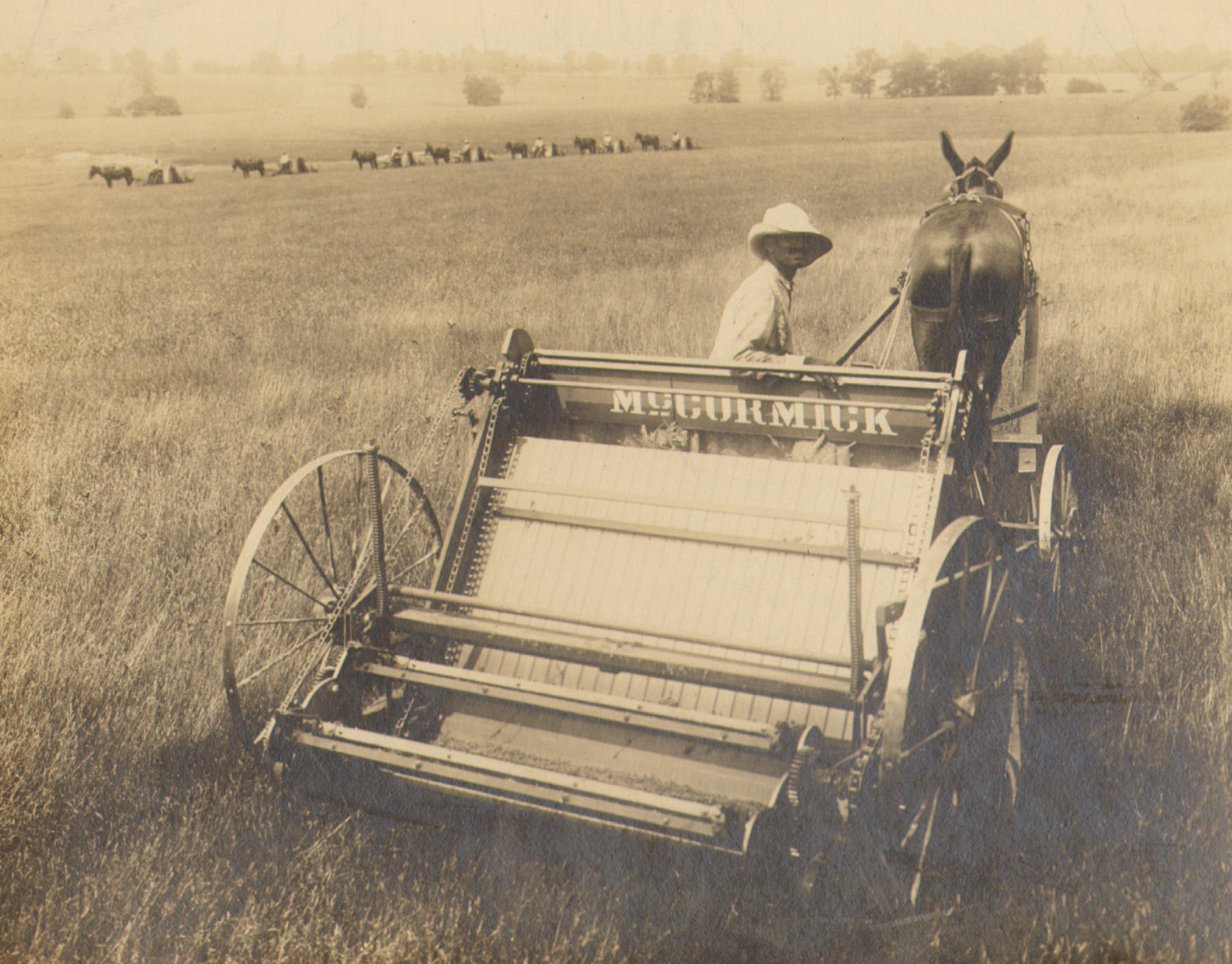
In 1895 five McCormick brothers began making bluegrass seed strippers at their blacksmith shop on Boonesboro Road. They enlarged their manufacturing operations at a new shop on Lexington Road, where Starbucks is now located. The brothers—Sam, Dick, Trigg, John and Cliff—produced the only bluegrass seed strippers manufactured in Kentucky. Three patents were issued for their strippers: one to Sam, one to Sam and Trigg, and one to Dick and Trigg.
Never miss a thing with our FREE weekly newsletter.
Another Winchester man, William N. Sewell (1862−1950), held six patents for a variety of inventions. Sewell, who had worked for the railroad in Lexington for a time, held three railway-related patents. He turned his patent for collapsible boxes into a local business making lunch boxes, the Winchester Novelty Works on Lexington Avenue, across from Central Baptist Church.

Margaret Donaldson (1875−1959) patented “new and useful Improvements in Underwaists.” These undergarments were in common use in the early 20th century. She formed the Premier Manufacturing Company in Winchester. The company rented the third floor of the Perry Building (now the Winchester Sun building) to produce underwaists of Margaret’s design. Margaret sold the company, and the owners moved operations to Lexington and then to Chaffee, Missouri.
Four other Clark County women held patents—Annette Hurst (cooking pan), Molly Griffith (baking pan), Dorothy Bonnell (carburetor), and Myra Gay (shoulder bag)—and one African American—Dr. John H. Tyler (putty-less window sash).
Many of the inventions had an agricultural focus: plows, grain drills, hemp brakes, conveyors, fence stretchers, etc. Surprisingly, a large number were railroad-related, such as car couplers, ties, and signals. A few fit only a miscellaneous category—John J. Eubank (umbrella), A. H. Hart (voting machine), Eldon Fox (display rack), Bert Noblette (slip-proof sandal), Tandy M. Quisenberry (lady’s skirt gauge), and John W. Smiley (card game).
In closing we note that Clark County’s multiple patent holders include S. J. Conkwright, William Woolcott, Joseph V. Morton and John W. Crain with four each; Miner T. Perkins, Eugene A. Bagby, Roger Eades, A. H. Hart and Warren Elkin with three each.