
When most people think about aging, they often think about healthcare, retirement, or long-term care facilities.
But after spending time talking with Susan Jones, Ron Kibbey, and Tim Janes, it became clear that aging in Clark County is something much deeper.
It’s about independence.
It’s about connection.
And perhaps most importantly, it is about making sure people don’t have to navigate one of life’s most challenging transitions alone.
The reality is that most families are unprepared when aging suddenly becomes personal.
It might begin with a parent forgetting an appointment. A spouse struggling with daily tasks. A loved one no longer feeling comfortable driving after dark. What starts as a small concern can quickly become a series of difficult questions.
Where do we go for help?
What services are available?
How do we pay for them?
Who can help us understand our options?

For Susan Jones, Family Services Office Supervisor, Commonwealth of Kentucky Health and Family Services, these are conversations she has every day.
Susan’s work places her directly alongside older adults and their families as they navigate the often-complicated world of aging services and support. She described situations where families are overwhelmed, trying to make important decisions while dealing with fear, uncertainty, and sometimes guilt.
Many people simply don’t know where to begin.
“They don’t know what they don’t know,” is a theme that surfaced throughout our conversation.
Families are often trying to make decisions about housing, healthcare, caregiving, and financial resources while managing the emotional weight that comes with watching a loved one change. Susan explained that a large part of her role is helping people slow down, understand their options, and connect with resources before situations become overwhelming.
Her work is as much about building trust as it is about providing information.
People need someone who can help them make sense of the system.
And the system can be difficult to navigate.
That challenge was echoed by Ron Kibbey, retired Social Worker and member of the Aging Taskforce here in Clark County, who has spent years observing both the strengths and shortcomings of aging services in our community.
Ron spoke candidly about the gaps that persist, not because people don’t care, but because resources, organizations, and services are often disconnected from one another.
One of the issues he sees most often is isolation.
It rarely happens overnight.
A person stops driving.
They begin missing community events.
Friends move away or pass away.
Health concerns make leaving home more difficult.
Gradually, the circle around them becomes smaller and smaller.
Before long, they are disconnected not only from social activities, but from information, services, and opportunities that could help them remain healthy and independent.

Ron believes communities must become more proactive rather than waiting for a crisis to occur.
Too often, help arrives after a hospitalization, after a fall, or after a family reaches a breaking point. The better question, he suggested, is how we identify needs before they become emergencies.
That question led naturally into a discussion about Rosemary C. Brooks Place and the work being done there.
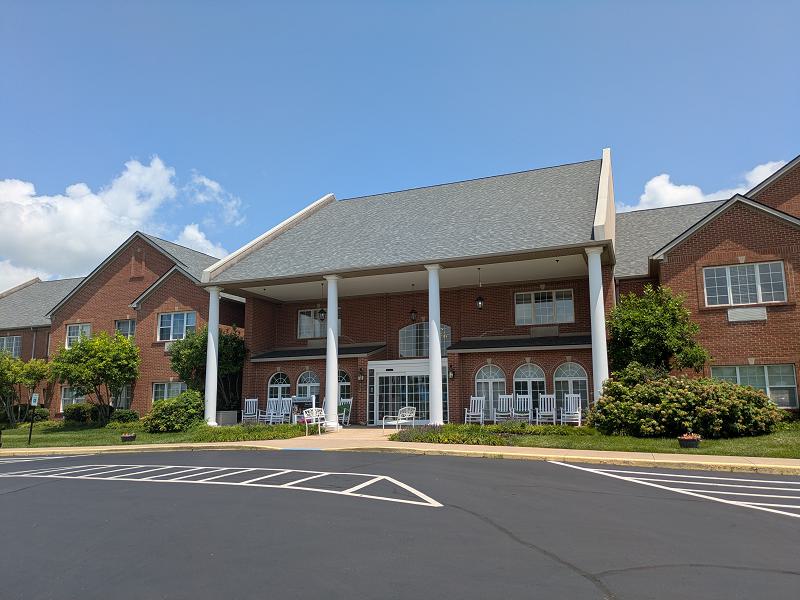
Tim Janes, Executive Director of Rosemary C. Brooks Place, described Brooks Place not as a facility, but as a community.
Located in Winchester, Brooks Place serves as an independent and assisted living community for older adults who may not require full-time residential care but would benefit from supervision, engagement, and social connection.
Brooks Place offers two distinct living options designed to meet seniors where they are on their aging journey. The first includes 67 independent living cottages, providing residents with the opportunity to enjoy homeownership while benefiting from a maintenance-free lifestyle. Residents hold the deed to their home, and Brooks Place manages all exterior maintenance, allowing them to focus on enjoying retirement rather than worrying about upkeep.
One unique aspect of the program is that when a resident chooses to move or passes away, the home is sold back to Brooks Place at a prorated value based on the length of time they lived there. These single-level homes are primarily two-bedroom, two-bathroom residences thoughtfully designed for accessibility, comfort, and convenience.
The second option consists of 44 assisted living apartments for seniors who may need a little extra support with daily activities while still maintaining a high level of independence. Although Brooks Place does not provide medical or skilled nursing care, residents can receive assistance with services such as medication reminders, personal grooming, and other day-to-day needs. This model allows seniors to remain active and engaged in a supportive community environment while receiving the assistance necessary to continue living independently and with dignity.
For many families, Brooks Place provides something invaluable: peace of mind.
A son or daughter who is balancing work and caregiving responsibilities knows their loved one is safe. A spouse who has become a full-time caregiver has time to attend appointments, run errands, or simply rest.
At the same time, participants are not sitting alone at home.
They are interacting.
Laughing.
Sharing stories.
Building friendships.
Maintaining routines.
Tim emphasized that this kind of connection is often just as important as the care itself.
What happens at Brooks Place demonstrates a larger truth about aging that all three conversations revealed: people thrive when they remain connected to others.
As our discussions continued, several common themes emerged.
The first was that aging is deeply personal.
No two people experience it the same way. Every family enters the journey with different resources, different relationships, and different challenges.
The second was that navigating available services can feel overwhelming. Resources exist throughout Clark County, but many people are unaware of them until they find themselves in crisis.
The third, and perhaps most significant, was the importance of connection.
Whether it was Susan talking about helping families understand their options, Ron discussing the dangers of isolation, or Tim describing the daily interactions at Brooks Place, each conversation ultimately came back to the same idea.
People need people.
Aging successfully is not simply about living longer.
It is about maintaining purpose, relationships, dignity, and a sense of belonging.
Clark County is fortunate to have dedicated individuals and organizations working every day to support older adults and their families. Yet these conversations also remind us that there is still work to do. Transportation challenges remain. Caregivers need greater support. Awareness of available resources can be improved. Opportunities for social connection must continue to expand.
The good news is that our community is not starting from scratch.
We have people who care.
We have programs making a difference.
And we have leaders willing to have honest conversations about what is working and what still needs attention.
As our population continues to age, these conversations will become increasingly important.
Because aging is not someone else’s issue.
It is a community issue.
It is a family issue.
And if we are fortunate, it is a journey that every one of us will someday experience ourselves.
My sincere thanks to Susan Jones, Ron Kibbey, and Tim Janes for sharing their time, expertise, and passion for serving older adults in Clark County. Their insights remind us that aging is not simply about growing older; it is about ensuring that every person has the opportunity to do so with dignity, support, and connection.
Never miss a thing with our FREE weekly newsletter.
And ultimately, that responsibility belongs to all of us.
Local resources on aging
Kentucky River Foothills: https://foothillscap.org/programs/aging,services
The Janes B. Allen Jr. Generations Center: https://seniorcenter.us/sc/the_Janes_b_allen_jr_generations_center_winchester_ky
Aging and Disability Resource Center: https://www.chfs.ky.gov/agencies/dail/Pages/adrc.aspx