
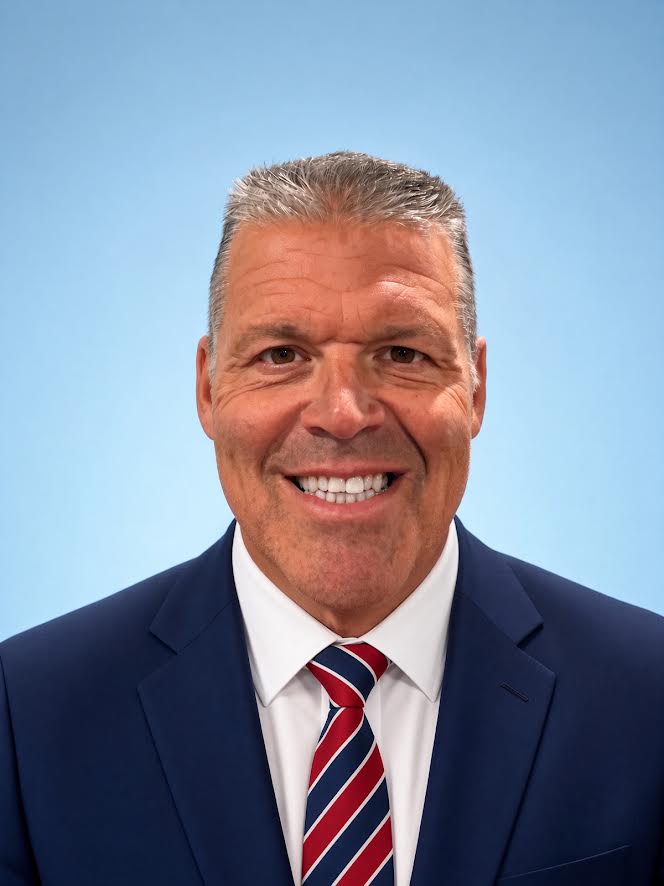
This isn’t the first time Perry Williams has considered being Winchester’s mayor. He’s been thinking about it for a decade.
But when the city began its major renovation of Main Street last year, his frustrations and those of other property owners caused him to think this is the time.
“I think when the rubber hits the road in this downtown project, we, groups of us, felt like we weren’t heard, and when we needed leadership, we didn’t have it,” he said in an interview.
Williams said he felt that someone should have been leading from the front, being open, explaining to business owners what was happening. And there should have been money given at the start to those who were going to be adversely affected by demolition and reconstruction.

“We had damage to all four of our buildings down here,” and so did some of his neighbors, Williams said. They were told their businesses wouldn’t be shut down, but they were, he noted. He said he was out several thousand dollars in damages, and, at the least, someone should have said they were sorry.
The Strength Fix training facility he owns has no back entrance, so when the contractor demolished the sidewalk in front of it, his clients had no way to get in.
“They say we’re responsible” for the sidewalks, “yet you can show up and start jackhammering away and not even tell us you’re coming? Both of those things can’t be true,” he said.
Although Williams thinks the new downtown looks better, he sees multiple problems with the design.
Eliminating parallel parking on the high side of Main Street reduced the number of parking spaces available in the heart of downtown as well as spaces for public transit vans for people with disabilities, he said.
“So you took the two biggest concerns, which are downtown parking and handicapped accessibility, and you made them tougher,” he said.
Williams is also wondering how he’s going to get a lift to paint his tall buildings or a truck to make deliveries now that the parallel parking spaces are gone and the street is too narrow for traffic to get around those obstructions.
He also thinks that while the sidewalks were torn up would have been a good time to do infrastructure improvements, which will now require tearing them up again.
“I don’t think they put a lot of thought into it,” he said.
Williams said that two days before the Friday filing deadline, his wife, Anna Selina, asked him if he was going to run for mayor. Nobody else had filed to challenge Mayor JoEllen Reed. He discussed it with Selina and his oldest son, Gabe, and decided to go for it.
“Winchester has been great for me,” said the chiropractor, business owner, real estate investor, and former football coach, who has made the town his home for nearly 30 years. He would like to give back something to the community.
It’s the right time, he said, because his children have moved out, and he’s “mostly retired.”
Williams works half a day three days a week, and Gabe, who is also a chiropractor, “does most of the heavy lifting with the practice.”
“I have this extra time now, and I’m at that age where I’m too young to sit around and make birdhouses,” said Williams, who is 55.
The mayor’s office is considered a part-time position that pays less than $15,000 a year.
Williams, a native of Indiana, grew up about an hour from Indianapolis and graduated from Indiana State University in Terre Haute. He earned his master’s and doctorate degrees from Palmer College of Chiropractic in Davenport, Iowa, and has done post-graduate study in exercise science and health and human performance.
He moved here in 1997 when he established Winchester Chiropractic, and he coached football for 20 years at Robert D. Campbell Junior High School. He got into weightlifting and started Strength Fix while coaching.
Williams was a chiropractor for the 2016 Olympic Games and two years later, the Paralympic Games. He also owns GSR Real Estate, which manages his four downtown buildings: Mason on Main, The Venue at Whiskey & Wiles, the former Berryman Law Office and Strength Fix.
He and Selina each have three children.
The problem, [Williams] said, is that so many people in government don’t understand business. Having private-sector people, not only public administrators, involved in decision-making would be a good start. That’s one advantage he has as a candidate for mayor, he said.
When Ed Burtner was mayor, Williams said he would never run against him. He also told Reed he wouldn’t run against her when she succeeded Burtner four years ago, but she led him to believe she would be a “one and done,” he said.
Reed doesn’t deny that she might have said she only wanted to serve one term, but she’s changed her mind because she wants to finish some things she helped start and believes this is an exciting time for Winchester.
Williams doesn’t see this as a grudge match.
“I consider her a friend,” he said.
But as a businessman, he perceived a lack of forward-thinking leadership in regard to how the downtown project was handled.
“I thought, if this is as good as we’ve got, then I can do better,” he said.
Williams believes his background qualifies him to lead the city.
“I think my track record in the community over 30 years” is important, he said.
Asked what he would like to accomplish as mayor, Williams answered: “I would like to see us use our resources a little bit better.”
He would also want to run the city “more like a business.”
One vision he’s had is for an indoor-outdoor climbing facility to promote fitness. Another is to use self-driving cars for public transportation.
“I’m not a fan of data centers,” he said, when asked about a controversial issue in the Bluegrass region right now.
He said business mogul Elon Musk has said they belong in orbit.
“If the smartest guy in the world says they’re eventually all going to be in space, I would be careful” about “chewing up farmland” for giant computer campuses that use a tremendous amount of water and electricity, he said.
Although city elections are supposed to be nonpartisan, Williams is a registered Republican running against a Democrat. But he describes himself as a libertarian and populist who is for “less government.”
Williams said he wants to bring in more businesses and jobs, but would be careful that incentives such as tax breaks are used responsibly. The city might tell a business that a tax incentive is for five years or 10 years, but “it can’t be forever,” he said.
He also questions why a local government would bring in franchises to compete against locally owned and operated businesses.
“I think, when you have more dollar stores, more used car lots, these kinds of places, that’s an indication of what the town can support,” he observed.
The problem, he said, is that so many people in government don’t understand business. Having private-sector people, not only public administrators, involved in decision-making would be a good start. That’s one advantage he has as a candidate for mayor, he said.
Williams said he would like to see infrastructure regulations to encourage the reuse of vacant spaces.
He said that when it comes time to redesign the parts of Main Street north and south of the core section that was recently completed, city officials should ask themselves: What did we learn?
“It’s about seeing what’s going to happen and managing it” beforehand, he said.
Never miss a thing with our FREE weekly newsletter.
Asked about preserving agriculture and farmland, Williams indicated that as long as landowners aren’t violating any planning and zoning regulations or other laws, they should be able to develop their farms.
Williams sees the legislative role of a mayor, who is a voting member of the city commission, to be not just a delegate or a representative, but both.
“It’s my job to vote the way they want me to vote, because I’m supposed to,” he said. “Now, if I know something they don’t, then it’s my job to convince them or educate them.”
Helping people understand something is easier than fighting them over it, he said.
