
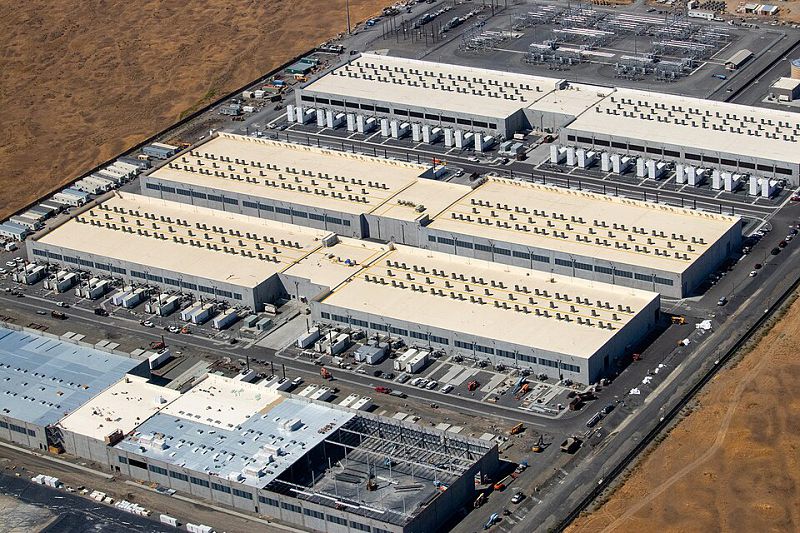

The Winchester Board of Commissioners has temporarily banned data centers within the city limits.
The one-year moratorium was enacted at the request of Planning and Zoning Director Rob Jeffries and City Manager Mike Flynn after the Planning Commission’s attorney, Robert L. Gullette Jr., raised legal questions about the lack of zoning for data centers.
“We want to make sure that if anyone were to call our office and pursue the application for a data center that we would know what to do and what to say,” Jeffries told the commission at the meeting Sept. 1.
“Unfortunately, we’re not ready . . . for anything like that,” he said.
The motion by Mayor JoEllen Reed was unanimously approved by the commissioners present. Commissioner Shannon Cox was absent. The vote was taken before the commissioners had heard from those in the audience, but they were allowed to speak afterward.
One resident, Misty Gay, thanked the commission for their decision but asked that the board consider extending the moratorium to two years.
“This isn’t about being against artificial intelligence or economic development, it’s about something much more basic: Can we support it?” Gay said.
She mentioned that the community has concerns about having an adequate water supply for the growth that is occurring already, and data centers use massive amounts of water to cool their giant computers.
“Our water supply is not limitless,” she said.
Douglas Hancock said he was against having data centers at all.
“I don’t see any way that it would benefit us,” he said.
Hancock said citizens should be allowed to vote on whether or not to have data centers, not the “five people” on the board. He said he has heard of other officials making secret deals to approve data centers.
Reed said the city will not make any decision without first having public forums on the issue, but the city board does not have the authority to have a ballot referendum on the issue.
Pete Lynch, the Kentucky Party candidate for the congressional 6th District, said both Ralph Alvarado, the Republican nominee, and Zach Dembo, the Democratic nominee, support data centers, but he is for a national moratorium.
He suggested several proposed regulations that would effectively ban data centers, including not allowing them to use water for cooling. Lynch asked for a show of hands of those who were against having data centers, and almost everyone in the room raised their hands.
Jesse Wilmoth said he was of the “minority opinion” and that he builds data centers.
He said a data center would be no different than the building at Winchester Industrial Park where Amazon had operated, and they would have a “closed loop” air conditioning system.
Wilmoth admitted that data centers would not have a great deal of truck traffic because so few people would work there.
“It’s nothing more than a big box” filled with computers, he said.
Wilmoth was not in favor of the delaying action approved by the city board.
“When you say, ‘Let’s put a moratorium on something’, you are not doing [anything] but kicking the can,” he said.
Robin Kunkel, who was a city commission candidate in the primary, said the Clark County Fiscal Court also needs to impose a moratorium because data centers could be located outside the city in the unincorporated part of the county.
That morning, Jeffries had talked with WinCity Voices about why he and Flynn felt there should be a temporary pause.
“We both felt like a one-year moratorium would be a good move for the city so we could take time to evaluate it, see what other communities have done . . . and also it would be a good time for our community to voice their concerns, voice their opinions, and have a year to evaluate all of that material and see what happens in other nearby communities and throughout the United States,” he said.
The state already has small data centers for online services such as digital cloud storage, but there are increasingly proposals for hyperscale centers for artificial intelligence. Those facilities can be gigantic, and they use large amounts of electricity and water, something that concerns utility ratepayers.
It is also an environmental concern.
Jeffries pointed out that if Winchester doesn’t pause data centers, it could be a prime target for developers.
“Surrounding communities have all done moratoriums, ranging from six months to one year to two years,” Jeffries said Tuesday. “And if we don’t have one in place, Winchester is going to look like a great place” to site them, he explained.
Gullette raised legal concerns in a letter to Mayor JoEllen Reed on Aug. 16 after Jeffries had warned planning commissioners last month that there is no zone designated for data centers in Winchester.
“The planning commission shares Rob’s concern that the lack of any zone for these facilities . . . places any future applications in troubling legal waters,” he said.
Jeffries noted in a letter Aug. 27 to the mayor and city commissioners that there also are no existing planning and zoning regulations pertaining to the facilities.
Neighboring jurisdictions that have enacted moratoriums include Lexington and Fayette County, Nicholasville and Jessamine County, Madison County, Versailles, Nelson County, London, and Louisville and Jefferson County.
Jeffries said that at the end of the year, local governments could choose to extend the moratorium or move in another direction. He said he expects there to be “multiple public hearings” if there are any changes to the zoning ordinance.
“We want to make sure we have time devoted for the public and for the planning commission and for everyone involved to really participate in these hearings and help guide our community in this new concept,” he said. “It’s really only in the last couple of years that it’s come out.”
Speaking at a Kentucky Farm Bureau gathering in Winchester in March, state Sen. Greg Elkins, a Winchester Republican, said that “data centers are coming whether we like it or not . . . and we’re going to have to be able to produce energy to keep up with them.”
Elkins was explaining his support for development of nuclear energy in Kentucky.
Never miss a thing with our FREE weekly newsletter.
The state senator compared the race between China and the U.S. for artificial intelligence to the race between Russia and the U.S. to land a man on the moon.
“It’s going to become a national defense issue,” Elkins said. “There’s going to be a lot of legislation over the next four or five years that deal with those data centers. They’re coming. You can’t stop them.”
Vaché King, the Democratic candidate for county judge-executive in the Nov. 3 election, has a different view. King, who works for NTT DATA, a multinational information technology company, said data centers don’t generate many jobs but use tremendous amounts of natural resources, which drives up costs for ratepayers, regardless of local governments’ good intentions to mitigate any ill effects.
“After the honeymoon period, a lot of things settle, and that’s when you learn, it’s not worth it,” she said.
