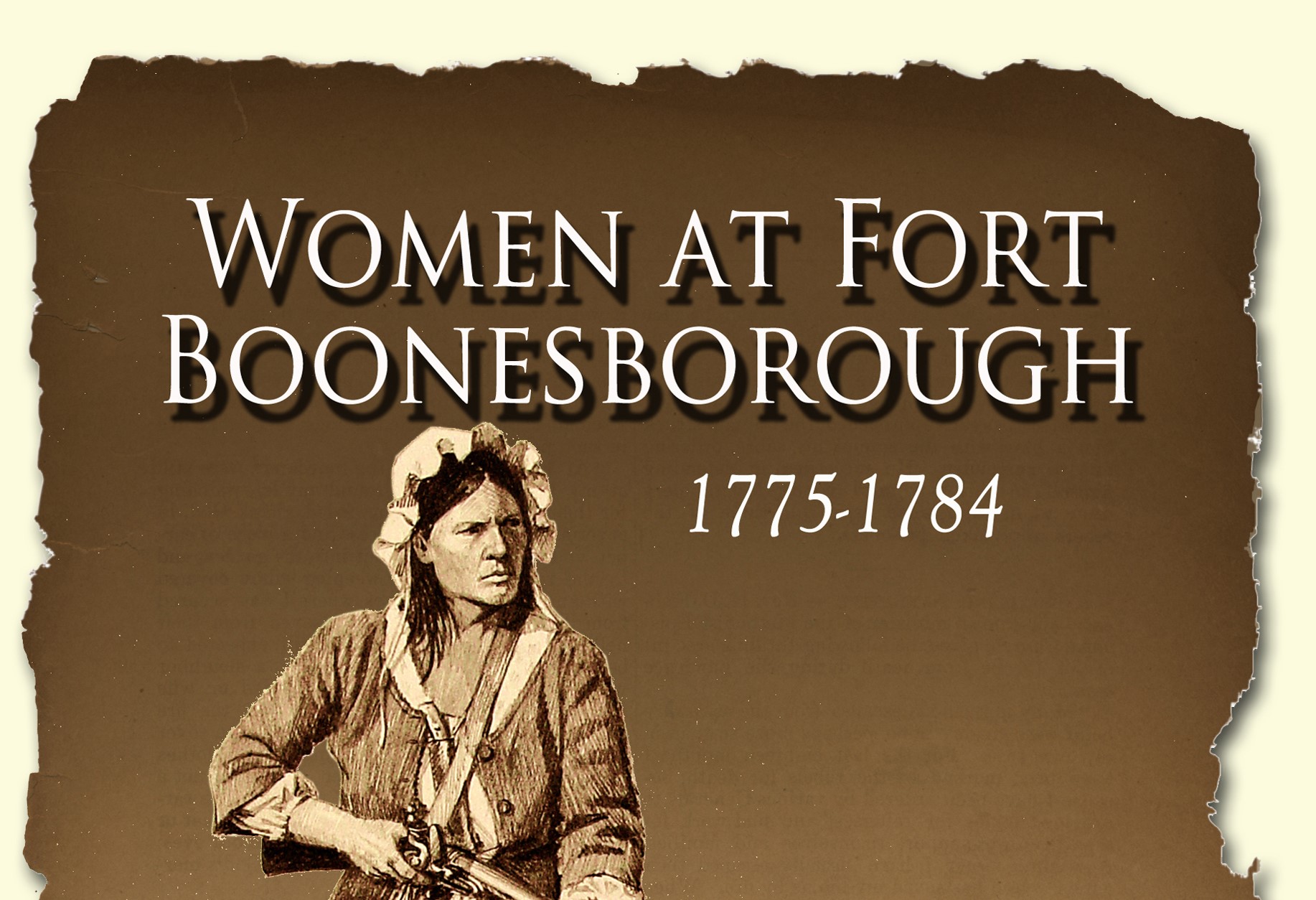
Sources of information about women on the frontier are sparse, therefore women seldom get recognized for their contribution to the settlement of Kentucky. In the male-dominated society of pioneer Kentucky, it was rare for a woman’s name to make it into the written records.
Anne Crabb and I conducted extensive research to identify the women who were at Fort Boonesborough. In 2014 we published a book listing 195 women at the fort between 1775 and 1784. These included the names of many children as well as 14 enslaved African American women. There were several widows on the list, but as a rule, due to the hardship of frontier life, most women hastily remarried.
The 1787 Fayette County tax roll lists 31 women as the head of a household. They were almost all widows who had lost husbands on the frontier and had not remarried. Knowing that a woman’s lot in the Kentucky wilderness called for a large measure of courage and unending hard work, imagine how much more challenging that role would have been for a single woman raising a family on her own.
My interest in the 1787 tax roll peaked when I recognized the names of seven of the women—they were living in what would become Clark County. Anyone with an interest in the beginnings of our county should know a little about these exceptional individuals.
Sarah Bush—Sarah married Josiah Bush, the eldest brother of Capt. Billy Bush. Sarah and Josiah resided in Albemarle County, VA until 1781, when they departed for Kentucky. They joined a group of Bush family members on the Holston River near present-day Abingdon, VA. Josiah took sick and died there. Sarah continued on to Kentucky with the Bush colony and settled on Twomile Creek in Clark County. She was one of the original members of Providence Baptist Church. In 1794 “Sary Bush” gave consent for her daughter Frankey to marry John Hooton; in 1797 she gave consent for her daughter Sally to marry John Duncan. The latter is the last positive record we have for Sarah. She had other adult children living nearby—son Philip and possibly sons Lewis, James, Joseph, Joshua, John, and William.
Elizabeth Clements—We know very little about Elizabeth. She was married to John Clements, and the couple resided at McGee’s Station on Jouett Creek. John was killed at the Battle of Upper Blue Licks, or “Holder’s Defeat,” on August 14, 1782. According to accounts of the battle, Clements was one of four killed and “left on the ground,” while two others later died from their wounds. Elizabeth received 26 pounds in compensation for the loss of “a Rone mare, a Bay Mare, one Saddle & Blanket.” She was listed on the tax rolls as a single woman until 1792. No further record could be found after that date.
Margaret Drake (1755–1827)—Margaret was a daughter of John Buchanan, a wealthy landowner of Botetourt County, VA. She married an adventurer, Joseph Drake, one of the Long Hunters of Kentucky. Joseph and Margaret came to Boonesborough with their two young children in the spring of 1778. That August Joseph was killed by Indians near the fort. Margaret remained at the fort, unmarried, and had a liaison with Capt. John Holder that resulted in a daughter, Rhoda Drake. When Holder moved across the river and established Holder’s Station, Margaret came too. Holder married Fanny Callaway and took Rhoda into his household to raise. Evidence indicates that Margaret had two more children by Holder—Sabrina and Euphemia—but since he was married at that time, he did not acknowledge these daughters. Margaret remained single until at least 1791, and sometime after married William Jones. They later moved to Franklin County, Tennessee, where Margaret died in 1827.
Never miss a thing with our FREE weekly newsletter.
Rebecca Hunter—Rebecca was a daughter of Michael Dumford, who came to Kentucky from North Carolina. Rebecca was married to Charles Hunter, also of North Carolina. In August 1782, an army of Shawnee laid siege to Bryan’s Station. William Hays, son-in-law of Daniel Boone, led a company to the aid of the besieged inhabitants. When nearing the station, the company came down a lane where Indians had set an ambush. According to one account, “Charles Hunter was wounded through the body & died that night.” In 1791, the widowed Rebecca purchased a 100-acre tract of land adjoining her father’s on Boone Creek. Rebecca remained single and the head of her own household until 1795, when she married Daniel Burch.
Margaret McGuire—Margaret and her husband James McGuire came to Kentucky in 1779, first to Boonesborough then to McGee’s Station. On August 19, 1782, James, a lieutenant in the Fayette County militia, was killed at the Battle of Blue Licks. Margaret was still single and the head of her own household on the 1787 tax roll with her son John. What happened to Margaret after that is not known.
Mary Sphar—Mary was married to Matthais Sphar. They resided in Berkeley County, VA, until Mary and her husband came to Kentucky. They occupied one of the cabins at Strode’s Station in 1779. In 1784 Matthais went out on a hunting trip with Michael Cassidy and Joshua Bennett. While they were camped a little east of present-day North Middletown, Indians crept up and shot Sphar and Bennett; Cassidy escaped. According to Mary’s son Daniel, “September 1784 my father was killed, about the 20th. Cassidy staid till 1786 or 1787 with my mother, then formed a station [Cassidy’s Station in Fleming County].” Nothing further has been learned of Mary. Her son Daniel left a line of prominent descendants in Clark County, including Asa Rogers Sphar (1851−1929), William R. Sphar Sr. (1880−1963), and William R. Sphar Jr. (1914−2005).
Jane Wilson—We have little information about Jane. Her husband, John Wilson, was killed at the Battle of Blue Licks on August 19, 1782. Jane was listed on the tax roll of 1787 and continued to be listed until 1794. On the latter, she appears as the head of a household with seven males over 21. She was taxed for two horses, seven cattle, and no land or slaves. Her son James claimed the land of his father in an 1803 lawsuit against David McGee, but the suit was eventually dismissed.