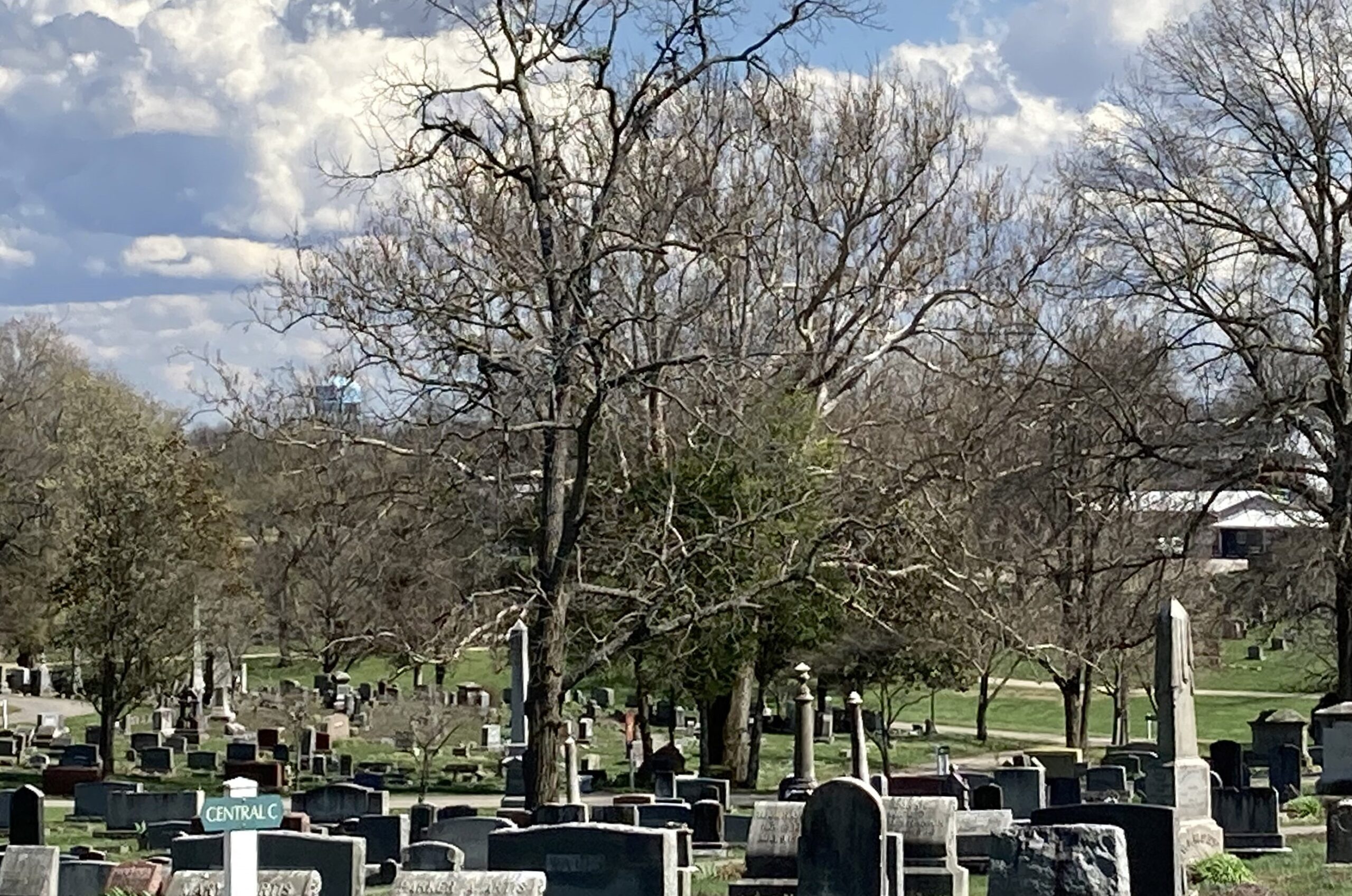
On a balmy but windy day last week, my wife Clare and I went for our weekly “long walk.” Since spring has sprung early this year, we decided to check out the scene at the Winchester Cemetery. We went for the exercise and stayed several hours, but we stopped so frequently that it wasn’t much of a workout. There was just too much to look at!
This year the flowers seem to be out at least a month before normal. In most parts of town, jonquils began blooming in February. On the late March day we went for our walk, the tulips at the front entrance dazzled as always. Then we found the spring beauties putting on a gorgeous display. These tiny pink wildflowers, Claytonia virginica — naturalized across the cemetery — turned the landscape into a sea of color. Many of the flowering trees had already come out and — surprisingly — peonies, normally May bloomers, had already broken ground.

The old section of the cemetery has so many handsome, one-of-a-kind monuments that we found ourselves zigzagging from one to the next, reading dates and inscriptions. One stop was Abram Renick’s towering monument near Lexington Avenue. It bears a likeness of Renick himself as well as a pair of his famous shorthorn cattle. We were unable to find a marker for his long-time mistress, Julia Fry, who — according to the cemetery ledger — is buried in Renick’s plot.
Near Renick’s grave is the unusual monument of John B. Huston, a noted 19th-century attorney. During the Civil War, Gen. Stephen Burbridge, the “Butcher of Kentucky,” had Huston arrested for not supporting Abraham Lincoln’s re-election. Lincoln personally ordered his release. Huston’s cast zinc (“white bronze”) monument is one of two in the cemetery. It was erected by his friends at the Lexington and Winchester bar.

The celebrated sculptor, Clark County native Joel Tanner Hart, carved a number of gravestones in Winchester Cemetery. The most prominent of these is known as the “angel vase,” a large marble vase with a finely sculpted angel face on its side. We saw two of his large horizontal tablets, and there are probably other pieces that have gone unrecognized, since Hart was not well known at the time he took these commissions.
We also came upon two small markers for Robert Brooking, born 1782, and his wife Mariam, born 1797. They are among Winchester Cemetery’s 135 pioneer burials (those men and women who were born before 1800). A list of their names can be viewed in this pdf document.

It would be easy to go on for pages and pages in this vein. But better that you should put on your walking shoes and get out to the cemetery for a spring hike of your own. Before you go, log onto the Winchester Cemetery website and check out their “Walking Tour” brochure. It lists some of the famous persons buried there and other interesting features worth seeing. The brochure even includes a list of “cemetery symbols.” You will find explanations of the “hidden messages” found on gravestones, items such as angels, anchors, lambs, lilies, and many more.
Zach Wills and his staff really do an outstanding job maintaining the cemetery grounds. You should go have a look — real soon.