
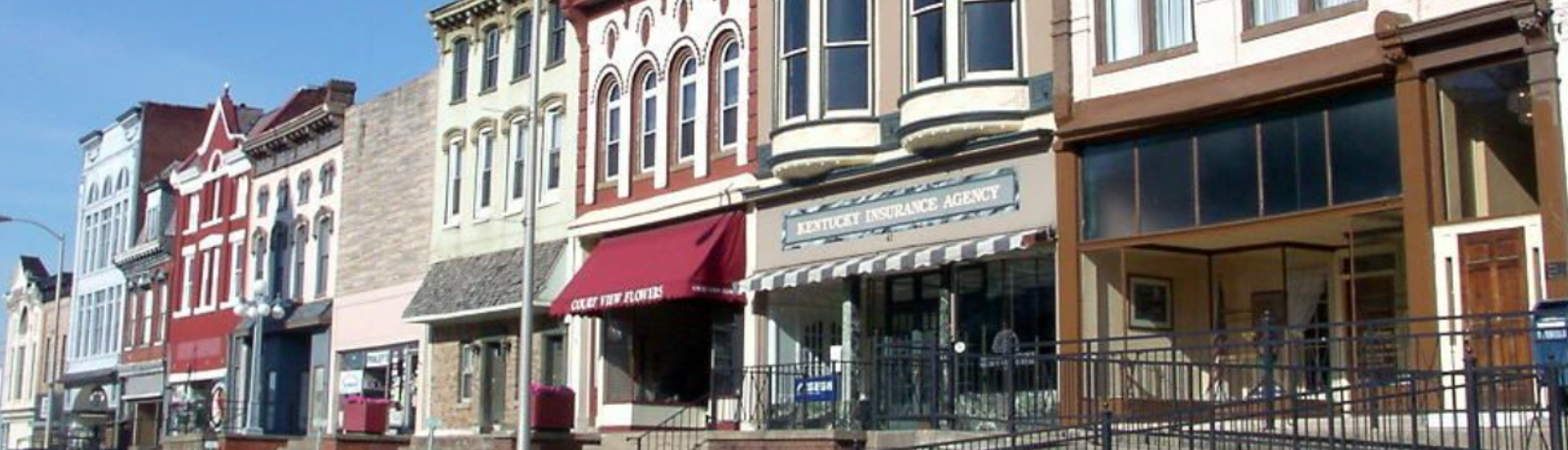
It appears a long-anticipated project to reimagine the “high side” of South Main Street between Broadway and Lexington Avenue may soon become a reality.
Last Tuesday, the public was invited to meet with city officials and representatives from Palmer Engineering to view two proposed plans and ask questions. Chuck Witt and I attended the event, along with several interested local residents.
My first impression of the proposed plans was extremely positive. The first thing I noticed was the scope of the project extended beyond just the east side (the “high side”) of Main. The plans involve both sides of the street, including sidewalks and parking amenities.
The differences between the two plans are fairly trivial. The dominant features are the same in both, and I’ll only describe those.
The proposals
The plans call for removing most of the steps along the high side, leaving only a rebuilt section of “social stairs” directly across the street from the courthouse. This makes sense. The steps are mainly used for seating at public events on the courthouse lawn, such as the Rock the Block and Christmas tree-lighting events. The removed sections of steps may be missed by attendees of parades, but other than that, they are simply in the way. Not to mention unsightly.


Removing long sections of steps enables the designers to widen the sidewalks in front of most of the storefronts along the high side, providing space for outdoor seating and other streetside activities.
The other major feature that stands out is the removal of parking on the high side while transforming the parking on the opposite side from parallel to diagonal. While diagonal parking is easier to navigate for most drivers and allows for more vehicles to park in the same amount of street frontage, the overall effect of both changes will result in the loss of about 13 parking spaces, according to a Palmer representative I spoke with.
This may bother some people, but the fact is there is no shortage of parking downtown. I have attended numerous events in the area over the years, including sold-out shows at Leeds, and have never failed to find a parking space within a block or two of my destination.
One possible negative feature is the removal of turning lanes at both ends of the project. This will, at times, result in longer wait times for vehicles turning left onto Broadway or Lexington. But most of the time, there isn’t enough traffic to justify those turn lanes. It’s a small price to pay to accommodate the other improvements.
Finally — and this is the most exciting part — the aesthetic appeal of the new designs cannot be denied. Replacing most of the steps with terraced landscape walls and attractive railings results in a street view that is stunning and nicely compliments the historic building facades fronting Main Street.
Other features adding utility and beauty include a paver band, landscape plantings, and what appears to be a new bike lane. (I failed to verify that with the officials at the meeting.)
The new designs also preserve the existing pedestrian crossing on the south side of Court Street, which aligns with the walkway from street level up to the high-side sidewalk.
City Manager Mike Flynn told me he is optimistic about moving the project forward this time around. The next steps involve selecting the winning option and other final touches, getting approval from the city commission, and securing funding for the project.
Regaining lost momentum
As the year 2020 dawned, I felt like our downtown business district had picked up considerable momentum and was well on its way to a renaissance. We all know what happened next. The COVID-19 pandemic set us all back several years.
Today, I see plenty of evidence that we have bounced back and are poised to make a quantum leap forward. Two new restaurants and at least one new store have opened in recent months. The McEldowny Building restoration is bringing that historic structure back to life. We’ve seen the addition of a new parklet.
But to really appeal to shoppers and diners — especially those from out of town — we need to see dramatic improvements in our infrastructure. This long-delayed project can be a spark that leads to further improvements.
Once this project is complete, I’d like to see the rest of the Main Street business district receive similar treatment. This block is a great place to start – the other blocks won’t face the same challenge of having a high side to contend with.
Like the vast majority of Clark Countians, I neither live nor work downtown. But whether one lives in Stoneybrook, Pilot View, Trapp, or anywhere else in the county, downtown Winchester is the focal point of our community. It’s where we celebrate holidays and festivals, where we find unique shops and the finest local eateries and bars, enjoy live theater, visit the Farmer’s Market, and so much more.
To a large extent, one can judge the health of a community by the condition of its downtown. Completing projects like this will boost commerce and preserve and protect the vitality of our town for generations to come.
History
(Information for the content of this section was gleaned from the memories of Chuck Witt, who served on the board of Main Street Winchester, along with articles from the Winchester Sun and the website of Winchester First.)
Main Street Winchester, originally established as Winchester First, was formed in 1996 during the tenure of Mayor Gene Kincaid and met for many years in the boardroom of the Clark County Bank on West Lexington Avenue before moving to the Chamber of Commerce Offices and then to City Hall.
In 2022, Main Street Winchester was dissolved and re-instituted once again as Winchester First, this time as a department within city government with a full-time director.
MSW was focused on helping to reinvigorate the downtown area. The board was able to establish a fund that was made available to downtown property owners on a participatory basis as a means of upgrading properties.
In 2015 (or 2017, depending on the source), a study was performed by CityVisions and funded by local governments and Clark County Community Foundation that resulted in a long-term master plan for the downtown area. The study was greatly facilitated by the efforts of the late Todd Denham, former director of the Industrial Development Authority, and concentrated primarily on a major redevelopment of the high side of South Main Street. It was designed to be an incremental program, one which could be accomplished in phases. Some of the proposals of that master plan have been implemented, but only on a very limited basis, such as some seating areas established outside businesses.
In 2021 MSW began a modest program of “artistic crosswalks,” largely as a result of the refusal of the Kentucky Transportation Cabinet to allow more defined pedestrian crosswalks along Main Street and West Lexington Avenue. The city can provide these artistic crosswalks at intersections that are not on state-designated roadways, such as the side streets.
Never miss a thing with our FREE weekly newsletter.
The 2015 master plan followed a study done in 1976, funded by the Bluegrass Area Development District, which primarily focused on maintaining the historic character of downtown but did not address many aspects of the problems of the high side. However, the 1976 study did provide a prototypical downtown sign ordinance, many of whose provisions were incorporated into the later ordinances.
MSW has also been involved in providing sidewalk amenities such as benches, bicycle racks, and planters.
Since the 2022 reorganization, Winchester First has established a new business stipend grant designed to encourage businesses to open in the downtown historic district. Funded by the Downtown Development Investment Fund, the grants assist new business owners with rent or mortgage and utility payments during the first two years of business.
Another grant program, the Historic District Retail Kick-Start grant, is designed to assist downtown businesses with expenses, including advertising, fixtures, and equipment not covered by other grants.
For downtown building owners, other grants and available to assist with renovations and other improvements to buildings in the downtown area.
