
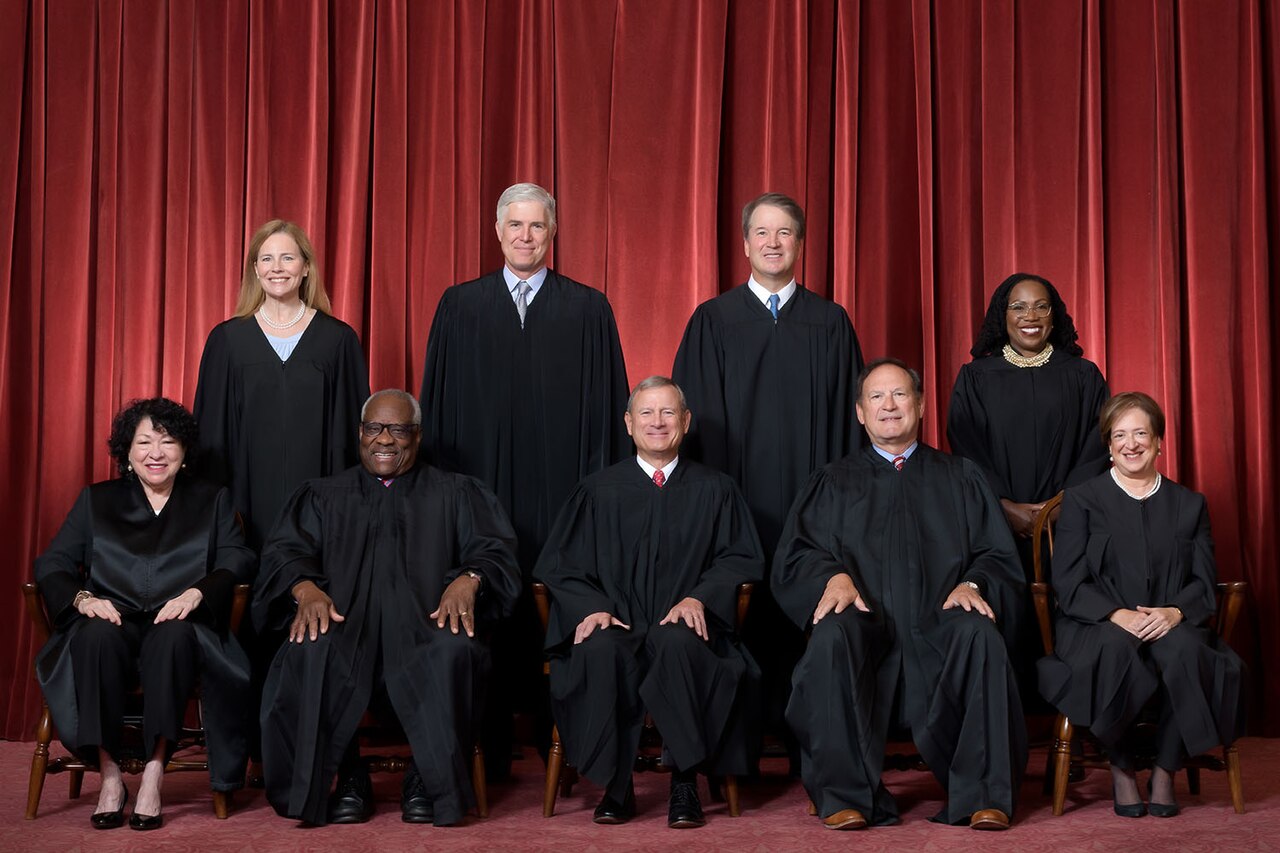

The United States Supreme Court is an integral part of the government of this country, the third leg that holds the tripod steady.
Over the years — even decades — disputes have arisen over the power that nine individuals hold when compared to the dilution of power vested among 535 members of Congress.
Of course, the Court was not always nine members. Early after its formation, it vacillated from as many as 10 to as few as five. In 1869 the number was set at nine, where it has remained, although there have been a few attempts to increase the number, most specifically under the tenure of Franklin Roosevelt who was frustrated by a court that continually thwarted his New Deal legislation.
A few interesting historical tidbits about the Court: George Washington made the most appointments because the Court was formed during his presidency. He appointed ten. Franklin Roosevelt appointed eight, Andrew Jackson appointed six, and Lincoln, Grant, Taft and Eisenhower each appointed five. Zachary Taylor, Andrew Johnson, William Henry Harrison and Jimmy Carter were all denied any appointments.
Prior to 1967, 67 justices of the 116 who have served, were confirmed by voice vote, none afterwards, and late in the twentieth century Congressional approval for justices became more contentious. In 1991 Clarence Thomas was confirmed by a vote of 52–48. After 2005, the highest approval was for John Roberts at 78% and the lowest for Kavanaugh at 51%.
According to a Brennan Center for Justice study there has been a rather drastic change in the makeup of the court since 1966. Prior to that year, the median term for a Supreme Court justice was 15.3 years. Obviously, some justices served a good deal longer, such as Justice William O. Douglas who served 39.9 years until 1980.
Following 1966 every single justice has served over 15 years, excepting the currently serving Neil Gorsuch, Brett Kavanaugh, Ketanji Brown Jackson, Amy Coney Barrett. Clarence Thomas is approaching 35 years on the bench.
After 1966, the median term for a justice rose to 25.7 years.
Never miss a thing with our FREE weekly newsletter.
The point of all this is that the time has long passed for consideration to be given to making terms on the Supreme Court subject to limitations. There is considerable current support for limiting the terms to 18 years, a period by which a justice would not be subjected to the vagaries of changing political considerations. My personal preference is for a term of 15 years, along with stipulations regarding age limitations.
It’s so odd that the Constitution stipulates the minimum age for president, senator and representative but not for a Supreme Court justice, and no upper age limits are noted for any of these offices. In fact, an appointee to the Supreme Court is not even required to be a licensed attorney. Forty-seven of the justices were not licensed attorneys but at least received some legal education. It was not uncommon in the 19th century for attorneys to be self-taught and to practice without law school degrees.
Article III, Section 1 of the Constitution simply states that justices “shall hold their Offices during good Behaviour” and while history has permitted justices to remain in office indefinitely per this constitutional provision, it has recently been suggested that terms on the Supreme Court could be adjusted without resort to a constitutional amendment by passing legislation stating that a Supreme Court justice shall be moved to a position in a lower court, and still continue “during good behaviour.”
Today’s Supreme Court has the lowest approval rating, perhaps in its entire history, even among members of Congress so it seems that the time is right to make changes to the court.
