
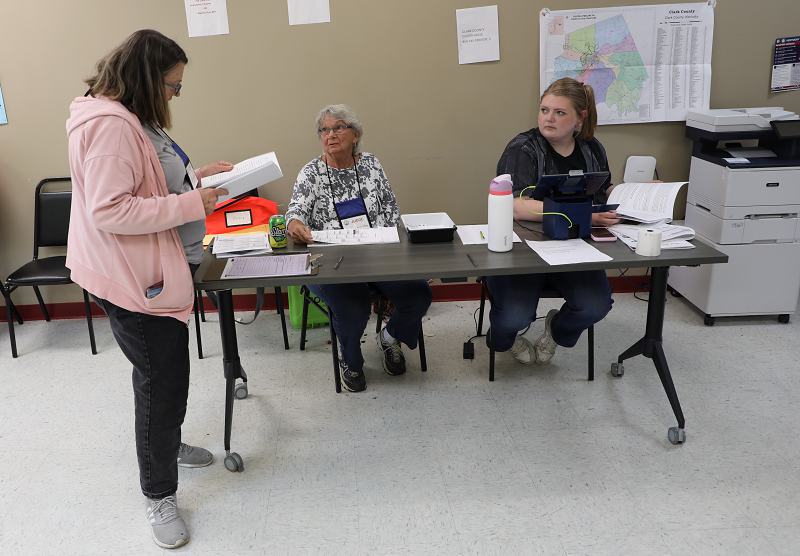

The 2026 midterm election produced a local turnout of 43%, one of the highest local midterm turnouts in recent memory. This is possibly because of the number of offices up for election, the close races in some districts, the addition of a state constitutional amendment on the ballot, and general voter dissatisfaction with national politics.
Regardless, there are many things which can be done to improve our election process, not just in Clark County or Kentucky but nationwide.
Most people don’t understand that the U.S. Constitution does not guarantee a right to vote. In fact, those who have had the voting privilege has changed dramatically over 250 years. Initially, only white males who owned property of a certain amount could vote. This provision gradually vanished as did poll taxes, and intelligence tests and, eventually, freed slaves (but only males), native Americans and women secured the right to vote, the latter not until 1920. Even in some states, incarcerated felons were still allowed to vote.
The Constitution says very little about voting. Article I, Section 4 states very simply: “The Time, Places and Manner of holding Elections for Senators and Representatives shall be prescribed in each State by the Legislature thereof; but the Congress may at any time by Law make or alter such Regulations except as to the Places of chusing Senators.”
From the inception of the Union, the states have created a myriad of regulations governing the elections therein, with virtually no two states observing the exact same provisions.
Never miss a thing with our FREE weekly newsletter.
Since Section 4 gives the Congress authority to alter the regulations within the states, perhaps it’s time to establish some universal provisions to govern the entire country and to attempt to generate greater participation of eligible voters. This would be a great step forward because the United States has become a nation among the world’s democracies with some of the lowest voter participation.
So here are a few suggestions for making elections more accessible and more fair.
- Require each state to have independent redistricting commissions in lieu of the ruling party overseeing redistricting and limit redistricting to census years.
- Restore preclearance allowing the federal government to step in when states attempt to institute programs aimed at inhibiting voting by specific sectors.
- Require automatic registration when someone applies for a driver’s license.
- Establish election day as a national holiday.
- Determine universal voter ID requirements and provide a method of meeting those requirements so that physically challenged and poorer voters have easy access to them.
- Establish voter/polling place ratios. At one point Arizona had a polling place for every 2,500 voters. It closed a huge number of polling places increasing the ratio to one per 22,000 voters.
- Automatic enfranchisement of felons who have completed their sentences or parole. Too many states require a lengthy and costly process for felons to re-acquire their voting privilege, including governors’ pardons (as in Kentucky).
- Establish a national ballot format, preferably one with a paper trail and machine tallying, to speed the process of counting votes and ensure records for any necessary recounts.
One additional reform deserves serious consideration, although it perhaps should be left to the states.
Only four states, in addition to Kentucky, have off-cycle elections, elections that occur in years other than when Representative and Presidential races occur (Kentucky will go to the polls again next year to vote for the Governor). These off-cycle elections are costly to the state and are burdensome to 120 county clerks here in Kentucky. Evidence suggests that elections that occur more often reduce voter turnout. If these five states would shift their off-cycle elections to years during biennial elections, there would be less voter burnout and more voter turnout.
