
It happened again. Someone accused me of using AI to write all of my Monday Motivations. I understand why people are asking that question these days. But words are how I make sense of being human and that’s not something I would outsource.
What a strange thing to accuse someone of using a tool to avoid the very human work of thinking, feeling, and making meaning. My writing comes from a lifetime of paying attention. The fact that a machine can imitate my language doesn’t make my thoughts any less valuable.
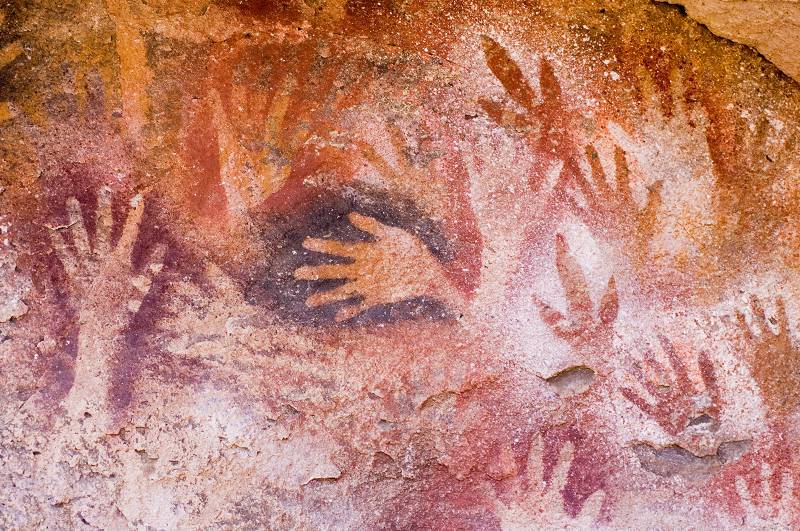
There is a Latin phrase I love. Homo faber, or humans are makers. We make tools and shelters, songs and stories, pots and paintings. We carve faces into stone, weave baskets from grass, and turn the grief of a broken heart into a poem someone else will hopefully read two thousand years later and think, Me, too. We have been making things for as long as we have been human. Perhaps longer, if you count the ochre-stained hands pressed against the walls of caves, reaching across tens of thousands of years to say I was here. I saw this. I wanted you to know.
We were made for this. Not necessarily by a god or a grand cosmic plan, but by the beautiful accident of being conscious creatures who can imagine something that does not yet exist and then bring it into the world. We are the animals who look at a sunset and want to paint it. Who hear a bird singing and want to sing back. Who gather around fires to tell stories, even when the stories are sad, even when the ending is uncertain, even when we already know how they go. We make things because being alive is an experience so strange and astonishing and heartbreaking that sometimes the only way to metabolize it is to give it a shape.
“A machine can generate a picture of a woman standing in a field of wildflowers. But it has never stood in a field and felt the particular ache of being a woman in a world that keeps telling her who to be.”
Erin Skinner Smith
Which is why I find the rise of artificial intelligence in the arts so unsettling. Of course a machine can produce an image or a song or a convincing paragraph; humans have always made technological tools that extend our abilities. The question is not whether a machine can produce something beautiful. The question is what we believe beauty is for.
Art is not merely an object at the end of a production line. It is the experience of making it. It is the years of learning to see, the hours of getting something wrong, the willingness to be a beginner, the peculiar satisfaction of finding the exact word or color or note that brings something into focus. It is the human being who has lived a life, gathered its sorrows and absurdities, and decided to make something from them.
A machine can generate a picture of a woman standing in a field of wildflowers. But it has never stood in a field and felt the particular ache of being a woman in a world that keeps telling her who to be. It has never watched the light fall across the grass and remembered someone who is gone. It has never been surprised by its own capacity for tenderness. Human made art may not always be technically superior, but art is not simply the production of something worth looking at.
Never miss a thing with our FREE weekly newsletter.
Creation is a way of being in the world.
When we outsource the making, we risk losing the practice of paying attention, of developing a point of view, of discovering what we think by trying to express it. We risk becoming consumers of beauty rather than participants in its creation.
And we do not need to be particularly good at making art for any of this to matter. You do not have to publish the poem, sell the painting, or play the piano beautifully. I write well, watercolor poorly, play the guitar just fine, and tap dance like I’m recovering from a stroke. It doesn’t matter if my creation is awkward, earnest, or lopsided, as long as it’s entirely my own. I’m not competing with a machine; I am being a person.
So go make things that do not need to be optimized. Write badly but honestly. Paint badly but with feeling. Plant gardens, bake bread, build birdhouses, sketch sleeping dogs, sing off-key in the kitchen. Make things that are unnecessary by every economic measure and indispensable by every human one.
We are homo faber. We are the makers.