

The first recording artist wasn’t a musician, but a factory worker.
In 1890, Thomas Edison decided that every little girl in America deserved a doll that could talk. It seemed like a reasonable ambition for a man who had already given the world the phonograph, the electric light bulb, and a vision of the future in which machines would transform ordinary life.
Edison imagined a nursery where a child could tuck their doll into bed, pull the covers to its chin, and hear it whisper a lullaby.
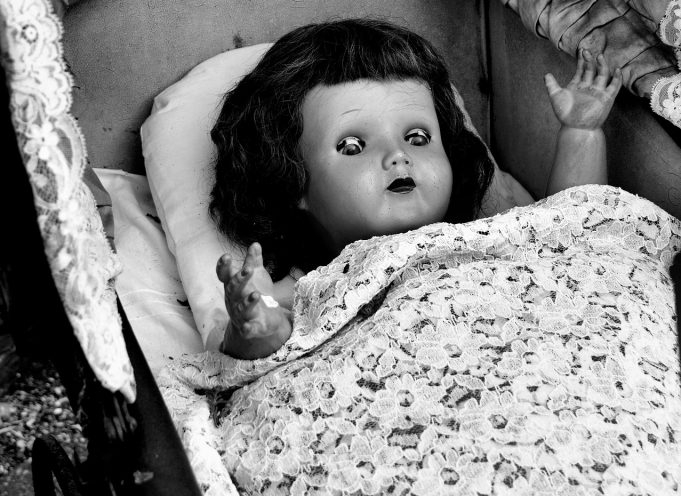
The problem was the dolls sounded haunted, like something that had crawled out of Stephen King’s Pet Sematary (sometimes dead is better). And when they suddenly spoke in the dark, it was terrifying.
Edison’s talking doll was a marvel of Victorian ingenuity. Inside its body, concealed beneath a porcelain head and a stitched dress, was a miniature phonograph. The mechanism played a tiny wax cylinder that reproduced a recorded human voice. Children would bring the doll to life by turning a crank.
The recordings were made by real women, who screamed nursery rhymes and lullabies into a horn-shaped recording apparatus. They had to scream because Edison hadn’t quite solved the volume problem. Their voices were captured on fragile wax cylinders, then installed inside the dolls.
I like to imagine little Victorian children winding them up for the first time. Doll heads are scary anyway, with their glass eyes fixed on nothing. Then they turned the crank, and the mechanism shuddered. From somewhere deep inside the doll came a voice.
“Now I lay me down to sleep. . .”
Except the voice was thin and scratchy, deeply distorted by the crude recording technology. The words emerged slowly, unevenly, as if spoken through a mouthful of dirt. The mechanical whirring underneath the voice gave the impression that something was struggling to speak from the other side of a very deep grave.
It was not the sweet, clear voice Edison had imagined, but the voice of something that had been buried and recently reanimated.
Never miss a thing with our FREE weekly newsletter.
The dolls went on sale in 1890, advertised as a technological wonder. At roughly twenty inches tall, they were expensive toys, costing about ten dollars apiece at a time when that was a substantial sum for an ordinary family. (About $370 in 2026! —Editor)
The real horror, though, was not the price, but the sound. The phonograph mechanism was delicate and unreliable. Sometimes the doll would start speaking unprompted. A product intended to demonstrate the wonders of modern invention instead delivered a performance that might have unsettled even the most devoted believer in progress.
Parents reported that their children had nightmares. Some couldn’t sleep for fear the doll would hurt them in the night. They had been promised a miracle, and received a doll that sounded like a tiny, haunted woman reciting a prayer from inside a wooden box. The talking dolls were withdrawn from the market after only six weeks.
A small number of these talking dolls survived, now prized museum artifacts. Their voices can still be heard, more than 130 years after they were made.
Listen to one here, if you dare!