
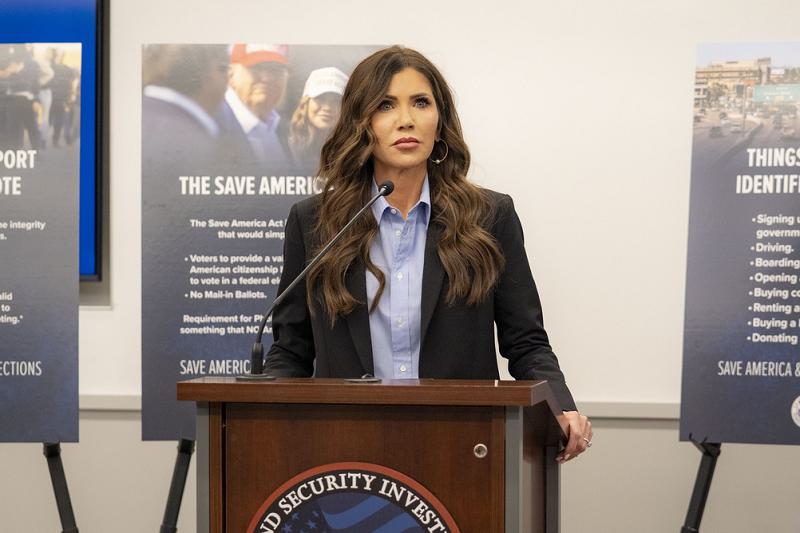
As the SAVE Act struggles to find traction in the Senate, many Americans are confused as to what the act truly says and what its purpose is. In this series, new guest contributor Crystal Brantly will explore what the SAVE Act is NOT and what the SAVE Act IS.
The SAVE Act is being touted as a simple mandate to show photo ID to vote. The requirement to provide voter ID is popular with Americans of both parties — garnering the support of 83% of Americans. However, nearly half of all states already require a photo ID to vote (including Kentucky).

Another 12 states require some form of non-photo identification (i.e., birth certificate, hunting license, bank statement, Medicare/Medicaid card). The remaining 14 states don’t require voter ID on election day, but they do use other ways of verifying identity, including signature matching, verifying personal information, or signing an affidavit. In addition, the Help America Vote Act (HAVA) requires that each state require proof of identity when a resident registers to vote or votes for the first time (even by mail).
These measures are used to prevent fraudulent voting by both citizens and noncitizens, though research has shown that these are exceedingly rare.
After the 2016 election, Trump’s claims that he would have won the popular vote if it weren’t for millions of “illegals” voting sparked a fear that noncitizens were voting in record numbers. Trump’s loss in 2020 and the resulting claims of voting fraud fueled the belief that a law such as the SAVE Act is necessary to keep noncitizens from voting.
Despite the numerous studies debunking this claim, many Americans are concerned that noncitizens are illegally casting votes in elections to a degree that would change the result of a presidential election. However, the Heritage Foundation (an ultra-right-wing think tank) has compiled a list of cases involving election fraud over the last four decades, and according to an analysis of their database, there are only 68 cases of noncitizens voting, and only 10 of those involve undocumented immigrants. This amounts to fewer than one in three million people over four decades. For reference, your chances of getting struck by lightning in any given year are about one in one million. According to those odds, there are three times as many people struck by lightning in any given year as there are cases of noncitizens voting in the past four decades.
Not only are the cases of noncitizens voting outrageously small, but in many cases, when noncitizens registered or attempted to vote, it was not due to malice or deception, but rather a belief that they were legally allowed to vote due to a misunderstanding of laws or misinformation by officials.
Never miss a thing with our FREE weekly newsletter.
Regardless, if the goal is to pass more laws to keep noncitizens from voting, there is already a law on the books that prevents noncitizens from voting in federal elections (Illegal Immigration Reform and Immigrant Responsibility Act (IIRIRA) of 1996) and, as previously stated, the HAVA requires states to verify identity and citizenship upon registration or first-time voting.

In addition to the lack of evidence of noncitizen voting, there is another issue at play: laws that aim to promote election integrity by restricting the right to vote often have the opposite result.
In 2011, Kansas purported that because an audit found 39 noncitizens on state voter rolls over a period of 15 years, a law requiring proof of citizenship to register (a birth certificate or passport) was needed. The law was in effect for three years. During that time, 30,000 Kansans were prohibited from voting. Ultimately, the law was found to be unconstitutional, and the state had to pay huge administrative costs and court fees in excess of two million dollars. Under the banner of “election integrity,” the integrity of the votes of the citizens of Kansas was actually compromised.
So if the SAVE Act is not simply a bill to require verification of voter identity or keep noncitizens from voting (both of which are already covered in both state and federal laws), what is it?
Check out the next story in this series next week to learn what the SAVE Act actually is.