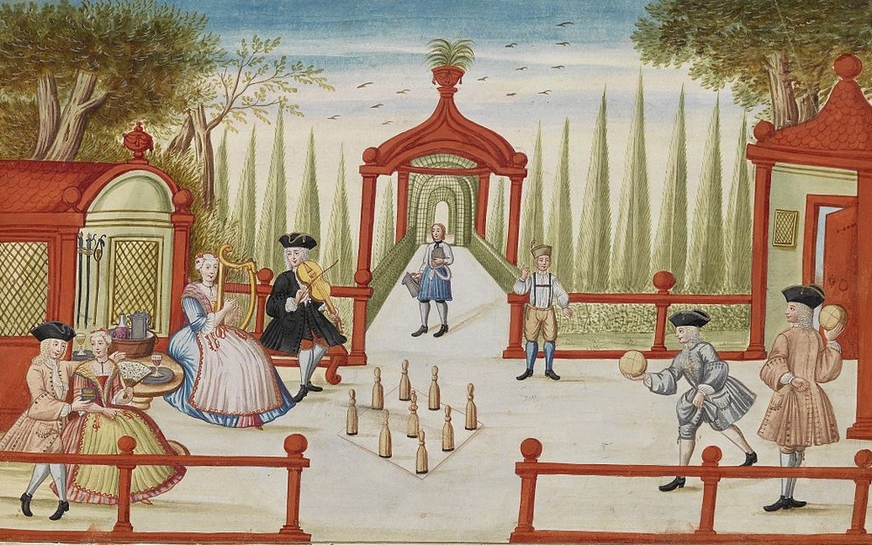
People over the centuries have always sought out amusements to occupy their leisure times. Many of these pastimes have long vanished, and some might seem a little surprising today.
Games or contests were the most common amusements in early Clark County. Wrestling, running and jumping contests were commonplace at that time, and horse racing may have been the most popular. Two other games have come and gone: ninepins, a type of lawn bowling with nine wooden pins set in a diamond formation, and “fives,” a type of handball with players taking turns hitting a ball against a wall with their hands (“fives”). It may be more accurate to say that these last two have evolved and moved indoors.
“Throwing long bullets” probably holds the claim to the most unusual game of the period. The object was to see who could throw a heavy rock (the “bullet”) a specified distance in the fewest chances. If available, the game could be played with cannonballs, which could be thrown or rolled. The game came over from Britain in the early 1700s and was popular all over the colonies.
The contestants agreed on a distance, usually a mile or so, and play would commence in the middle of local streets and roads. Games often drew large crowds and heavy betting on the outcome. As thoroughfares became more heavily traveled, the game eventually became a public nuisance.
Citizen complaints finally led to the game being outlawed everywhere. At their March session of 1805, the Winchester trustees “Resolved that all persons be prohibited from throwing Bullets within the Bounds of the Town of Winchester under the penalty of three dollars for every such offense to be recovered and applied as fines usually are in such cases.”
“Shooting anvils” was a popular 19th century pastime. No, this didn’t involve taking target practice on a blacksmith’s anvil. Shooting anvils usually occurred during celebratory events like the Fourth of July. It was enjoyed for the loud boom and for the spectacle of seeing a heavy anvil launched high into the air.
Here’s the process involving two anvils: First, one anvil was placed upside down on the ground, ideally in a level, unobstructed area. A large measure of black power was spread over its base, and then another anvil was set in place on top of it, this one right-side up. A long metal rod, which had had its tip heated red-hot in a fire, was used to touch off the powder, while keeping the individual at a safe distance. Upon ignition and a loud report, the top anvil (the “flyer”) would be launched high into the air.
Never miss a thing with our FREE weekly newsletter.

The practice had its hazards. A spark could pre-ignite the black powder harming the ones placing the anvils. Also, anvils could explode sending deadly shrapnel flying in all directions. Finally, sending heavy anvils flying through the air could result in bystanders being crushed.
Anvil shooting survived into the early 1900s in Clark County, when young people would shoot anvils after they finished stripping tobacco each year. After the Armistice was signed in 1918 ending World War I, the Winchester Sun reported, “The custom of shooting the anvil was resurrected and loud explosions were heard throughout the evening.” The practice survives today with daredevils launching 50-pound anvils 100 feet in the air. You can watch on YouTube!
In the first half of the 20th century many people in Winchester entertained regularly. The society pages in old issues of the Sun are filled with reports of parties complete with guest lists. There were usually games followed by a buffet or sit-down dinner. Surprisingly, these events often included 20 or 30 people.
There were regular gatherings at card parties; those most often mentioned in Winchester were euchre clubs and bridge clubs. Also popular were forty-two clubs. Forty-two is a domino game played like a card game. It was invented in Texas in 1887 by two young men whose Protestant families frowned on card-playing. The game involves bidding, trumps and trick taking; it is similar to pitch but played with dominoes instead of cards.
Forty-two parties became fashionable all across the country. In Winchester the fad lasted until the 1920s. However, the game is still popular in Texas today.