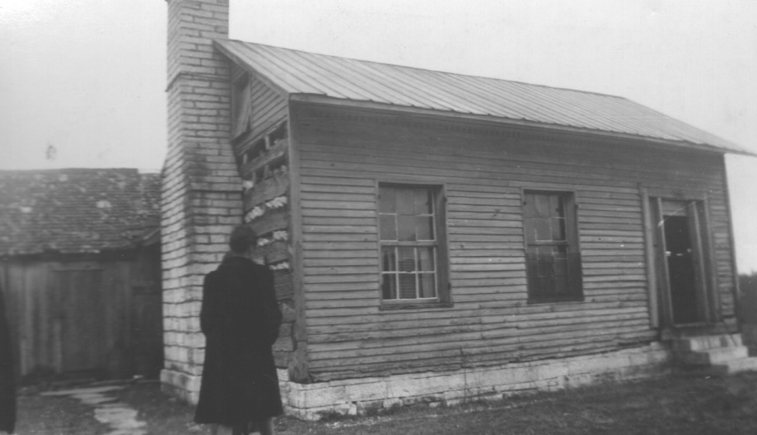
On January 4, 1939, the two-inch headline in the Winchester Sun shocked Clark County residents: “3 SLAIN AT HOME NEAR BOONESBORO.” This was followed by “Buck Sowers, John Martin And Sampson Estepp Dead; Stanley Martin In Custody.”
The Lexington Herald reported, “Three men were shot to death late Tuesday afternoon during a bloody gun battle staged in a ramshackle three-room cabin on the side of a hill near the Kentucky river in Southern Clark county.”
The slayings occurred at an old cabin located on a cliff above Lower Howard’s Creek just west of and above Hall’s Restaurant. Buck Sowers resided in the front room of the cabin, while Sampson “Sampse” Estepp, his wife Mary, and stepson Herbert lived in the back room. The two rooms were separated by a hallway.
The victims were William Henry “Buck” Sowers, 71; Sampson Estepp, 65; and John Martin, 55. Sheriff Leo Cruse took Stanley Martin into custody at the scene for the murder of Sowers. The following sequence of events was pieced together from newspaper accounts.
According to Mrs. Estepp, Sowers “had been awful drunk since about Christmas Day.” On the day of the slaying, Robert Martin, brother of John and Stanley, was visiting Sowers. After the pair finished off three pints of whiskey, they began arguing.
Sampse and Mary Estepp had been out gathering firewood. As they were returning to the cabin late that afternoon, they heard a shot from inside and saw Robert Martin fleeing from the cabin.
Mary later testified that her husband opened the door into the hallway to investigate. She saw Sowers, standing in the doorway to his room, lower the barrel of his shotgun and fire point-blank at her husband, killing him instantly. She ran outside and raised the alarm, yelling that Sowers had “killed Sampse and Bob both.”
John Martin, who lived on the other side of Lower Howard’s Creek, heard her cries and shouted, “You old [expletive], get ready, I’m coming after you.” Martin made it up the hill and was shot to death as he entered the cabin—apparently by Sowers, as no one else was in the cabin.
Stanley Martin also heard the screams and was the next to arrive on the scene. Stanley told Sheriff Cruse that when he entered the cabin, he saw his brother dead on the floor and Sowers crouched in a corner. He stated that he grabbed the gun from Sowers’ hands and beat Sowers over the head with it. “I beat him until I got tired,” Stanley said and claimed he acted in defense of his life.
A gruesome sight awaited the investigators: two men dead from wounds inflicted by a 12-guage shotgun, and a third victim with his head battered beyond recognition. On the floor, they found two shotguns, both broken to pieces.
Then on Wednesday morning, the coroner discovered that Sowers had been shot ten times with a 22-caliber rifle—six near the heart and four in the abdomen. The sheriff said Stanley had the rifle in his possession, but when questioned, said he did not shoot Sowers.

That raised the question, “Was Sowers shot to death and then clubbed beyond recognition? Or, was Sowers beaten to death and then riddled with bullets?” That question was answered when Stanley Martin’s story apparently changed. At his hearing, county officers testified that Stanley admitted he shot Sowers.
Never miss a thing with our FREE weekly newsletter.
One week after the slayings, Ben Bartlett held a coroner’s inquest. The jury found that Sampson Estepp and John Martin died from single shots from a shotgun wielded by Sowers, and that Sowers “came to his death at the hands of Stanley Martin.”
The trial judge, Joe Lindsay, described the gun battle as “the bloodiest in Clark County history.” He then dismissed the murder charge “on the grounds of self-defense and temporary insanity.”
The cabin itself had a long history. In the 1840s, it was home to Benjamin Hieronymous (1772−1859) and his family. The cabin continued to be occupied until it burned in the late 1960s. The cabin site and the foundation of John Martin’s house are both located along the John Holder Trail in the Lower Howard’s Creek Nature & Heritage Preserve.
Note: After publishing the story “Wainscott Mysteries,” I received an email from Kathy Howard, who was the last principal of Hannah McClure Elementary. She had an answer for the question, “Who named Ale‑8.” It was Anna Bruce Gordon Boone (1914−2006), who as a child was very close to the Wainscotts. Mary’s husband used to visit her when she was widowed and living in Lexington. “Aunt Anna Bruce used to talk about her time with the Wainscotts and shared that she helped name the new drink A Late One.”