
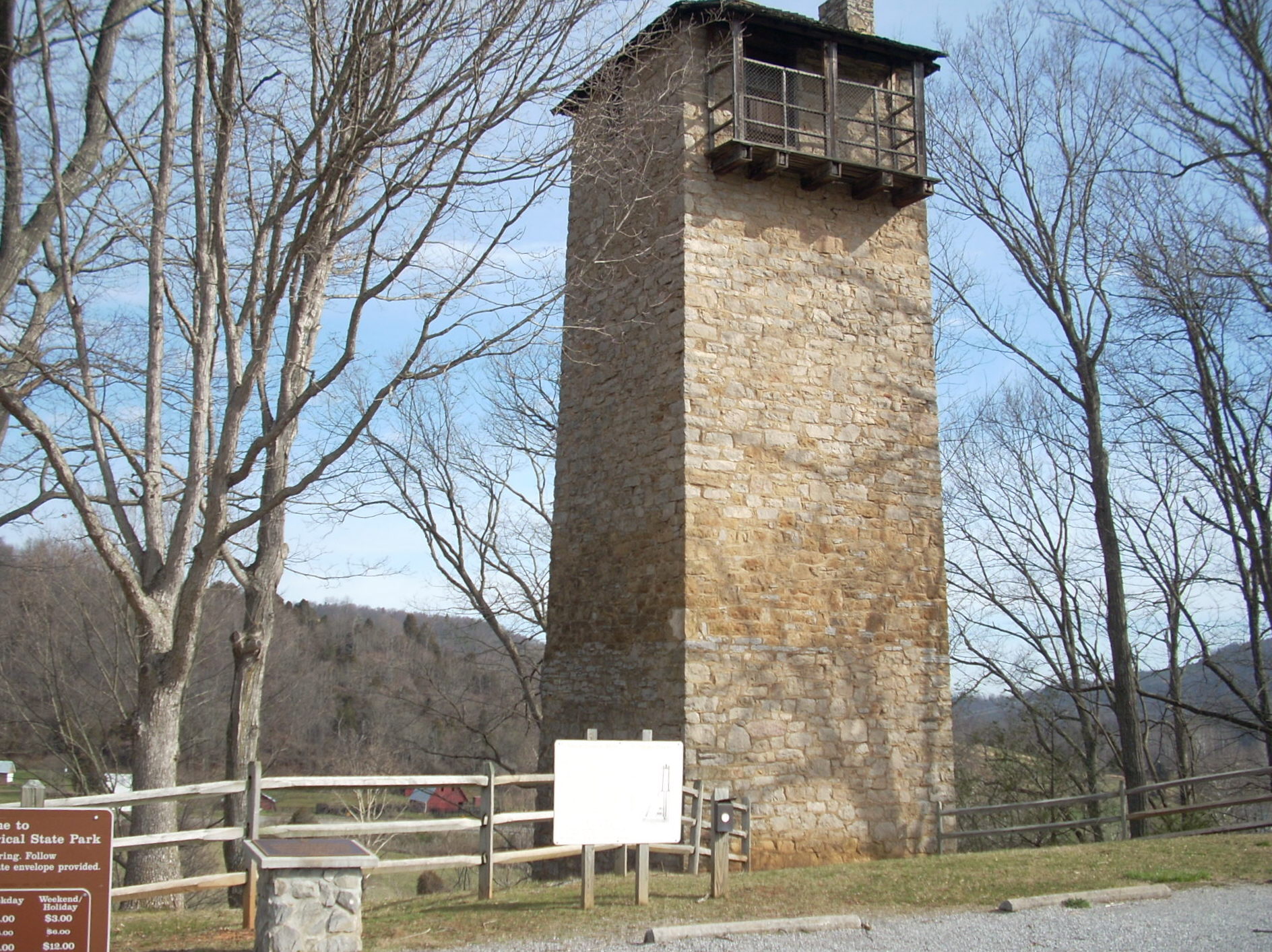
The Shot Factory was located on a cliff high above the Kentucky River about three-tenths of a mile upstream from the mouth of Boone Creek. The factory was located on a cliff 110 yards east of a picturesque little stream called Berkley Spring Branch. This small manufactory produced buckshot for use in muskets and fowling pieces.
A British plumber by the name of William Watts developed an ingenious process for making buckshot. Watt added a two-story tower to his three-story house, cut holes through each floor, and placed a water tank in the basement. From the top floor, he poured molten lead through a copper sieve. As the lead fell, it formed tiny spheres which solidified when they hit the water. He then collected the shot from the bottom of the tank. Watt patented his process in 1782. Previous methods for making shot were difficult and expensive. His method for making what came to be called “drop shot” caught on quickly. To produce shot, specialized structures called “shot towers” began to proliferate.
The Kentucky Gazette first advertised drop shot for sale by Lexington merchants in 1788. A number of early shot towers survive today: The Jackson Ferry Shot Tower in Wythe County, Virginia, dates from 1807; Sparks Shot Tower in Philadelphia from 1808; and Phoenix Shot Tower in Baltimore from 1828. The shot factory on the Kentucky River was contemporary with these, but the exact date is impossible to fix.
The earliest reference to the shot factory on the Kentucky River is John G. Stuart’s journal of a trip to New Orleans in 1806. Stuart hired on as a hand to work on a flatboat laden with Kentucky produce. In late March his boat was tied up at Cleveland’s Landing, very near the present Clays Ferry bridge. He was whiling away the time, as dry weather had forced about 100 boats to wait for the river to rise. Before construction of the locks and dams, the Kentucky River was only reliably passable after the spring rains raised the water level. One day he and a companion “went up to view the old shot manufactory built on the edge of precipice 2 or 300 feet high.”
It has been impossible so far to figure out who started the business. The first owner of the property, William Triplett, who obtained the Virginia patent, never lived on the land. The factory site lies at a corner of a subsequent owner Samuel Talbott, who died in 1833 leaving the farm to his son John.
The shot factory was mentioned by name in an 1837 deed from John Talbott to John Berkley. It was mentioned again in 1853, when the estate of Daniel Berkley was divided among his heirs: one of the division lines was described as “crossing the River bottom and ascending an inaccessible clift” to “a red cedar on the point above the shot factory.” Plotting the lines on a topo map pinpointed the factory’s location.

With the shot factory now marked on a map, I went in search of the site with my wife Clare and archaeologist friends Terry Tune and Bill Sharp. We located the spot at the top of the cliff and found cedars still growing there. This is where the molten lead would have been dropped. The cliff is not a perfectly sheer precipice, so getting a clear vertical path to the kettles at the bottom required a structure cantilevered out over the edge of the cliff. An account from a retired riverboat pilot, Charles Johnson of Frankfort, described a “Shot Factory Cliff, 6 miles below Boonesboro, where the old timers made drop shot.” He said he had “talked to old people who remember when the big timbers were still at the top of the cliff, but no one could ever tell me where they mined the lead.”
The question Johnson raised about the source of lead is still a mystery. There were small deposits of lead in the Boone Creek area in the form of galena (lead sulfide), but it is not known if they were commercially mined. The major source of lead in early America was the mine near Fort Chiswell in western Virginia.
It’s hard to say how long the shot factory operated. We have references to it dating from 1806 to 1853. It could have been used on and off at times during that period and possibly before—John G. Stuart called the shot manufactory “old” in 1806. Shot towers were commercially viable until after the Civil War. By the twentieth century, the shot factory on the Kentucky River was apparently a distant memory.