
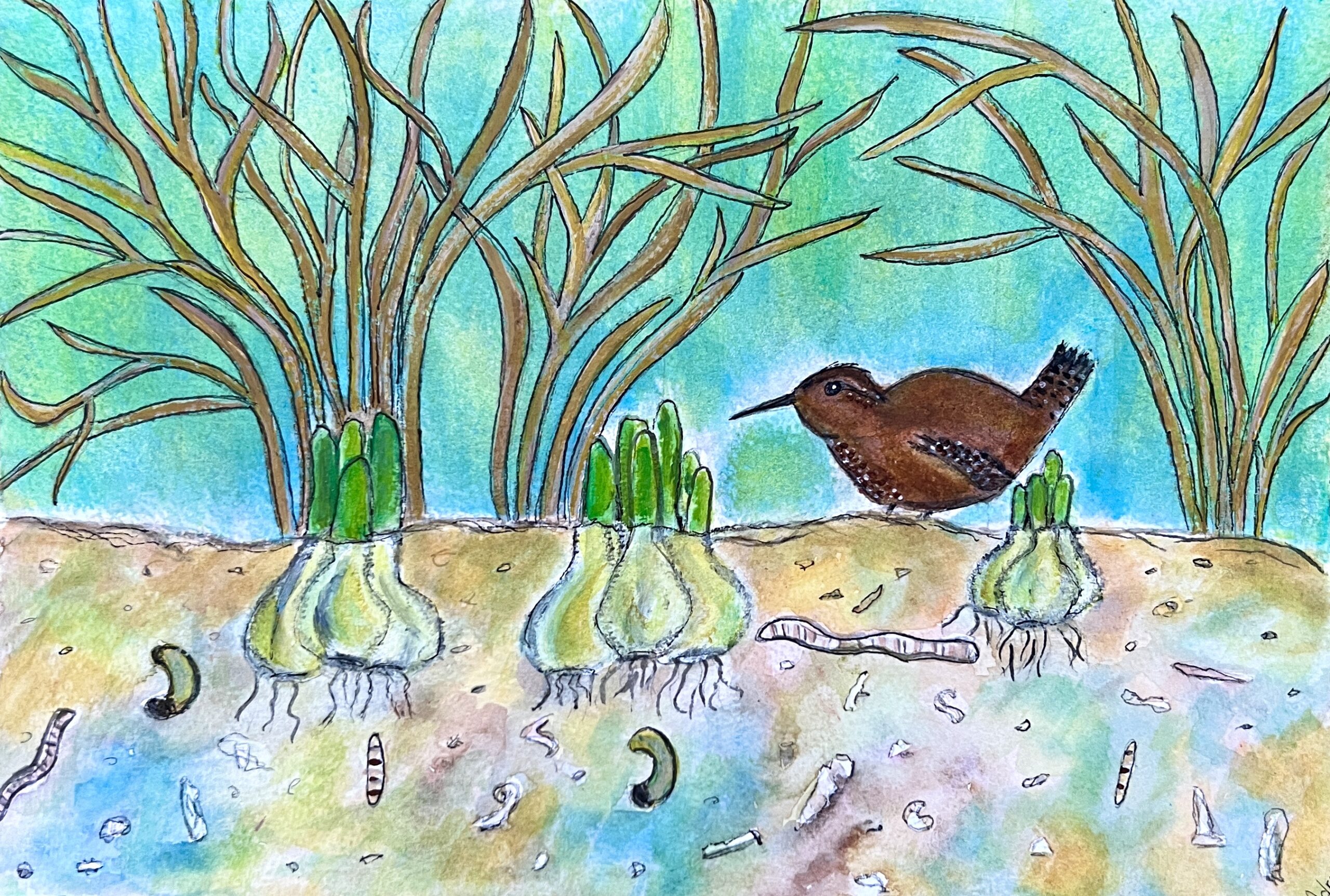
Sprout
Sleeping bud snug
in papery womb.
White dreamer in the shadows.
In stillness you doze
through wars and tender lifetimes,
soft as unformed bone.
Then, one unknown instant,
the moon mouths your name;
her ancient breath
the warm signal
that stirs
your yellow heart.
Slowly you awaken and rise
from the silent place
that was your life, that was your season,
and tear yourself in two;
pale nub greening
at the mere idea of a sun.
— Adra Fisher
A few weeks ago, the daffodil bulbs along my back fence line pushed their oval fingertips through the soil, an always-thrilling sight even after 30-plus years of gardening. The temperatures were frigid and the soil surface brittle, but these hardy spring bulbs were undeterred.
The natural world never ceases to inspire and delight if we’ll only take time to notice it.
Of the four distinct seasons we enjoy in Clark County, spring is by far the most uplifting: winter tends to overstay its welcome, summer can be oppressively humid, and flamboyant fall is the final hurrah before our annual polar plunge into early-evening darkness.
Springtime may be mercurial and stormy, but it’s the only season that offers a heartening sense of renewal.
While our calendars claim spring doesn’t arrive officially until March, it starts for me the second I spot sprouts emerging from beneath their winter blankets of garden debris. Never mind that the television weather folks squawk about snow and ice through April — daffodils don’t watch tv, which is another reason to revere them and wonder who, really, is the higher form of life.
Every year I mark the beginning of spring by a series of joyous events: the emergence of spring foliage and blooms (natch), the first raspy “cong-a-REEE” of the Red-winged Blackbird, the tease of a few 60-degree days, and the public library’s seed giveaway. Once the Burns Avenue lawn across from the library bursts into its annual sea of lavender crocus blooms, I’ll consider the season to be in full glorious swing. (Note: This short-lived spring spectacle is starting now and is not to be missed.)
How to celebrate? That’s up to you; we all have our preferred methods. Mine involves sorting through bags of refrigerated seed packets and staring out windows. There is also a lot of wandering the yard in my bathrobe or decades-old loungewear — or both, depending on the hour, temperature, and my overall mood.
Because the scene can change quickly and I don’t want to miss anything, vigilance is required. On inclement-weather days, binoculars allow landscape scouting from the comfort of my couch. If you’ve never studied trees or plants with binoculars, I highly recommend it. Just be careful not to creep out your neighbors.
On one recent yard patrol, I noticed greening mounds of winter cress, new growth on my grandmothers’ heirloom cowslip and iris, plus tiny blue-green catmint leaves that make the neighborhood cats more than a little wacky on the junk. (It’s only February and already they are writhing ecstatically out there . . . thank goodness I didn’t plant actual catnip, their purported drug of choice.)
As much as there is to see above ground, even more activity is taking place at the soil line. Perhaps you’ve noticed the spring platoons of American Robins standing around in the grass. These perceptive birds aren’t imitating statues, they’re hunting. The winter berry supply depleted, they’re on to the next course — earthworms and soil arthropods. Standing stock-still in the lawn helps them better see the slightest movement of even the tiniest prey.
Meanwhile, inches below the soil surface churns a diverse universe of insects and microbes that makes our own lives possible. These tireless critters’ activities and eventual dead bodies create the actual soil necessary to support plant life.
Never miss a thing with our FREE weekly newsletter.
I will never forget learning many years ago in botany class that plants can live without us, but we can’t live without plants. This revelatory statement caused a seismic shift in my consciousness: Gardening is not something one does to the earth, it is undertaken in humble collaboration with it.
Today, the door to my garden shed bears a plaque that I have displayed in my gardens since 1992. Its inscription, paraphrased from an 1854 speech attributed to Native American Chief Seattle, reads: “Earth does not belong to us, we belong to the earth.” Every time I retrieve a tool or survey my garden, I see these words and am reminded of my place on this amazing — and bountiful — planet.
This year, as spring blooms before our winter-weary eyes, let’s see it for the miracle it truly is. Let’s appreciate our unique place in this astounding natural world and treat it with the care and respect it deserves.
In these fraught times of pandemics, climate change, and political polarization, we’ve managed to survive another winter. Daffodils are shooting skyward and crocuses are in bloom. Before long, we’ll be surrounded by the technicolor beauty of yet another Kentucky spring.
I can’t imagine a better reason to celebrate.

