
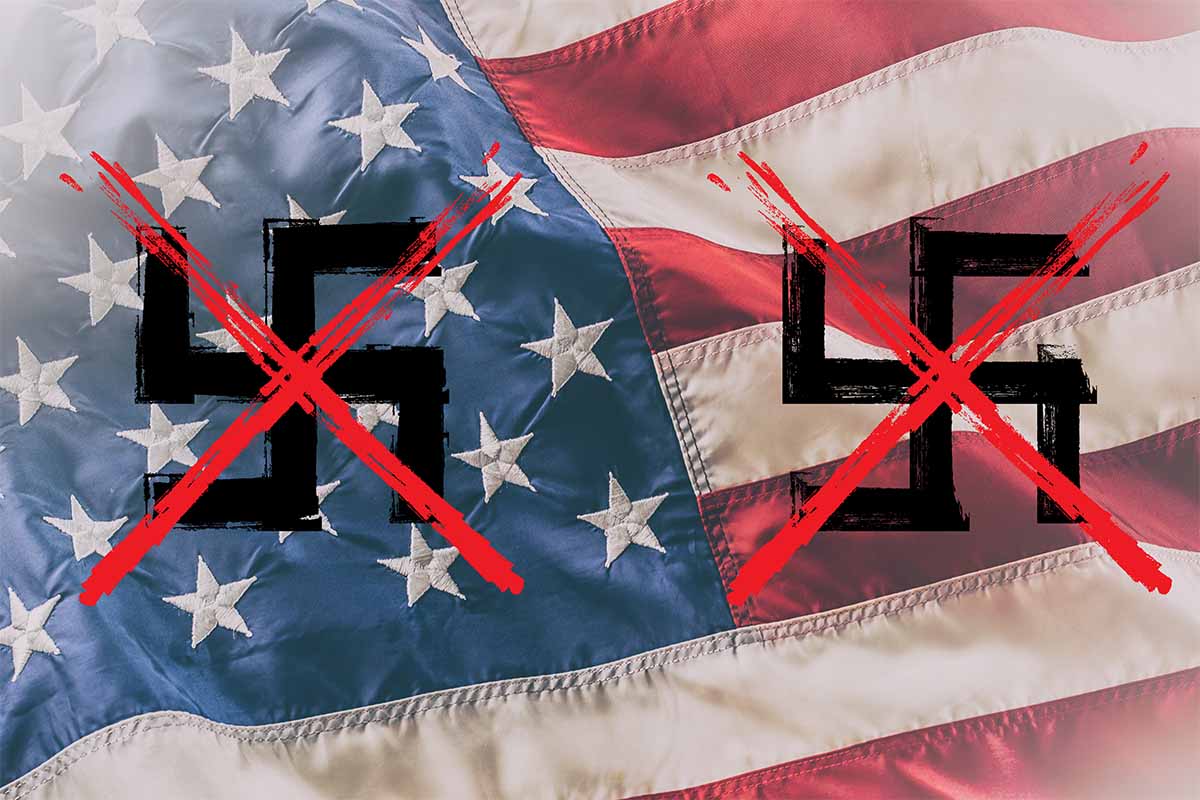
There is perhaps no more hated symbol in all the civilized world than the broken cross of the Nazi régime, the swastika.
The Nazis were not the first to use the symbol. It may have originated as many as 7,000 years ago. Evidence of it has been found in the Indus Valley, which was inhabited from 2,500−1,700 BCE, and in artifacts from pre-Christian European cultures.
The word comes from the Sanskrit word “svastika,” which means “good fortune.”
Regrettably, the Nazis perverted the symbol into something that has come to epitomize the worst kind of hatred and virulence.
Many countries around the world have banned any form of Nazi symbolism following a war that annihilated as many as 40 million people.
Across the world, numerous countries with democratic forms of government have instituted bans, including Australia, Austria, Belgium, Brazil, France, Germany, Hungary, Italy, Poland, Sweden, and Switzerland.
Here in America, we take pride in the fact that we are a generally free people, tolerating many activities that would be unacceptable in other civilized nations, such as hate groups, discordant speech, and public utterances that are blatantly untruthful—at least until these activities result in destruction of property or harm to individuals.
Our extreme tolerance may well have been a spark that resulted in the assault on the Capitol on January 6th, 2021, an action that evolved from what began as a peaceful—although vitriolic—assembly.
We have traditionally resisted intrusions into our freedoms: assembly, religion, speech, and the press, which are all guaranteed by our Constitution.
Before World War II, the Nazi party was quite prevalent in the United States, holding rallies in many cities and even resorting to violence that was recorded on film at the time. Aerial hero Charles Lindberg was, for a time, an admirer of Nazism, often extolling it in public.
That all changed in early December of 1941 when Germany declared war on the United States.
The Communist Party boasted many thousands of adherents in the 1920s and 1930s when America was going through its worst depression, and people were seeking some outlet that promised a change and a return to the prosperity that existed before 1929. This was dramatically reversed in the 1950s when the government actively pursued any hint of “Red” activity.
Never miss a thing with our FREE weekly newsletter.
The point of all this is that Nazism seems to be rearing its ugly head in America once again. The swastika is being painted on synagogues across the nation. Though it is not frequently displayed in public, some symbols are obviously derived from it that adorn the uniforms and paraphernalia of other hate and extremist groups.
Liberalism and freedom go too far when they permit the symbol of Nazism to be used and displayed in support of the brands of hatred now arising across this country. The symbol itself is a firebrand that seems to ignite the very core of hatred that festers under the surface and supports the false courage that results in the suppression and antagonism of minority groups and individuals.
The laws in many countries that have banned the display of the swastika are framed in such a way that its legitimate use in historical education is acceptable. It is important that future generations understand the full implications of how this symbol was used to generate and foster hate, greed, and the annihilation of millions of individuals. Still, it should not be allowed to be freely displayed when the sole purpose of any such display is to foment that same hate today.
All Americans esteem our freedoms and are loathe to see them abated. But freedom can exist just as well when something as simple as suppressing the display of a single icon can be accomplished without adversely affecting freedom-and-peace-loving individuals, especially when those icons are universally recognized for their inflammatory intent, history, and purpose.
Those who disseminate swastika-laden literature or spray-paint it on churches and synagogues should face retribution more severe than simple misdemeanor charges, and such symbols should be recognized for their ability—and intent—to instigate more radical actions.
