
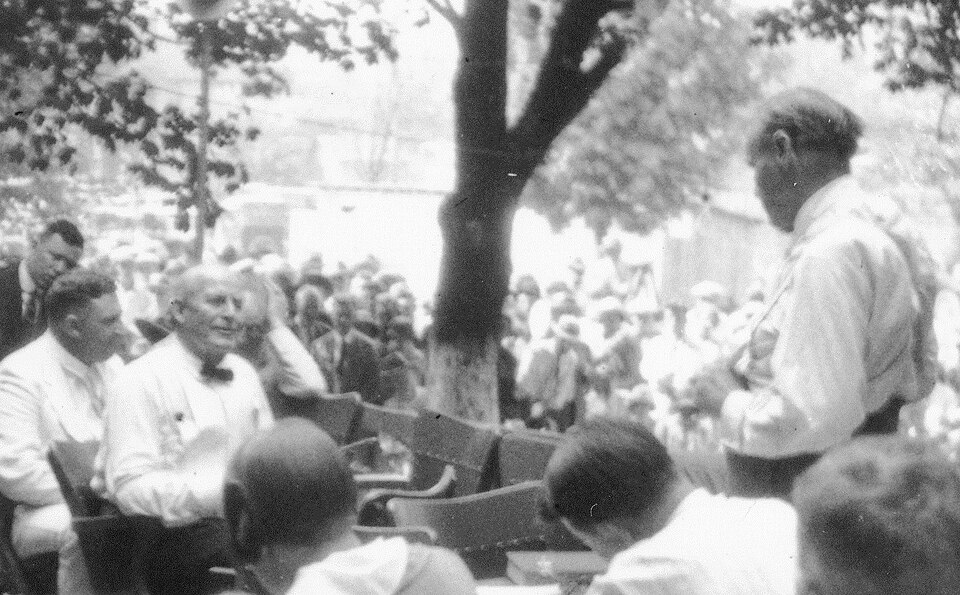

It’s been an interesting century since the culmination of the Scopes trial, more popularly known as the “Monkey Trial.” Actually, it was 101 years ago that the trial took place in Dayton, Tennessee in the summer of 1925.
Briefly, the trial was the prosecution of John Scopes, a local high school teacher who had agreed to be a test case of the recently passed Butler Law, which banned teaching evolution in public schools.
Local businessmen thought a public trial would bring some notoriety to the town so they arranged for Clarence Darrow to serve as defense lawyer for Scopes while William Jennings Bryan would be the prosecuting attorney.
The businessmen’s vision paid off. Thousands came to the town, creating a carnival atmosphere and the trial was broadcast on radio, something highly unusual for the period. The trial quickly devolved into a debate over evolution, with the fate of Scopes taking a background position.
Scopes was found guilty. He did, after all, violate state law, but the verdict of a $100 fine was later overturned on a technicality.
All the furor in Dayton must have spurred ongoing conversation about evolution since Mississippi passed a similar law in 1926, followed by Arkansas in 1928. All these laws stayed on the books until 1967 for Tennessee and 1968 for Mississippi and Arkansas.
In more recent years, efforts have continued to require the teaching of alternative creation theories in the public schools. Part of those efforts have centered around renaming these religion-based proposals under the title of “creationism” and “intelligent design.”
In 2002, stickers were placed on biology textbooks in Georgia instructing students that evolution was a “theory only and not a fact.”
In Kentucky, in 1999 “evolution” in science curriculum guidelines was replaced with “change over time.”
In 2001, Senator Rick Santorum (Republican of Pennsylvania) proposed an amendment to the education funding bill that promoted the teaching of intelligent design.
Perhaps the most well-known attempt to insert anti-evolution theories into the public classrooms was thwarted in the case of Kitzmiller v. Dover Area School District in Pennsylvania in 2005. Judge John E. Jones issued a 130-page ruling that stated that intelligent design was a religious theory with no scientific basis. Since the school board members who defended the policy of teaching intelligent design were all defeated in elections that year, the case was never appealed. This was essentially the death knell of intelligent design, at least as a subject for public high school classes.
Today, evolution is taught in every state’s public schools and no states require the teaching of creationism — although it may be taught in civics, current affairs, philosophy, and comparative religion classes.
In a 2019 Gallup poll, 40% of American adults were inclined to the belief that “God created humans in their present form at one time within the last 10,000 years.”
It would be interesting to see how that belief appears in other countries of the world.
Dayton returned to its small-town simplicity not long after the trial; it sits a short distance off I‑75 and one can visit the courthouse where the trial took place. Interestingly, a statue of Bryan was erected at the courthouse in 2005, but it was not until 2017 that a similar statue of Darrow was erected nearby, its $150,000 cost paid by the Freedom From Religion Foundation.
Never miss a thing with our FREE weekly newsletter.
The movie Inherit the Wind (1960) is a dramatization of the trial, starring Spencer Tracy as Henry Drummond (Darrow) and Frederick March as Matthew Harrison Brady (Bryan). Harry Morgan, whom many remember as Colonel Potter of M*A*S*H, was the presiding judge. Gene Kelly plays E.K. Hornbeck (H. L. Mencken, who covered the trial).
Some of the dialogue in the movie is actual testimony from the trial, especially Darrow’s (Spencer Tracy’s) speech about “marching backward in time.”
This was a most interesting period of American history and the trial was a fascinating pinpoint in that period.
Excellent reading about the trial, with actual transcripts from parts of the trial, can be found in Monkey Business by Marvin Olasky and John Perry, Keeping the Faith by Brenda Wineapple, The Last Trials of Clarence Darrow by Donald McRae and Summer for the Gods by Edward J. Larson.
