
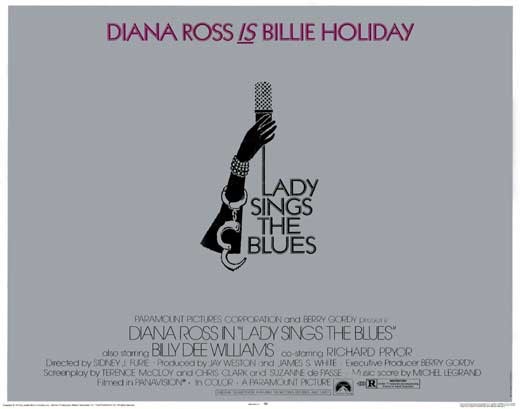
Billie Holiday is one of my favorite jazz singers; in my opinion, she was the best.
But she was a troubled soul. She wrote an autobiography in 1956, Lady Sings the Blues. The title was taken from one of her well-known songs. The Reel Classic we look at today is loosely based on that autobiography and shares the same name. It was produced by Motown Productions (Berry Gordy). Gordy wanted one of his top Motown performers, Diana Ross, for the role of Billie Holiday even though she had very little acting experience.
The choice of Ross to portray Holiday was controversial to some degree as many feared she would be “too pop” to portray a jazz diva. There were even concerns of “nepotism” as she was seen as his “protégé” and, as it was later divulged by Ross, they had had an affair and a child together. Regardless, Diana Ross portrayed Billie Holiday and was nominated for an Academy Award for her efforts.
For those who are familiar with Billie Holiday you may know that she suffered some terrible experiences in her life. These included rape, racism, physical abuse, and drug addiction. She experienced the heights of fame (including a famous concert at Carnegie Hall) and the depths of despair (being jailed for drug use). These experiences are depicted in the film.
We meet the young Eleanora Fagan as a fifteen-year-old girl working as a maid in a Baltimore brothel. She loves to play blues records and sing along with the tunes. After experiencing rape by a drunken customer, she flees Baltimore and heads to New York where her mother lives and works as a housekeeper for a rich family. Her mom can’t take her in and sends her to a friend, Ms. Edsen, who agrees to let her stay in her “boarding house,” which in actuality is a brothel. She prostitutes herself to earn money for clothes and gifts for her mother. Eventually she goes to a local night club to answer an advertisement for dancers. Though her dance moves are not what the owner wants, her singing of “All of Me” leads to her being hired. The piano man (Richard Pryor) takes her under his wing, and she adopts the name Billie Holiday. Another attendee of the club, a handsome well-to-do Louis McKay (Billy Dee Williams), takes a liking to the young Billie Holiday.
Billie’s singing gives rise to her reputation in the city and she is invited to join an all-white band and go on tour. On this tour while traveling through the South she sees the body of a black man hanging from a tree. This was the inspiration for her disturbing and powerful song “Strange Fruit.” It is also on this tour that she experiences the impact of “Jim Crow” and is introduced to heroin. She struggles with addiction the rest of her life. We see her rise in fame and attempt to get off the drugs. We see her become famous and record many records. We also see her thrown into jail on drug charges and suffer the pains of withdrawal. She actually spent a year in rehabilitation and lost her cabaret license in New York City.

After the publication of her autobiography, Hollywood producers wanted to bring her story to the screen. Several attempts were made by various producers to make this dream become a reality. During this time several different actresses were considered for the lead role including Dorothy Dandridge, Abbey Lincoln, Diahann Carroll, and Cicely Tyson. However, Berry Gordy joined the production effort and as mentioned above, insisted on Diana Ross for the role of Billie Holiday.
Some jazz purists were upset at just how “loosely” the career was portrayed. Billie Holiday’s multiple marriages were combined into one character, and many of her famous musical associates (including Artie Shaw, Count Basie, Benny Goodman, and Teddy Wilson) are not mentioned. The Turner Classic Movies (TCM) review describes the work of the screenwriters as an effort to “capture the spirit of Holiday’s career rather than exact details.”
Reportedly Diana Ross worked very hard on this project. She studied Holiday’s life, including the autobiography, to give her insight into the woman she was to portray. She also worked with an acting coach. One of the things most people were concerned about was how Ross’ singing style would come across. Her style familiar to fans of “The Supremes” was not Billie Holiday’s style. She worked at modifying her own sound to utilize Holiday’s phrasings. She also worked at trying to bring Holiday’s emotional delivery to the sound. The soundtrack was released as an album and was a hit — making #1 on the Billboard album chart in 1973.
Lady Sings the Blues was nominated for five Academy Awards including Best Actress (Diana Ross). Ross lost out to Liza Minelli for her role in Cabaret. It was also the first African American biopic to be nominated for an Academy Award. With the nomination for Best Original Screenplay, Suzanne De Passé became the first African American to be nominated for that category. She recently received a nomination for Best Adapted Screenplay in 2017 for her work on the film Mudbound.
Though many of the movie critics at the time found the story a “bit of a cliché” they were generally in agreement that Diana Ross put forth an excellent performance. Roger Ebert wrote that Ross had given “one of the great performances of 1972” and that the film “has most of the cliches we expect — but do we really mind cliches in a movie like this? I don’t think so.”
Gene Siskel of the Chicago Tribune acknowledged that though the film may not have been an accurate portrayal of the life of Holiday, it can be “an entertaining movie. And it is just that — entertaining — because of an old-fashioned grand dame performance by Diana Ross.”
The critic for the Los Angeles Times wrote Ross gave “one of the truly fine screen performances, full of power and pathos and enormously engaging and sympathetic.”

In addition to Diana Ross, Billy Dee Williams, and Richard Pryor, there are other familiar faces to be found in the cast. James Callahan plays Reg Hanley, Sid Melton is Jerry, and Isabel Sanford (who was mentioned in our previous Reel Classic review of Guess Who’s Coming to Dinner) plays “The Madame.” Scatman Crothers has a small role as Big Ben.
An interesting note — Richard Pryor’s role was expanded when he impressed everyone in the early scenes at Jerry’s club as the “Piano Man.” It was also Pryor who taught Diana Ross how to act when using and under the influence of drugs.
Even though Lady Sings the Blues is “loosely based” on Billie Holiday’s autobiography, it does give the viewer a glimpse into the torment and the joy that was her life. The film begins with her being locked away, alone and in pain and in desperate need of “a fix.” We see the impact of “Jim Crow” and racism, and the body of a Black man hanging — ”Strange Fruit.” We also see the struggles that people make to overcome these obstacles, and the power of music to help heal. We see the value of support in times of need, and the benefit of having someone who cares.
Never miss a thing with our FREE weekly newsletter.
This film is filled with the music of Billie Holiday, and I encourage you to seek out Holiday’s performances. She is powerful and full of emotion. As I mentioned earlier, she is my favorite and I think she is the best.

The Internet Movie Database rates Lady Sings The Blues at 7 of 10. Rotten Tomatoes gives it a critics’ rating of 68% and an Audience rating of 86%. I searched my Roku device for free streaming sites but was not able to find any. Unfortunately, the Clark County Public Library does not have a copy for loan (but I feel sure they will obtain one if you ask).
Information for this Reel Classic review was gathered from Internet Movie Data Base (IMDb), Rotten Tomatoes, Turner Classic Movies (TCM), and Wikipedia.
In addition to the usual trailer, I am including a video that has Billie Holiday singing “Strange Fruit” in 1939. The video also includes the lyrics and a bit of history about the song. The subject matter is a part of our history, and we need to acknowledge it.
I’ll be back soon with the next Reel Classic, but before I leave you with the trailer below let me remind you that if you enjoy these classic movies, please join me on the second Tuesday of each month at 6 PM at the Clark County Public Library for “Ron Kibbey’s Comedy Classics.” I present a classic comedy film usually accompanied by a vintage cartoon. Popcorn and drinks are provided. More information about the next film is available on the library’s website and Facebook page, as well as WinCity Voices Facebook page.
