
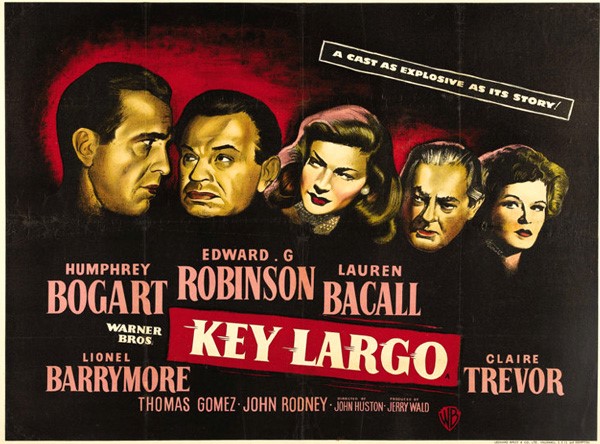
Recently reading and seeing stories about the hurricanes that hit Florida made me think of a classic Bogart-Bacall film that also prominently featured a hurricane pummeling the Keys in Florida—Key Largo. Key Largo was the fourth and final film starring the couple — the others being To Have and Have Not (1944), The Big Sleep (1946) and Dark Passage (1947).
Key Largo, released in 1948, had an all-star cast that, along with Humphrey Bogart and Lauren Bacall, starred Edward G. Robinson, Lionel Barrymore, and Claire Trevor. The story is set in a hotel located in the Florida Keys and operated by Nora Temple (Bacall) and her disabled father-in-law James Temple (Barrymore). Nora is a widow who had lost her husband in the war. The story opens with a bus traveling along the road in the Florida Keys to Key Largo. On the bus is Frank McCloud, a former soldier and friend of Nora’s husband. They had been stationed together in Europe and McCloud was on his way to visit the family of his friend and to honor his memory.
Upon his arrival he is warmly greeted by both the widow and father of his friend. He shares with them some details of his experiences with his friend Temple, and tells them of his bravery and heroism. They also share with him the mention of McCloud in the letters they received from their loved one. However, his reception is not so warm from the several guests who have booked the hotel exclusively for the next few days—allegedly for a fishing trip. The leader of this party of guests is the infamous Johnny Rocco (Robinson)—a noted gangster who had been deported from the country. He was in Key Largo awaiting contact with another local gangster to pull off a deal that would then take him to Cuba to set up his operations there. He is accompanied by several of his mobsters and also by his alcoholic girlfriend Gaye Dawn (Trevor).
Frank McCloud, along with Nora Temple and James Temple, soon find themselves prisoners of this gang and are held at gunpoint. In the meantime, a couple of local Native Americans have escaped from jail and are thought by local law enforcement officers to be headed to Key Largo to join up with their family and tribe. James Temple has always befriended the local tribe members and often offers them shelter in the hotel during major storms. As it turns out, a major hurricane has been reported heading to the Keys and the Native Americans begin to boat in to the dock where the hotel is located.
One of the local deputies searching for the escapees gets a bit too inquisitive and is killed by the mobsters. His body is dumped in the ocean. In the meantime, the storm begins to hit and Rocco refuses to let the tribal folk in to shelter from the storm. He spends a great deal of time bullying those around him—especially his girlfriend Gaye. She had at one time been a very popular night club singer, but the ravages of the alcoholism had eroded her skills. Rocco would taunt her and deny her a drink and abuse her both emotionally and physically.

James Temple openly confronts Rocco but there is little he can do being confined to a wheelchair. Meanwhile, Frank McCloud generally remains aloof and doesn’t get involved. His experiences in the war have impacted his view of the world and he has become distanced from others as a result. An incident between Johnny Rocco and Gaye Dawn begins to bring him out of that shell. Rocco refuses to give Gaye a drink unless she sings a cappella for the group. She is desperate for a drink and sings the song “Moanin’ Low.” Interestingly, the lyrics include the following lines: “Don’t know any reason why he treats me so poorly. What have I gone and done. Makes me troubles double with his worries when surely I ain’t deserving of none.” She is off key and does not do well. Rocco humiliates her and refuses to give her the drink. McCloud steps up and pours her one—taking several slaps from Rocco for his impudence. McCloud begins to overcome his reluctance to get involved.
As the story progresses, we see the deal between Rocco and the other mobster completed and plans for Rocco and his mob to sail to Cuba. We also see the Sheriff discovering the body of his deputy that had been washed ashore by the storm and he comes to the wrong conclusion as to who the killer may be. Tension mounts throughout the story, but we also see the rising courage of the characters in the story.
Key Largo was based on a play written by Maxwell Anderson that opened in 1939. In the play the story involved the Spanish Civil War and Mexican bandidos. The screenplay was written by Richard Brooks and John Huston (who also was the director) and updated the story to post-World War II. The story is primarily set in the hotel and has a “stage-like” feel to it, though there are scenes that take place outdoors.
Edward G. Robinson’s character was reportedly modeled after famous gangsters Al Capone and “Lucky” Luciano. Playing a gangster was not new for Robinson. He starred in the film Little Caesar (1930) which helped form the cinematic vision of the gangster. As mentioned above, this was the fourth pairing of Bogart and Bacall. However, it was the fifth film that Bogart and Robinson appeared in together. At this stage of his career Robinson was no longer the top-billed actor but was reportedly treated like the star on the set by those around him. In his autobiography (All My Yesterdays) he wrote: “The journey down. No suspense to this. I didn’t even argue. Why not second billing? At fifty-three I was lucky to get any billing at all.”
Lionel Barrymore too had been a star of the silver screen. At this point in his life he was suffering from severe arthritis and the need for the wheelchair was real. His film career started in the silent films, and he appeared in over 200 films as an actor. He also directed fifteen films.
In her autobiography (By Myself) Lauren Bacall described Key Largo as “one of the happiest movie experiences. I thought how marvelous a medium the movies were, to enable one to meet, befriend, and work with such people.”

Claire Trevor won an Oscar for Best Supporting Actress for her portrayal of alcoholic and abused Gaye Dawn. She was not a trained singer and thought that the song she was to sing would be dubbed. However, that was not director John Huston’s plan. He did not inform her of the planned shooting of the scene until the day it was done, and she had not yet rehearsed the song. She felt very nervous and uncomfortable singing before the cast and crew and her rendition came off that way—exactly what the director wanted.
The mounting tension and drama building within the film was a highlight for many of the film reviews. The critic for Variety wrote: “A tense film thriller has been developed from Maxwell Anderson’s play, Key Largo . . . Atmosphere of the deadly, still heat of the Keys, the threat of a hurricane and the menace of the merciless gangsters make the suspense seem real, and Huston’s direction stresses the mood of anticipation.”
The New York Times critic wrote: “With remarkable filming and cutting, Mr. Huston had notably achieved a great deal of interest and tension . . . Though largely confined to a few rooms, he kept people on the move and has used an intrusive hurricane for some slam-bang melodramatic effects.”
In his book “The Great Movies” film critic Roger Ebert listed Key Largo, praising the direction of John Huston and noting the film’s “exploration of post-war cynicism and disillusionment.”
The American Film Institute nominated Key Largo for inclusion in its list of “Top Ten Gangster Films.”
An interesting note here. Viewers may recognize one of the Native Americans who has escaped from jail. Though he did not receive credit in the film, many will recognize Jay Silverheels, who played “Tonto” in The Lone Ranger (1949−1957).
Never miss a thing with our FREE weekly newsletter.

Another interesting note—John Huston wanted Charles Boyer to play the role of Johnny Rocco but studio head Jack Warner preferred Edward G. Robinson. Robinson and Claire Trevor reprised their roles for the Lux Radio Theater presentation in November 1949.
The Internet Movie Database (IMDb) rates Key Largo at 7.7 of 10. Rotten Tomatoes gives it a Critics Score of 97% and an Audience Score of 88%.
In checking my Roku device, I was unable to locate any free streaming sites for the film. Unfortunately, there is not a copy of the DVD at the Clark County Public Library (though I feel certain they will obtain one if you ask).
[Key Largo is available to rent on Amazon Prime for $3.99. –Ed]
Information for this Reel Classic review was gathered from Internet Movie Data Base (IMDb), Rotten Tomatoes, Turner Classic Movies (TCM) and Wikipedia.
I’ll be back soon with the next Reel Classic, but before I leave you with the trailer below let me remind you that if you enjoy these classic movies please join me on the second Tuesday of each month at 6:00 PM at the Clark County Public Library for “Ron Kibbey’s Comedy Classics.” I present a classic comedy film usually accompanied by a vintage cartoon. Popcorn and drinks are provided. More information about the next film is available on the library’s website and Facebook page, as well as WinCity Voices Facebook page.
