
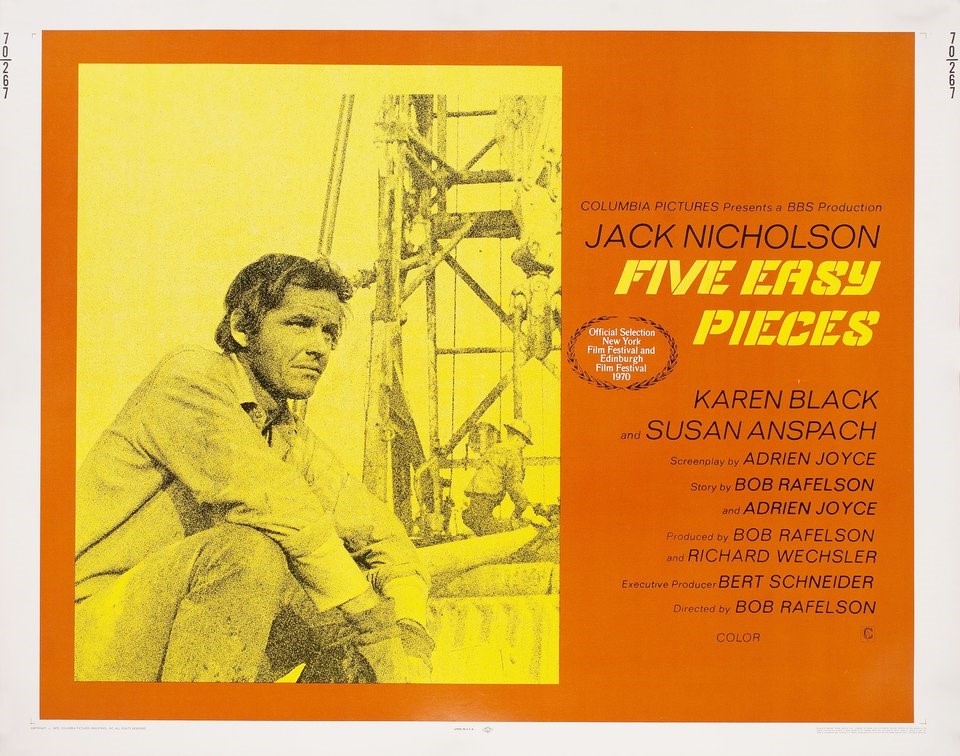
In a previous Reel Classics review of the film Easy Rider, we talked of how Jack Nicholson’s role in that film revived his acting career. It led to the starring role in this edition of Reel Classics—Five Easy Pieces. We see him as Robert Eroica Dupea, a troubled soul trying to find out who he is and where he belongs.
The film opens with Robert working on an oil rig in California, hanging out with his blue-collar friends from the trailer park and living with his girlfriend Rayette (Karen Black) who is a waitress in a local diner. After work, they gather together and go bowling and drink lots of cheap beer. His friends know him as Bobby. His friend and co-worker is Elton (Billy Green Bush) who has a partner, Stoney (Fannie Flagg) and an infant child. Rayette, though a waitress, sees herself as someday being a country music star and goes about singing Tammy Wynette songs.
We soon begin to learn that Bobby is not a happy man, and he is not who he appears to be. We learn that Bobby was born into a very well-to-do family who happen to live in a fine house on an island in Puget Sound off the coast of Washington state. They are all trained classical musicians and Robert (as he is known in his family) was trained at an early age as a classical pianist. When he reached adulthood, Robert decided that this upper-class life was not for him, and he escaped to California where he took on the appearance of a man of the working class and immersed himself in that lifestyle.
As we get to know Robert (or Bobby) we learn that below the surface he struggles with trying to discover who he really is and where he really belongs. He is not happy in his current life and often takes it out on Rayette, bringing her to tears. But we also learn that she truly loves Bobby. When Bobby learns that Rayette is pregnant he shares with Elton that he is thinking about quitting his job and taking off. Elton takes him to task stating that he needs to show some loyalty and care for Rayette and his soon-to-be child. As we get to know Bobby there are hints that he is not what he appears to be.
One memorable scene in the film finds Elton and Bobby stuck in a traffic jam on the freeway. Bobby gets frustrated and gets out of the car, running up to various other stalled vehicles. Ahead of him he sees a truck with an upright piano on the back covered with a tarp. He jumps up on the truck, throws back the tarp and begins to play Chopin.
Not long afterward, Elton is arrested for a holdup and Stoney and the child are left alone. Bobby’s frustration grows. He quits his job and ventures down to Los Angeles to see his sister Partita (Lois Smith), who is recording a classical album. She informs her brother that their father has suffered two strokes and is dying. She urges him to go visit him. Bobby travels back to Rayette to inform her of his father’s condition and tells her he has decided to travel to Puget Sound to see him. Rayette insists on going with him, threatening to kill herself if he leaves her behind. He reluctantly agrees to take her, but decides that once they arrive, he will get her a motel room as he doesn’t want her exposed to his family.

The trip north to his family’s home is quite eventful. On the way they pick up two stranded women who are making their way to Alaska: Terry (Toni Basil) and Palm (Helena Kallianiotes). Palm is a bitter person who rants on and on about consumerism, waste and the ecology. Her rants become increasingly annoying to Bobby. The four of them stop at a local diner and we witness the most infamous scene in the film.
In the diner Bobby’s order is rejected by the waitress as she tells him it is not listed on the menu and there are “No substitutions.” This exchange leads to rising anger on Bobby’s part, and he orders an item on the menu then insists that she hold the butter, hold the lettuce, hold the mayo and hold the chicken. When questioned further he suggests she hold the chicken between her knees. Needless to say, they are thrown out of the diner. Back in the car Palm tries to compliment him:
Palm: “Fantastic that you could figure that all out and lie that down on her so you could come up with a way to get your toast. Fantastic!”
Bobby: “Yeah, well, I didn’t get it did I?”
Palm: “No, but it was very clever. I would have just punched her out.”

At the family home we begin to see the dysfunction from which Robert escaped. We meet Robert’s brother Carl (Ralph Waite) who is a classical violinist, and his fiancé Catherine Van Oost (Susan Anspach), who is a classical pianist. We also meet his father, Nicholas (William Challee) who is bound to a wheelchair and appears non-responsive. A relationship develops between Catherine and Robert, but she confronts Robert with a very powerful observation: “You’re a strange person, Robert. I mean, what will you come to? If a person has no love for himself, no respect for himself, no love of his friends, family, work, something — how can he ask for love in return? I mean, why should he ask for it?”
In many ways, that observation sums up the internal struggles we find with Robert (or Bobby). Another telling moment is when Robert gets his father alone to speak to him (knowing his father cannot react or respond). He says: “I don’t know if you’d be particularly interested in hearing anything about me, my life, I mean. Most of it doesn’t add up to much that I could relate as a way of life that you’d approve of. I move around a lot. Not because I’m looking for anything, really, but ’cause I’m getting away from things that get bad if I stay. Auspicious beginnings. You know what I mean?”
As the story plays out, we see Robert’s struggles grow both with his family and Rayette, but more so within himself. As usual, no spoilers, but I will say Five Easy Pieces is a powerful film illuminating the struggles that folks may have in achieving identity and acceptance of who they are and how they fit into society. Film critic Roger Ebert summed it up very well when he wrote “The title of ‘Five Easy Pieces’ refers not to the women its hero makes along the road, for there are only three, but to a book of piano exercises he owned as a child. The film, one of the best American films, is about the distance between that boy, practicing to become a concert pianist, and the need he feels twenty years later to disguise himself as an oil-rigger. When we sense the boy, tormented and insecure, trapped inside the adult man, Five Easy Pieces becomes a masterpiece of heartbreaking intensity.”
No folks, this is not a Hallmark movie.
Five Easy Pieces was nominated for four Academy Awards including Best Picture, Best Actor (Jack Nicholson) and Best Actress (Karen Black). Jack Nicholson went on to star in several other very popular movies in the 1970s including The Last Detail (1973), Chinatown (1974) and One Flew Over the Cuckoo’s Nest (1975).
Interestingly, Nicholson’s choice for the role of Palm was Janis Joplin but reportedly she did not get the offer. Also, this was the first credited feature film for Sally Struthers who later went on to fame in the TV series All in the Family. Considered for the role of Rayette were Ellen Burstyn (well known for her roles in The Last Picture Show and Alice Doesn’t Live Here Anymore) and Susan Anspach (who was cast as Catherine Van Oost).
Never miss a thing with our FREE weekly newsletter.

In 2000 Five Easy Pieces was selected for preservation in the National Film Registry by the Library of Congress. The American Film Institute nominated it in 1998 for the Top 100 Greatest American Films. Roger Ebert has included it on his “Great Movies” list. The Internet Movie Database (IMDb) rates the film at 7.4 of 10. Rotten Tomatoes gives it an Audience Rating of 84% and a critics rating of 89%. Searching with my Roku device I found the film available for free streaming on PlutoTV. There is not a copy on the shelf at the Clark County Public Library (but I feel certain they will obtain a copy if you ask).
I’ll finish with a quote from the Turner Classic Movie (TCM) review: “In the end, Five Easy Pieces is a family portrait of lovelessness, for Bobby and everyone he infects with it as he stumbles away from pain through whatever open door may beckon. Nothing is easy for Nicholson’s alienated artist — rootless, adrift, afraid, on the lam — or for the people in his life.”
Information for this Reel Classic review was gathered from Internet Movie Data Base (IMDb), Rotten Tomatoes, Turner Classic Movies (TCM) and Wikipedia.
I’ll be back soon with the next Reel Classic, but before I leave you with the trailer below let me remind you that if you enjoy these classic movies, please join me on the second Tuesday of each month at 6 PM at the Clark County Public Library for “Ron Kibbey’s Comedy Classics.” I present a classic comedy film usually accompanied by a vintage cartoon. Popcorn and drinks are provided. More information about the next film is available on the library’s website and Facebook page, as well as WinCity Voices Facebook page.
