
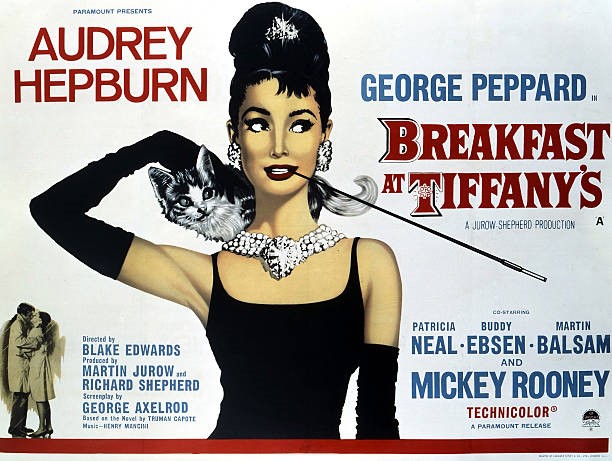
This edition of Reel Classics takes a look at Breakfast at Tiffany’s, released in 1961 and starring Audrey Hepburn and George Peppard. Included in the well-known cast are Patricia Neal, Martin Balsam, Buddy Ebsen, and Mickey Rooney. Once again we have a film with a prominent role for a pet. Orangey appears as “Cat,” Holly Golightly’s “roommate.” (Note: Orangey gets the billing but in reality was one of nine cats playing the role. Orangey won the animal actor equivalent of an Oscar, the “Patsy” award. It was given out annually until 1986 by the American Humane Society, and the very first recipient was “Francis the Talking Mule” in 1951.)
Holly Golightly (Audrey Hepburn) lives in New York City and appears to be an independent socialite who loves to visit Tiffany’s, an upscale jewelry store. She often visits with her breakfast in a paper bag—standing out front admiring the window displays. She also makes regular visits to Sing-Sing prison to provide a weekly “weather report” to mobster Sally Tomato. His cohorts pay her $100 a week to provide him the coded messages about the gang’s doings. Holly hopes to marry money and has her eyes set on a rich gentleman.
Meanwhile, a struggling writer, Paul Varjak (George Peppard), moves into Holly’s apartment building. They meet when he buzzes her apartment to be let into the building, and they talk and get to know each other while she dresses to make her weekly journey to Sing Sing. As she leaves she is introduced to Paul’s “decorator,” Emily Eustace Failenson (Patricia Neal). She is a wealthy older woman, and Paul refers to her as “2E.” Later that evening Holly sees “2E” kiss Paul and leave him some money.

As Holly and Paul get to know each other, they both learn that the other is hiding things from their past and that there is a powerful attraction between the two of them. Holly shares that she is saving money to help her brother when he is discharged from the military. She was previously married at the age of 14 to an older man, but it was eventually annulled. Paul shares that he hasn’t published anything in five years. For Holly, the attraction becomes a barrier to her goal of getting money to help her brother. Paul continues to pursue, but a couple of unanticipated events flip everything. “Cat” plays a major role in helping them to discover what they truly need and want.
Buddy Ebsen plays the ex-husband from Holly’s past, Doc Golightly, and Martin Balsam plays O. J. Berman. Another familiar face is John McGiver who plays the salesman at Tiffany’s.
Mickey Rooney plays the role of the apartment building manager Mr. Yunioshi. As years have gone by this role and character have become more controversial for the film. The director, Blake Edwards, brought the character to the film as a comedy bit. Edwards was well known for incorporating comedy into his films. He thought Mickey Rooney would be great in this role. The character was of Japanese origin, and the role was to exploit the character for laughs. Today the role is criticized as being racist. In an interview in 2008, Rooney stated that he was heartbroken about the criticism he has received. He stated “Blake Edwards ... wanted me to do it because he was a comedy director. They hired me to do this overboard, and we had fun doing it.” He said that if he had known people would have been offended by the character “I wouldn’t have done it.” Blake Edwards also commented and said, “Looking back, I wish I had never done it ... and I would give anything to recast it, but it’s there...”
On a more positive note, the appearance of Buddy Ebsen revived his career. He had been considering retiring. Ebsen was a song-and-dance man in the films of the 1930s. He also became well known as Davy Crockett’s sidekick in the Disney series in the 1950s. The role of Doc Golightly got him attention again and led to him becoming Jed Clampett in the very popular TV series The Beverly Hillbillies.
Henry Mancini won two Oscars for his music in the film, including Best Song for Moon River. In an interview, Mancini stated that he had written that song specifically for Audrey Hepburn. He was quoted as saying that while there have been many versions of the song recorded (Andy William’s version immediately comes to mind), he thought her version was the best. Mancini stated that he found inspiration in Audrey Hepburn. “It’s unique for a composer to really be inspired by a person, a face or a personality, but Audrey certainly inspires me. Normally I have to see a completed film before I’ll compose the music, but with Tiffany, I knew what to write for Audrey just by reading the script.” The scene where she is sitting on the fire escape strumming the guitar and singing Moon River is one of my favorites in the movie.

The screenplay for Breakfast at Tiffany’s was adapted from a novella by Truman Capote. It was originally set in the 1940s but was changed to be set in 1960. He wanted Marilyn Monroe to play the role of Holly Golightly. Reportedly she was originally cast for the role but was talked out of it by her drama coach, Lee Strasberg. He thought that playing the role of a “lady of the evening” would not be good for her image. Capote was reportedly very upset that Monroe didn’t get the part, stating “Paramount double-crossed me in every way and cast Audrey.” Also considered for the role were Shirley MacLaine and Kim Novak. Audrey Hepburn was offered and took the role. It turned out to be a very good choice as she was nominated for an Oscar for her efforts.
Another interesting note regarding Truman Capote. In the original trailer for the film (as seen below) the announcer mispronounces Capote’s name—calling him “Capot.” This error was used for laughs in a 1970 episode of The Mary Tyler Moore Show. Anchorman Ted Baxter (Ted Knight) complains that they need better writers and should hire “that Truman Capot fellow.” Cloris Leachman’s character, Phyllis, corrects him by just saying “E.” Ted replies “Oh yeah, Truman E. Capot.”
Steve McQueen was offered the role of Paul but was unable to accept as he was under contract for the TV series Wanted: Dead Or Alive. Ironically, by the time the film was released the TV series had been canceled.
George Peppard reportedly had difficult relationships with others on the set. He did not take well to Blake Edwards’ directions, wanting to do the scenes as he thought they should be done. It was said that the disagreements were very intense at times with the two of them nearly coming to blows. Patricia Neal knew him from the past and stated that he had changed (and not for the better). She described him as “spoiled.” She stated “His character was written with a battered vulnerability that was totally appealing, but it did not correspond to George’s image of a leading man. He seemed to want to be an old-time movie hunk.”
There is a scene in the film where Holly and Paul go to Tiffany’s. He has found a ring in a box of Cracker Jacks and tells Holly he will get it engraved for her. The production crew reportedly opened two hundred boxes of Cracker Jacks before they found a ring. The most common prize was a whistle (which Paul could have used in the scene where Holly has to whistle to get a taxi).
Another interesting scene is where Holly throws a wild party at her apartment. This scene took six days to film. There were many extras who were friends of Blake Edwards. To help the party-goers get in the spirit of the scene they were provided with champagne, 120 gallons of soft drinks, 60 cartons of cigarettes, hot dogs, cold cuts, chips, dips, and sandwiches. They had a really good time.

Breakfast at Tiffany’s was a critical and commercial success. It cost the studio $2.5 million to make and grossed $14 million. Audrey Hepburn’s role is often thought to be her most memorable role by many. She stated it was one of her more challenging roles as she saw herself as an introvert cast to play an extrovert. The New York Times review said it was a “completely unbelievable but wholly captivating flight into fancy composed of unequal dollops of comedy, romance, poignancy, funny colloquialisms and Manhattan’s swankiest East Side areas captured in the loveliest of colors.”
Never miss a thing with our FREE weekly newsletter.
Breakfast at Tiffany’s has been included in the American Film Institute’s 2002 list of top 100 America’s Greatest Love Stories and in 2012 was selected for preservation in the U.S. Library of Congress’s National Film Registry.
Internet Movie Database (IMDb) rates the film at 7.6 of 10. Rotten Tomatoes has a critics’ score of 88% and an audience score of 91%. In searching for free streaming sites I found it available on the following sites:
- Kanopy (available with a Clark County Public Library card)
- Movieland TV
- Fawesome (free awesome TV and movies)
Breakfast at Tiffany’s is also available on DVD at the Clark County Public Library.
Information for this Reel Classic review was gathered from Internet Movie Data Base (IMDb), Rotten Tomatoes, Turner Classic Movies (TCM), and Wikipedia.
Until the next edition of Reel Classics, enjoy the trailer below:
