
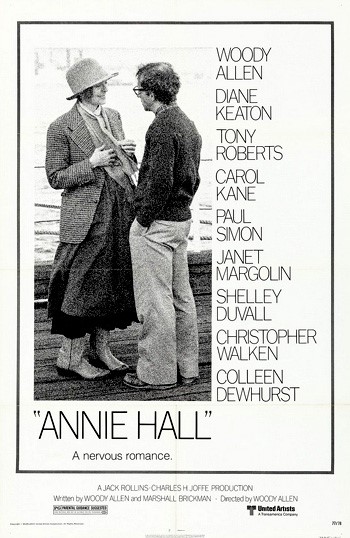
In the previous edition of Reel Classics we looked at a film described as “a classic romance.” Today we take a look at another classic described as “a nervous romance.” Released in 1977, Annie Hall features Woody Allen as Alvy Singer and Diane Keaton as Annie Hall. I would describe them both as two of our most quirky characters and actors.
The film also includes a host of well-known names including Tony Roberts, Carol Kane, Paul Simon, Shelley Duvall, Janet Margolin, Colleen Dewhurst, Christopher Walken, Dick Cavett, Jeff Goldblum and Sigourney Weaver. Quite an impressive list, eh?
Alvy Singer is stand-up comic living and working in New York City. When we meet him, he is forty years old, married and divorced twice and has just gone through another relationship break-up. We quickly learn that he is also quite neurotic and has been in therapy for many years. We explore with Alvy what he perceives to be the causes for his neuroses and difficulties in his past relationships. This includes his guilt-ridden childhood experiences with constantly arguing parents living in a home next to Coney Island in Brooklyn.
Annie Hall is originally from the Midwest and has moved to New York City with the goal of becoming a nightclub singer. As we soon see, she too has her quirks (which is a good part of her attractiveness.)
Alvy and Annie first meet on a tennis court. After playing, they enter into small talk which leads to Annie offering Alvy a ride uptown, an invitation to a glass of wine on her balcony, and increasing flirty behaviors between the two. They agree to a date after Annie does an audition as a singer at a local club. The song she sings is “It Had to Be You.” They proceed on their date, and it ends in passionate lovemaking. In typical Woody Allen fashion, he is a nervous wreck afterwards while Annie kicks back and smokes a joint.
The couple find themselves falling in love with each other. Annie professes her love and Alvy responds by buying her books on death. He professes that his feelings for her are much more than love. They eventually move in together but in time the relationship grows more tense. They eventually part ways and Alvy again tries to understand what and why things went wrong. He stops total strangers on the street asking them what they believe to be the nature of love.

In many ways it is the “quirkiness” of both Alvy and Annie that carry this film and lead to the comic scenes within. There is a scene where Alvy and Annie are waiting in line to get into a movie theater and behind them there is a man going on and on about the works of Federico Fellini (film maker) and Marshall McLuhan (philosopher). Alvy has had enough of what he perceives to be errors in the man’s statements and goes off camera to bring on Marshall McLuhan himself to refute the man.
Another unforgettable scene occurs when Annie and Alvy are at a friend’s house and the friend lays out some cocaine. Alvy is persuaded to give it a try. Alvy sneezes and the cocaine goes flying. That scene was not in the original script, but in one of the rehearsals Allen did sneeze and it was decided to keep the scene in the film. Reportedly in test runs of the film that scene was received with so much laughter from the audience that dialogue was delayed to allow the laughter to die down.
One scene that is special to me is when Alvy and Annie decide to fix lobsters at a beach house. The lobsters escape and run all over the kitchen. As Alvy tries to capture them Annie runs to get her camera and begins to take pictures of Alvy in his efforts — laughing while doing so. Why is this scene special to me? Because I experienced a very similar scene. While visiting my mom and aunt in Baltimore one summer many years ago, I bought some crabs for us to steam. They were preparing them for the pot when I heard screams from the kitchen and pleas for me to come immediately. When I got there, I saw crabs running all over the kitchen floor and my mom and aunt dancing to get out of the way yelling “Do something Ron!” I immediately ran to get my camera and began to take pictures. And yes, I did help capture the escaping crabs.
As mentioned above, Annie Hall includes a host of well-known names. This was one of the early appearances of Jeff Goldblum when he appeared in the party scene. The film was the screen debut for Sigourney Weaver. She appeared as Alvy’s date near the end of the film (no speaking part, however.) Not mentioned above in the credits is Truman Capote. A fellow passes by Alvy and he states he “is the winner of the Truman Capote look-alike contest.” In fact, it was Truman Capote.

Part of the quirkiness attributed to Annie was her choice of clothing. As it turned out, the clothes worn by Diane Keaton in the film were indeed her own. Her outfits became quite a fashion statement for a period of time after the release of the film. Woody Allen once recalled that when Diane Keaton showed up on the set the costume lady said “Tell her not to wear that. She can’t wear that. It’s so crazy.” Allen responded “Leave her. She’s a genius. Let’s just leave her alone, let her wear what she wants.”
Keaton also later proclaimed the character of Annie Hall was indeed an “affable version” of herself. She had worked with Woody Allen in several films prior to Annie Hall, including Play It Again, Sam (1972), Sleeper (1973) and Love and Death (1975). Keaton once described the similarities between her and the character of Annie Hall. She said both were “semi-articulate, dreamed of being a singer and suffered from insecurity.”
Many have thought the character of Alvy to be similar to Woody Allen as well. Both were stand-up comedians, Alvy was Allen’s nickname as a child, and they shared similar childhood experiences. Also, Allen and Keaton had been romantically involved in the past. Allen denied that the character was autobiographical. He was quoted as saying “The stuff that people insist is autobiographical is almost invariably not . . . People got it into their heads that Annie Hall was autobiographical, and I couldn’t convince them it wasn’t.”
Annie Hall was an extremely successful picture earning over $38 million — making it the 11th highest grossing picture in 1977. Not only was it financially successful, but it was critically acclaimed as well. It was nominated for five Oscars including Best Picture (won), Best Actor (Woody Allen), Best Actress (Diane Keaton-won), Best Director (Woody Allen-won) and Best Writing, Screenplay (Woody Allen and Marshall Brickman-won).

Critics reviews were very positive. The Los Angeles Herald-Examiner called it Woody Allen’s “wittiest, best film to date, both more socially and personally observant in its departure into the foibles and traumas of human relationship.” Judith Crist in Saturday Review described it as “Allen’s most satisfying creation and our most gratifying comedic experience in recent years.”
Annie Hall has continued to receive tributes as time has passed. The film was selected in 1992 for inclusion in the National Film Registry, and is listed as #2 in American Film Institute’s Top Ten Romantic Comedies. It is also listed in American Film Institute’s list of Top 100 Greatest American Movies.
Never miss a thing with our FREE weekly newsletter.
Roger Ebert has included Annie Hall on his list of great movies, stating “Annie Hall is a movie about a man who is always looking for loopholes in perfection. Who can turn everything into a joke and wishes he couldn’t.” A critic with The Guardian named it as the best comedy of all time, stating “this wonderfully funny, unbearably sad film is a miracle of comic writing and inspired film-making.” Rotten Tomatoes ranks it as #2 on their list of 25 best romantic comedies.
The Internet Movie Database (IMDb) rates Annie Hall at 8 of 10. Rotten Tomatoes gives it a critics score of 97% and an audience score of 92%.
Unfortunately, I was unable to locate any free streaming sites on my Roku device. Also, surprisingly, the Clark County Public Library does not have a copy of the DVD on the shelf. However, I’m sure they will get a copy if you ask.
Information for this Reel Classic review was gathered from Internet Movie Data Base (IMDb), Rotten Tomatoes, Turner Classic Movies (TCM), and Wikipedia.
I’ll be back soon with the next Reel Classic, but before I leave you with the trailer below let me remind you that if you enjoy these classic movies, please join me on the second Tuesday of each month at 6 p.m. at the Clark County Public Library for “Ron Kibbey’s Comedy Classics.” I present a classic comedy film usually accompanied by a vintage cartoon. Popcorn and drinks are provided. More information about the next film is available on the library’s website and Facebook page, as well as WinCity Voices Facebook page.
