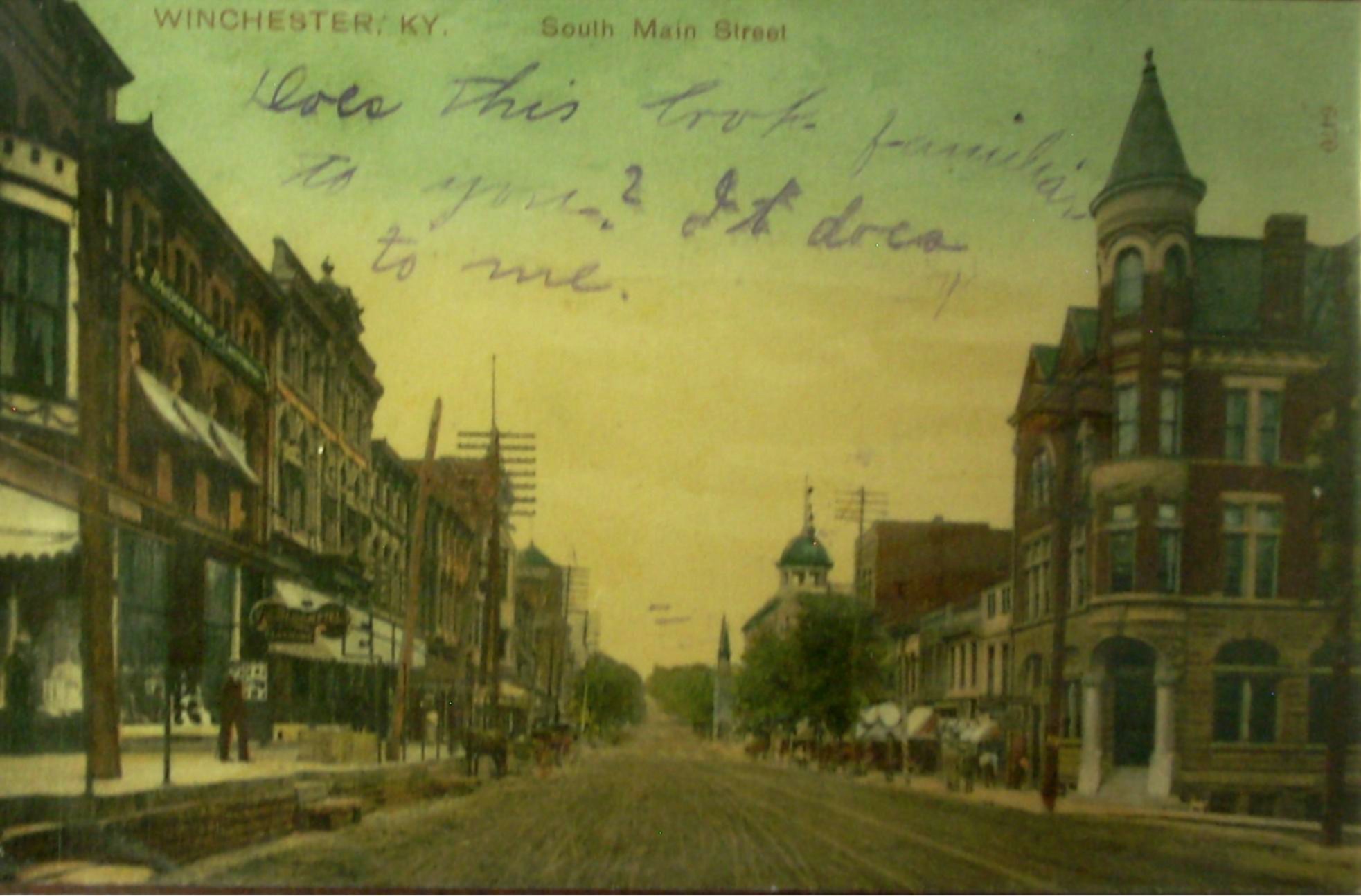
The first known picture postcard was created in France in 1870, and initially, the industry grew slowly. The golden age for postcards in the US occurred from about 1905 to 1915, during which about one billion were sent. Postcards had gotten a major boost when the Post Office decreased the cost of mailing from two cents to one cent, and improvements in color photography and printing made high-quality images possible. Postcards from this era are prized by collectors (they’re called “deltiologists.”)
I scanned the collections archived at the Clark County Public Library (donated by Bob Coney) and the Bluegrass Heritage Museum (donated by Mac Starnes). I found the most prolific purveyor of Winchester postcards was the S.H. Kress Company, known for its five-and-dime department stores across the country. The richest source in Kentucky was the Ferguson News Company of Lexington.
Most interesting to me were several Winchester vendors of postcards. These included H.H. Phillips, E.E. Kidwell, and several local businesses. Phillips’ postcards accompanying this article were produced during the heyday of popularity, postmarked between 1906 and 1908.
Henry Harrison Phillips (1867−1931) was the son of T. F. Phillips, who kept a drugstore in Winchester for forty years. (His enumerable advertisements featured an assortment of patent medicines guaranteed to cure just about anything.) Henry worked for his father until 1895, when he opened a drugstore of his own in Millersburg, his wife’s hometown. The year 1902 found him back in Winchester. He gave up the druggist profession and purchased a “news business,” a store offering books, magazines, newspapers, stationery, and postcards. In 1913, he changed occupations again, going to work at the Citizens’ National Bank, where his father had been a founder and longtime director.
Returning to Phillips’ postcard venture, we can speculate about the sequence of events involved. While H.H. Phillips was listed as the publisher, he would have had to hire someone to take the photographs or prepare the artwork. During that period, the best-known photographer in the city was A.J. Earp; another professional, B.S. Barrett, advertised specifically for making photographs for postcards. However, only one of Phillips’ postcards listed a picture credit: F. Earl Christy, a prolific early 1900s illustrator in New York City. This is also the only Phillips postcard with artwork rather than a photographed scene.
During the period before World War I, most postcards were printed in Germany. A PCK-peacock logo appears on the back of all but one of Phillips’ postcards. These were the work of the Paul C. Koeber Company of Kirchheim, Germany. Their postcards often feature schools, street scenes, or notable buildings. Prized by collectors, they also provide valuable visual evidence of the time period.
The Kentucky Wesleyan postcard with the lady holding a KWC pennant had a different printer: Raphael Tuck & Sons, widely recognized pioneers in the picture postcard industry. Although the company was located in London, they had their printing done in Saxony, Germany.
Postcard Gallery