
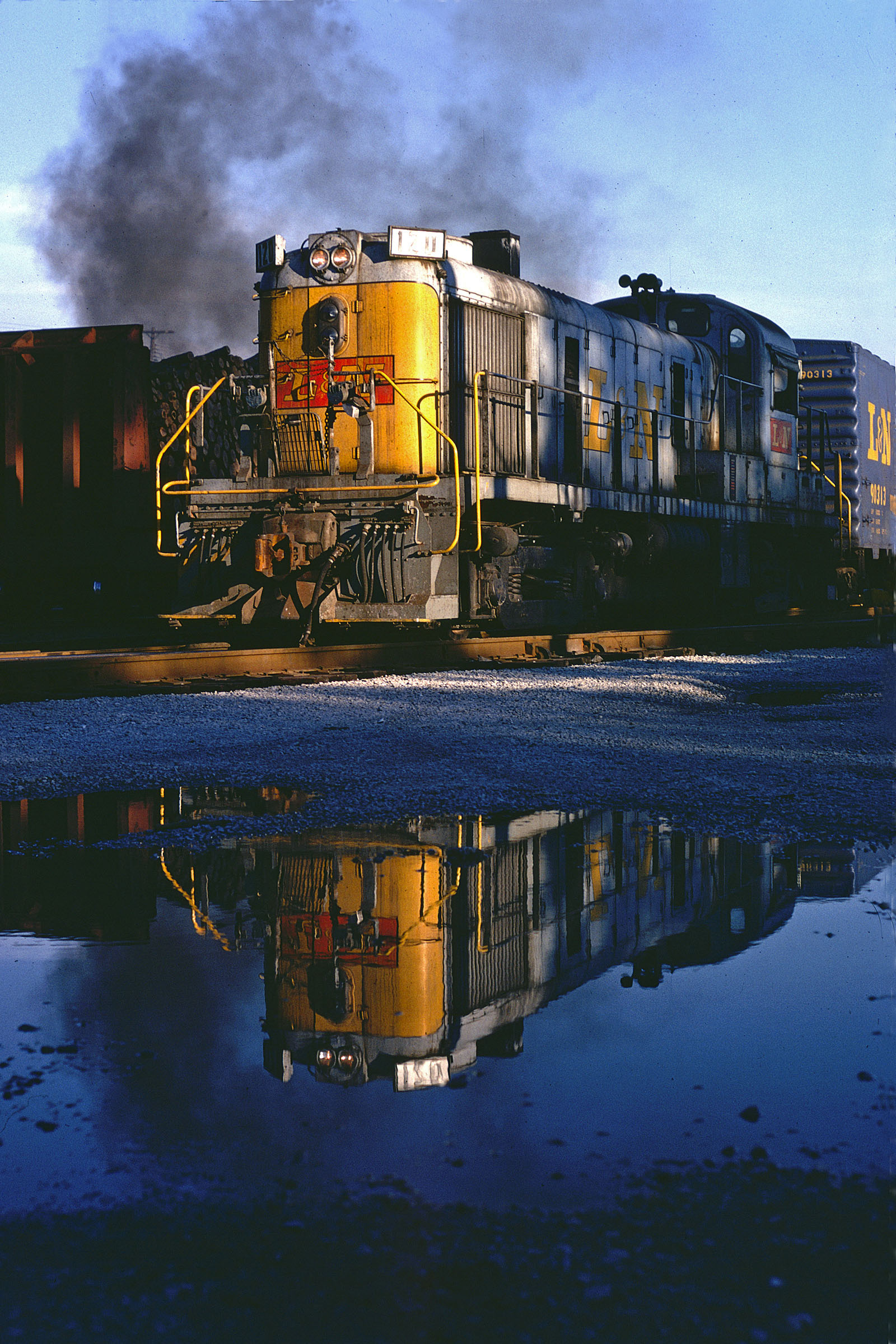
One of the major functions of the Patio yards was making up coal trains headed to or coming from the eastern Kentucky coal region. The L&N line to Ravenna and Hazard, known as its Eastern Kentucky Division, became their major coal route. After passing through Hazard, trains had access to the mining areas of Perry and Letcher Counties, and served the colorfully named coal towns of Jeff, Viper, Leatherwood, Blackey, Mayking, and Fleming-Neon.
During World War II, coal fueled the nation’s defense industries. Though hard to imagine today, in 1942 approximately 1,500 coal cars passed through Patio each day.
For more efficient transport, railroads later adopted unit trains that carried a single commodity. Coal trains of 100 or more cars stretched over a mile long. They could carry 10,000 to 15,000 tons of coal from mines to electric generating plants.
As the Louisville & Nashville Railroad grew to a 6,000-mile system, it became a vital transportation link between the Gulf Coast and the nation’s heartland. Its reliable service earned the nickname, “The Old Reliable.” Then came the era of corporate mergers.
While the L&N’s rail lines are still in use today, the company itself no longer exists as a corporate entity. In 1982 the L&N was absorbed by the Seaboard Coast Line. Then in 1986 Seaboard merged with the C&O and B&O (the Chessie System) to become CSX Transportation.
In recent times, coal markets have dwindled, and the number of coal trains coming through Patio has also declined. In 2016 CSX idled a large section of the Eastern Kentucky Division, and it seems likely that the future will bring more closures.

I am grateful to rail photographer Garland McKee for permission to reproduce his work in this series of articles. Garland lives in Lexington and, after fifty plus years, still goes on the road to photograph trains.