
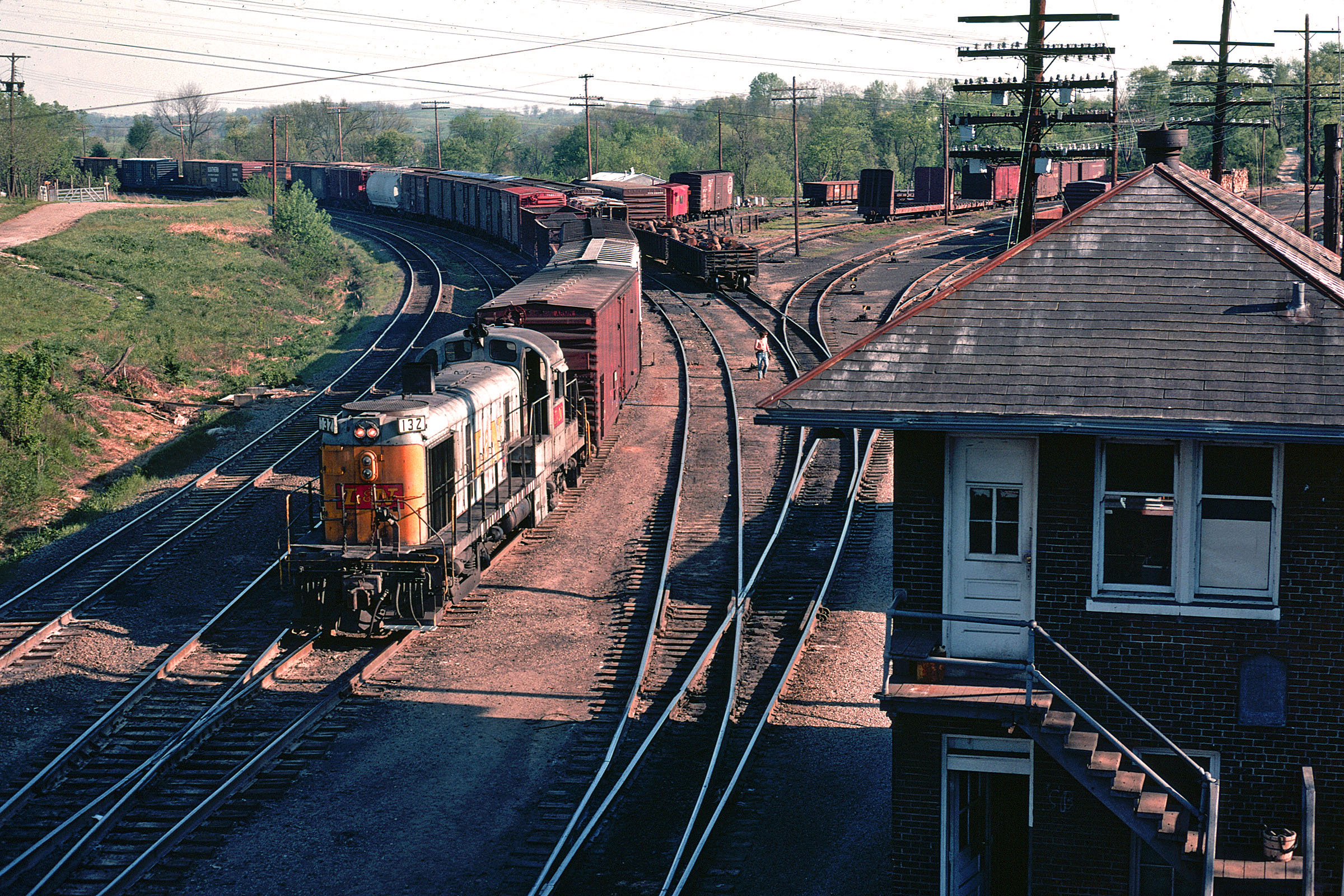
The Louisville & Nashville Railroad provided most of Clark County’s rail service for many years. The company acquired the north-south route of the Kentucky Central (Cincinnati to Richmond) in 1890. They followed by purchasing the Lexington & Eastern (Lexington to Jackson) in 1910. Then in 1914 L&N built a new line from Winchester to Ravenna that would eventually extend into the coal region of East Kentucky. Thus did Winchester become an important rail center.
Several months ago, retired librarian, Andy Gary, gave me a lovely picture book for railroad lovers (like me): Ron Flanary’s Louisville and Nashville in the Appalachians (1990). The book has numerous photographs taken in Clark County that I thought would be worth sharing. I am extremely grateful to outstanding rail photographer, Garland McKee, for giving permission to reproduce his work in this series of articles.
Patio Tower
With the L&N’s expansion in Winchester came the need for a yard to handle and coördinate rail traffic. They established the Patio Yard to accommodate switching operations needed for making up trains and to provide a central control point. Railroad men referred to Patio as “the graveyard,” no doubt due to the three African American cemeteries immediately south of Patio: Daniel Groves, Reeves Memorial, and the Colored Paupers Graveyard. The latter became the burial site for many black men who died on the job while working on the L&N’s 1914 expansion line to Ravenna.
The most important building at Patio was the interlocking tower built in 1916. These were once a vital component of rail systems. They provided a central point for coördinating signals on a busy section of main lines. Here operators could set the signal devices and switches to ensure safe passage of trains through crossing points.
Improved technology, especially the advancement of computers, made these towers unnecessary. The Patio tower was razed in 1992.