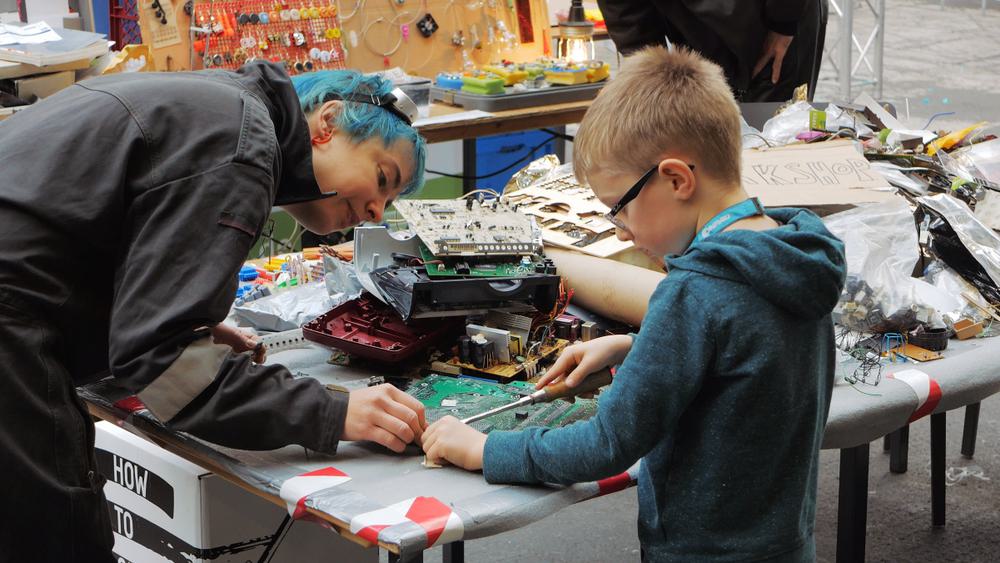

I often hear from folks in town who want more third spaces that foster creativity, engagement, and community building. We have restaurants, a few theaters, a reading room, and a public library, but one thing we seem to lack is an affordable location to breathe life into projects. With the increased use of predatory AI, many people are looking to escape the slop, get off the internet, and learn new skills the old-fashioned way.
I’ve written before about how reducing consumption through choices like prioritizing buy-nothing groups, tool sharing, and community teach-ins can change how we interact with one another for the betterment of our community. Though not often talked about outside of big cities, other towns are already building Makers and Hackers spaces to empower one another to take up tools from various crafts and trades and provide hands-on learning experiences. For those unfamiliar with the concept, let me share a few details about how these spaces change towns for the better.
What is a makerspace?
A Makerspace can take many forms. It can be adaptable. It can change over time, but ultimately it is a space where people can use tools, book time to work on projects, and craft beyond what they may be able to accomplish at home or with limited resources. For some, it’s sewing machines, teaming up with other quilters, and studio space for mixed-media art. For others, it’s CNC machines, woodworking tools, perhaps a forge with lessons from a local blacksmith. Examples nearby can be found in Lexington and Berea.
The Lexington Makerspace contains a woodshop, pottery wheels, and 3D printers. They offer classes on a rotating schedule, and membership starts at $65 a month. A bit costly for many of us, but they’re focused on their local market. There’s also The Eastside Branch Makerspace, part of the Lexington Public Library network, that teaches everything from sign making to sewing to engraving.
At the Berea Makerspace, the focus is on tools, resources, and knowledge. Their makerspace has a robust tool library that provides people with opportunities to learn how to repair things and work safely. The forge classes stand out as a unique offering where members can learn from local blacksmithing legend Bob Montgomery, who has had a long and fruitful career creating beautiful metalwork featured throughout the region.
All of these spaces have programming that helps to not only create life skills but also long-term skills that can benefit us all. Because it is unreasonable to expect many Clark County residents to drive out of town to access these resources, I believe we should have our own space, and I hope to be part of the network that builds it. We have so many talented locals who, with a little support, could help build our creative arts scene into something that benefits all of Winchester through increased events, tourism, and cultural development.
Are there pros and cons to creating a makerspace?
Absolutely. Makerspaces require dedicated staff, volunteers, and teachers who are prepared to invest in the long term. It takes transparency from members and strict enforcement of safety protocols to prevent novice makers from potential harm. Often this includes the use of closed-system cameras (CCTV, not Flock or Ring), tool checkouts, and dedicated chore charts for maintenance and cleaning. It also means each member has to take on some personal accountability for their own safety and the well-being of themselves and others.
Back when I lived in Texas, I visited the Austin Hackerspace many times with a friend who was a member. Their high regard for safety is what kept me coming back as I learned new skills week by week. If you visit a makerspace that doesn’t enforce use of PPE, get out while you still can. Cutting corners during production and half-assing safety protocols tends to get people hurt.
Depending on how grants and funding are structured, the cost of operation is often paid for in part by members. Sometimes those costs can be subsidized by strategic investment funds, city grants, or other forms of support. As with many local-level ventures, egos and selfish intentions can come into play.
All the more reason to prioritize transparency and operations protocol.
The biggest pro is, of course, the immediate return on social investment. Makers come in many forms and from many backgrounds. At a time when so many things are culturally divided, finding what we have in common is what keeps our community strong and united. Who knows what you could learn or who you could learn it from! Some surprises are good ones, especially within the creative process we humans love.
What’s the difference between a makerspace and a hackerspace?
Some of you may be familiar with both of these terms, which are often used interchangeably. The terms “shop” and “lab” are also used in similar ways, but there are some distinctions.
Hackerspaces tend to be tech-focused and rely on the interests of programmers and coders. Not “hacking” in the sense of those Scam Likely calls we all reject every day, but more the development of open-source programs, accessible resources, video games, repair of hardware, ag tech, and small-scale apps. Some makerspaces will dedicate a corner of the workshop to tech, but, really, the use of the space is dictated by each community’s needs. In Winchester, there is an obvious need for more accessible tech outside of the clutches of Altman, Elon, Zuckerberg, and friends.
Never miss a thing with our FREE weekly newsletter.
Shops and labs are often larger workshops that focus more on laser cutting, CNC machinery, and large-scale production. While this could seem like an interesting venture, it is an extremely heavy lift for a community our size. Often, these are the hardest to fund and require the most permitting to get started. They are also the most vulnerable to financial collapse in the event of an injury or liability issue.
So how do we get a makerspace going here?
The first step is learning from those who have successfully done this before. This is a journey I’ve already begun, and I encourage you to do the same. Take free classes, visit open houses, ask your crafty friends where they go to learn, and skillshare.
If we find there is enough interest to launch, then we talk to our officials about what permitting is required and which industrial spaces might be open to establishing that relationship. If you are interested in helping to build a new chapter in our city’s history book, please complete this survey for more information and to be updated on the development process.
Survey link: https://forms.gle/JG67CZiQQzQhgTrr8