
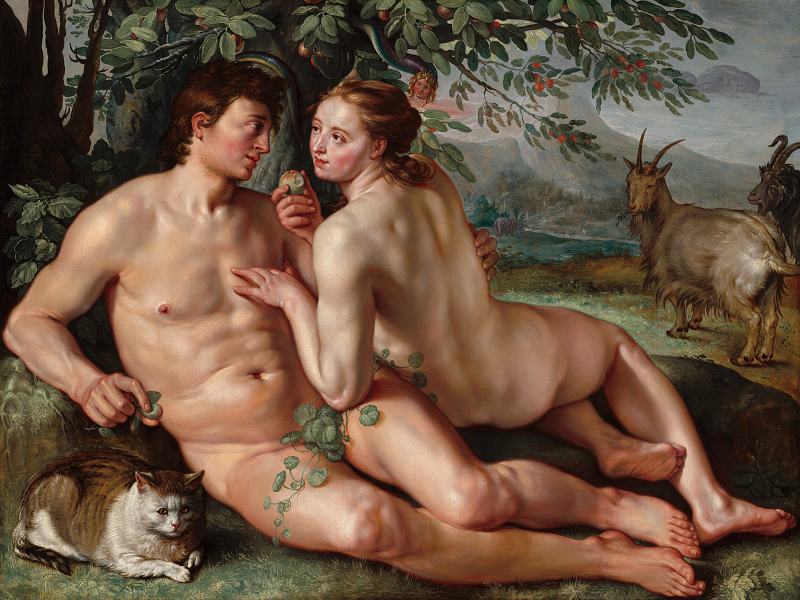

As I was slicing an apple yesterday, I started thinking about poor Eve and how the patriarchy really screwed her over.
For centuries, the Book of Genesis has been relayed as a cautionary tale about women who want too much, who reach too far. Eve becomes the first to err, the first to tempt, the one whose curiosity fractures paradise. From pulpits to paintings, her hand extends toward the fruit as if toward evil itself. And somewhere along the way, the story hardened into a quiet justification for mistrusting women’s voices, bodies, and desires.
But that interpretation says more about the storyteller than the story.
In the Book of Genesis, the apple is never actually named, and Eve is never described as uniquely flawed. Perceptive and attentive, she sees that the forbidden fruit is good for food, pleasing to the eye, and desirable for gaining wisdom.
She isn’t corrupt, only curious. She questions the boundary she has been given. In a narrative that has often been used to reinforce obedience, her curiosity reflects a deeply human desire to know and understand.
“To defend Eve is not to rewrite the story, only to read it more fully. To see in her not a warning against curiosity, but an invitation toward it. To recognize that the impulse to know, to question, to reach beyond what is given, is a force that shapes everything we are.”
Erin Skinner Smith
The apple enters the story much later, shaped by language and imagination. When Jerome translated the Hebrew into Latin, he used malum, a word that can mean both apple (mālum, with a long “a”) and evil (mălum, with a short “a”).
It is a linguistic coincidence that became a cultural verdict. The difference rests on a subtle shift in pronunciation, invisible on the page. In that ambiguity, something profound took root. The fruit of knowledge and the concept of wrongdoing became entangled by language but not doctrine.
It’s no coincidence that Jerome was a scholar of Tertullian, an early Christian who famously called women the devil’s gateway based on the story of Genesis. Tertullian’s rhetoric became a cornerstone for gender inequality in the church, casting women as inherently sinful.
To control the story of God was to control inheritance, marriage, sexuality, leadership, and law. Patriarchal societies depended on stable hierarchies, fathers over households, kings over nations, priests over worship. A spiritual tradition in which women spoke with divine authority would destabilize that order.
So the image of a disobedient Eve with an apple began to circulate, written down by monks and sung by traveling bards. Medieval artists took up the story and gave it form. In carvings, paintings, and engravings, the fruit became a round, luminous apple. This image echoes to this day, always to justify the oppression of women.
But back to Eve, who was probably just hungry, for both sustenance and consciousness. She wanted a life of reflection, purpose, and meaning. Without her, there is no history, no art, no questioning, no transformation. To cast her as the villain is to misunderstand the cost and necessity of awakening.
The whole thing just reeks of the patriarchal suspicion of any woman who questions authority. Across time, systems of power have often depended on discouraging inquiry, framing curiosity as dangerous when it disrupts established order.
Never miss a thing with our FREE weekly newsletter.
Eve refused a world in which she is not allowed to know and that refusal has been recast conveniently as blame. But blame simplifies complexity, forcing responsibility on a single, marginalized figure. Eve becomes the warning, while poor Adam — and thus all of humanity — is simply led astray.
To defend Eve is not to rewrite the story, only to read it more fully. To see in her not a warning against curiosity, but an invitation toward it. To recognize that the impulse to know, to question, to reach beyond what is given, is a force that shapes everything we are.
If there is something subversive in that, it is only because it has always been easier to control a story than to honor its depth.
But Eve’s story resists control. It asks us instead, What does it mean to wake up?