
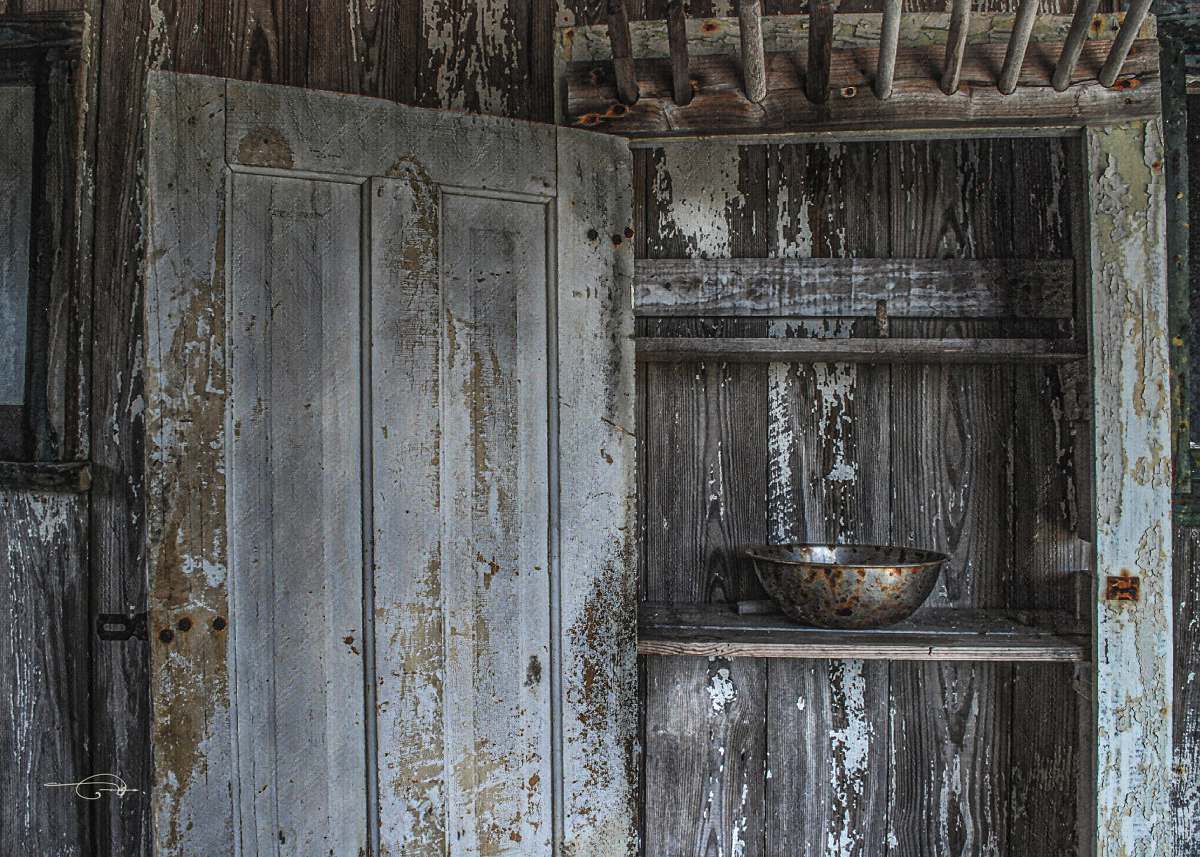
A recent lunch with a dear friend turned to a discussion of art objects. “I like square bowls,” she said, showing me a picture on her phone of a hand-built, ceramic piece she liked. Her remark prompted me to think about the bowls in my life. So often taken for granted, it strikes me that bowls are fundamental.
I discovered the stainless-steel vessel pocked with rust accompanying this missive in an abandoned house on North Carolina’s Outer Banks. The sea air had been doing its job on the house and its contents for a long, long time.
Most bowls in my life are not as lonely as the one pictured. Many have been ride-alongs for decades. I have had a basic white set of eight cereal coupes by the German company, Arzberg, since the 1980s. They are shallow, daily, go-to bowls for everything from egg-whipping to oatmeal. Their number had been dwindling, as years and granite counter tops took their toll. The pattern was discontinued in 2017, so they are a tough find, but I located three pristine examples recently. I can breathe easily again.
Other bowls in inventory are not mundane. One nice white bowl decorated with blue arabesques was given to me by Nina Leonidovna Stromova during a visit to her home in Vinogradivka, Ukraine. I was in the back country documenting traditional stories. As my ethnographer colleagues and I climbed back into our four-wheel-drive Renault wagon, Nina came running up to the car with the gift-bowl brimming with honeycomb from her apiary. Today, the bowl stays full of grape tomatoes. I think of Nina and the rockets flying over her village every time I grab a snack.
I have a large kitchen bowl by Mossy Creek, Georgia, potter Lanier Meaders. He is most esteemed for his folk face jugs, some of which are in the Smithsonian. A piece of his kiln fell into my bowl during firing. It became a white glob in the bottom of his stone black art piece. I wonder if he was disappointed. I’m comfortable with wabi-sabi.
Never miss a thing with our FREE weekly newsletter.
Drawn to the magnetic possibilities of artistic conical creations, I have them in wood and clay by artists near and far. Several of my favorites are were turned and fired by Ashley and Carvel Norman at Dirty South Pottery here in Winchester. They birthed hundreds of bowls for the annual Empty Bowls fundraiser at First Presbyterian Church. It is special when local art and good deeds collide to build trust and belonging in our community.
Other bowls portend more ominous fortune. I am holding on to four circa 1999 pastel French Retroneau bowls like my life depends upon it. One member of the quartet has an invisible hairline crack. I keep it in the cabinet as a prayer, even though it thuds instead of rings when tapped with a spoon. When will it fail? Some of life’s mysteries are unknowable.
Whether ceremonial and sacred, ordinary or ornate, bowls embody the intent of their makers and deliver joy whether feeding us, warming our hands, or decorating a shelf.
I am surrounded by the shapely artifacts. Some embrace jade plants. Artist Bob put a slash in his creations to cry out in human angst. Terry’s little blue compote is always full of garlic cloves. Mitzi’s hands became so tired that she had to stop shaping clay on her wheel, but her brown crock still reminds me of her last days in the studio.
We have been living with bowls for 18,000 years. No doubt you have your own collection. I am certain that like mine, your bowls have many interesting stories to tell.