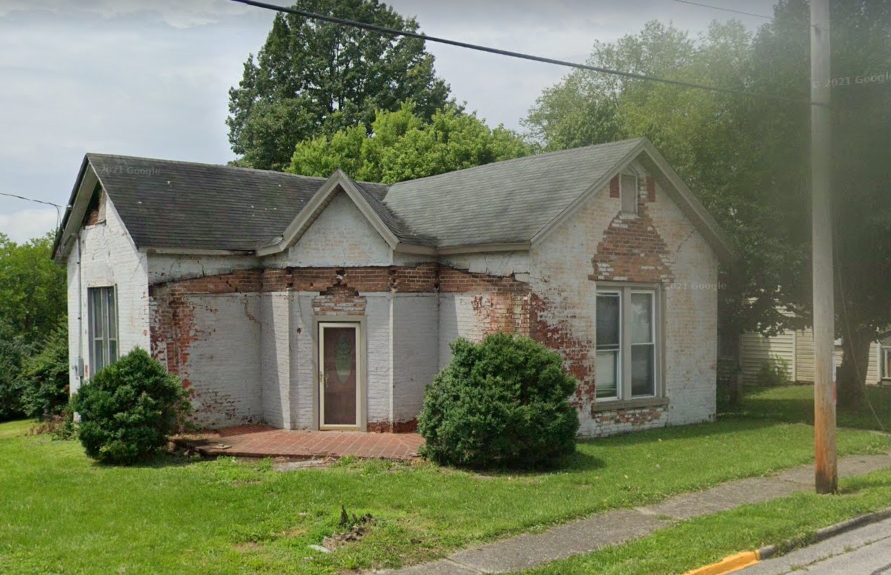
This is the third in a series documenting some of Clark County’s abandoned places.
Several weeks ago at the library, I stumbled upon a book called Abandoned Kentucky by Jay Farrell. According to the author, “Abandoned structures are places that open the imagination and invite interpretation. While often overlooked by passers-by, their skeletal remains act as the perfect subject for the camera, quietly waiting to be captured and shared.”
Farrell, a Nashville resident, focused his camera on southern and western parts of Kentucky. The need to seek abandoned structures in Clark County fairly hollered out at me. So with Clare at the wheel and me behind the lens, we were off. With so many targets of opportunity, the results will have to be shared in a sequence of WinCity articles.
[Editor’s note: This image gallery displays well on desktop or laptop computers and larger mobile devices. On phones, the experience will be degraded; we apologize for this, but it’s simply a limitation of the gallery software we employ and the realities of displaying images with text.]

115 E. Lexington Ave.
This building at the corner of Lexington Avenue and Hodgkin Alley is something of a mystery. Erected in the 1940s as an apartment building, it has been unoccupied for many years. The city came close to demolishing it, but last year a new owner started making improvements. At this time, it still appears to be abandoned.

William Taylor House
William Taylor, an early cloth manufacturer, lived on Lower Howard’s Creek. His house, pictured here in the 1970s, is one of the numerous stone structures built in the Bush Settlement. (photograph from the Robert F. Collins Collection)

Taylor House ad in the Kentucky Gazette
The house dates from before 1802, the year Taylor offered it for sale along with his fulling mill, grist mill, still house and farm.

Taylor House 2005
The old house, long abandoned, is slowly succumbing to the elements.

William Clinkenbeard House
This historic house, which still stands on Paris Road, was the residence of William Clinkenbeard, one of the first settlers of Strode Station. Clinkenbeard left an interesting recollection of early times in Clark County.

Greenhouse
This greenhouse, former home of Winchester Florists on Old Boonesboro Road, has not been a going concern for many years.

Barn on Waterworks Road
Old barns provide excellent photo opportunities. This one is barely standing on Waterworks Road.

Barn on Paris Road
Clark County has many picturesque old barns like this one on Paris Road.

Barn on Old Boonesboro Road
This derelict barn on Old Boonesboro Road stands on farmland that has been converted to a rural residential area.
Never miss a thing with our FREE weekly newsletter.

Garage at Sewell Shop
This garage on Mt. Sterling Road appears to be abandoned. It is close to the site of the now demolished Sewell Shop and the Sewell House that stood nearby.

House at Jackson Street and Jefferson
William Gilbert, a Winchester grocer, purchased the corner lot at Jackson and Jefferson Streets in 1907 and built a house on it. In recent years this attractive house fell into disrepair and was abandoned. I took this picture about a year ago. When I went back last week to get an up-to-date photo, I found only an empty lot.

Redmond House
The Redmond House stands about a half mile back off the road to Mt. Sterling (US 60). The Kentucky Heritage Council estimated the oldest portion was built about 1790; they got the house listed on the National Register of Historic Places. That was not enough to save it, however, as it appears to be headed downhill.

Vanmeter House
This house on Paris Road belonging to William Vanmeter is shown on an 1877 map of Clark County, but is missing from the 1861 map. At present the house is being allowed to return to nature.

Root cellar
This stone structure on Mt. Sterling Road appears to be the remains of an old root cellar. The house that once went with it is long gone.