
The Muckletonian Club was organized in 1870 by a group of Winchester sportsmen. Sometimes called a rod and gun or fin and feather club, they gathered twice a year for hunting and fishing expeditions in far-flung places and more frequently for weekend outings.
I’ve often wondered where “Muckletonian” came from. One member stated that the club’s name was “one of the Eleusinian Mysteries and past finding out to the uninitiated.” A newspaper article speculated that “the club, no doubt, derives its name from the muckle game its members capture,” whatever that means.
According to the Oxford English Dictionary, muckle can refer to eminent people, and to muckle about is to mess around or waste time. Both meanings could apply to the Muckletonians: The group was composed of prominent local men who gathered regularly for outdoor recreation.
The club elected Robert N. Winn, president; M. G. Taylor, treasurer; Lee Hathaway, secretary; and G. R. Snyder, commissary. Members included well-known lawyers, bankers, druggists, merchants, and farmers. Their banquets often featured a game menu. One held at the Rees House consisted of grouse, woodcock, pheasant, mallard and canvas-back ducks, trout, red snapper, and red deer.

The club was known far and wide and attracted frequent out-of-town visitors. In 1880, for example, they entertained Gen. Fitzhugh Lee (son of Robert E. Lee). Muckletonians hunted in all parts of Kentucky, but also organized trips to Tennessee, Arkansas, Florida, Minnesota, and Colorado. Due to a singular event, the outing to Colorado in 1878 garnered coast-to-coast newspaper coverage.
Club historian Lee Hathaway published a pamphlet on the outing entitled “The Muckletonians in the Rocky Mountains in 1878.” The trip schedule called for three weeks of hunting in the mountains. Fourteen members went — R. N. Winn, James D. Gay, David A. Gay, John J. Eubank, A. H. Sympson, George R. Snyder, Robert J. Snyder, Ben Goff, T. F. Phillips, Grant Jackson, Lee Wheeler, M. G. Taylor, and Lee Hathaway — along with their guests Dr. James Sympson, Rodney Haggard, James S. Winn, Weed Gay, and two African Americans, Robert Brown, the club’s cook, and Thomas Brown, their waiter.
On August 27, they left Winchester on the Big Sandy Railroad. At Louisville, they transferred to the Ohio and Mississippi Railroad and arrived in St. Louis on the 28th and Kansas City on the 29th. From there, they took the Kansas Southern for the trip across the Great Plains and arrived at Denver on the 30th. Then they boarded the Colorado Central R.R. and headed west into the mountains, reaching Golden on the 31st.
Continuing west, they entered the thirty-foot-wide Clear Creek Canyon cut through granite that rose to 600 feet high on either side. A roaring stream ran through the rift, dropping 300 feet per mile. On September 1, they reached Georgetown, where they witnessed miners panning for gold.
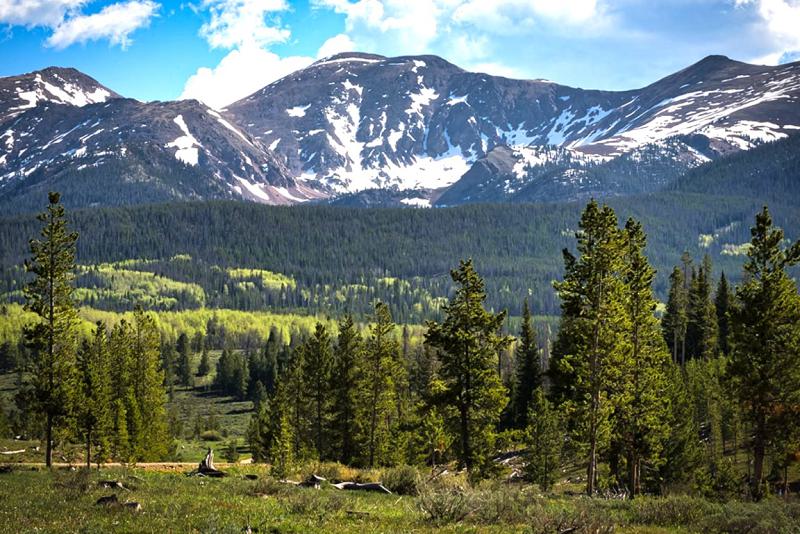
At this point in the journey, they continued on horseback with their supplies loaded on ten wagons. A winding road carried them up to Berthoud Pass, elevation 11,350 feet. At the summit, they stopped at a log cabin, normally snowed in for seven months of the year, where they enjoyed a repast of venison and grouse.
They next descended the mountain and went into camp for the first time on Frazer Creek. Here, the Muckletonians began their stay on the western slope of the Rockies in Middle Park, a 150- by 250-mile scenic basin abounding in elk, antelope, buffalo, deer, and small game. They enjoyed their first antelope steaks prepared by Bob Brown.
Then came a sudden change of plans.
After gold miners flocked to this area in the 1860s, the Ute Indians were driven to a reservation in the southwest corner of Colorado. They occasionally left the reservation to hunt in their old homelands in Middle Park. In late August 1879, a dissident band of roving Utes began stealing horses and driving farmers from their homes; they followed this with the murder and scalping of nineteen men.

On the first of September, the day the Muckletonians pitched their tents, the sheriff of Grand County sent them a warning that seventy-five of these Utes were camped just five miles away. U.S. Troops were called in from one hundred miles away, and while a local posse tried to keep the Utes in check, the sheriff advised the club to give up their hunt.
Before leaving, James D. Gay found one of the Indians’ abandoned camps and collected some of the belongings they had left behind. In 2021 Gay’s great, great granddaughter donated these artifacts to the Grand County Historical Association.
Never miss a thing with our FREE weekly newsletter.
Hathaway described what happened next.
“After three days spent in Middle Park, we folded our tents and left reluctantly for Georgetown, believing it was not prudent for us to scatter far hunting and fishing as matters then stood with the Indians. Having been cheated out of our hunt, we decided to turn our attention to sightseeing for a few days and then start for home. Our first visit was to Gray’s Peak, fifteen miles from Georgetown. Its summit is reached by a winding trail, up which a horse labors and man gazes and wonders. We soon reached the land of perpetual snow.”
At 14,276 feet, Gray’s Peak is the highest point on the Continental Divide. From its summit, the Mucks could view Long’s Peak, Pike’s Peak, and the Mount of Holy Cross.
They donned winter clothing for the crossing, then descended the mountain. One recalled that Weed Gay took off down the hill at breakneck speed, causing their guide to exclaim, “I never saw such a d—-d fool on this mountain before!”
The club visited Green Lake, Colorado Springs, Garden of the Gods, Manitou Springs, the Devil’s Punch Bowl, Queen’s Canyon, and Rainbow Falls before returning to Denver to begin the journey home.
The Mucks kept the club going well into the 1890s. By 1900, with eighteen of the original twenty-five having passed away, the Muckletonians finally ceased to exist.