Kentuckians volunteered in large numbers during the War of 1812 and played a significant role in the outcome of America’s “second Revolution.” Approximately 25,000 Kentucky men saw some type of military service. Our state’s casualties exceeded all the other states, largely due to two disastrous battles and their aftermath which involved the slaughter of prisoners—the River Raisin Massacre and Dudley’s Defeat. Clark County certainly did its part in the conflict, raising ten companies headed by John Martin, Wiley Brassfield, Isaac Cunningham, James Sympson, Samuel R. Combs, Leslie Combs, Thomas Wornall, John V. Bush, Robert Scobee, and Joseph Clark.
William Joseph Clark (1776−1813) was the son of James Clark, a native of Antrim, Ireland, and Alice Lockhart. James Clark settled in eastern Clark County, in the area between Schollsville and Hedges Station. Joseph came out with his father from Virginia in 1792, then stayed with the horses and cattle while his father went back for the rest of the family.
Joseph Clark married Jane Frame, daughter of John and Elizabeth Frame, and settled in the area near his father’s plantation. Joseph acquired landholdings in Clark and Montgomery and owned a gristmill on Lulbegrud Creek. The ambitious young man also read for the law and became a practicing attorney in Winchester. He and Jane had four children.
We would know little more about Joseph were it not for a remarkable journal he kept on a trip to Missouri as an agent for the widow, Sarah Swinney. By way of background, her husband, James Swinney, was involved in numerous business ventures. He built a gristmill on Stoner Creek and established a village nearby, Swinney’s Town, that later became North Middletown. He had extensive operations on Red River at the future site of Clay City. These included a gristmill, sawmill, gunpowder mill, a boatyard, and a warehouse for inspecting flour, tobacco, and hemp. In March 1804, he sold his mills to Robert Clark Jr. and William Smith, who would go on to erect an iron furnace, Kentucky’s second, at this location. Swinney died unexpectedly later that year. His wife Sarah appointed Joseph Clark to collect all the debts owed to her deceased husband.
On December 18, 1804, Joseph set out on Sarah Swinney’s behalf to take a deposition of the famous pioneer Col. Daniel Boone, then living in the Louisiana Territory in present-day Missouri. While on his journey, Joseph kept a record that he called “Memorandum of my travels and Expenses.”
(In quoting from the diary, I have kept his original spelling for its charm but added some punctuation to improve readability.)
He arrived in Springfield, Washington County, the day after Christmas and was delayed more than a week by bad weather. Rain turned to sleet followed by 18 inches of snow. Joseph paid 50 cents for some tow linen “to make a bag to Carry Corn for my horse through the wilderness.” He followed a southwesterly course with a friend, Edward Cheatham, and arrived at Clarksville, Tennessee. There, he said,
I Could get no dinner until after night, then I went and Robd the Cook Shop and we had a hell of a ball, and the dregs of impoliteness were the managers, although we had wine and Cherry bounce a plenty. Thus faird por Clark & Cheatham in a Cursd litt town where they Could get nothing and had to pay high for that.
Cherry bounce, a popular drink of the time, was a mixture of brandy, cherries, and sugar. Joseph followed the Cumberland River to the mouth and crossed the Ohio on a ferry. His first night in the Northwest Territory was spent in poor accommodations.
The pigs ware under the floor Biting the Childrens toes through the Cracks and the Gees in the other room biting the peoples noses and the Sows Sleeping in the poarch.
Joseph traveled to St. Louis and then 30 more miles west to the Femme Osage, where Daniel Boone had settled with his extended family. Joseph arrived there on February 5 and “Staid all night at Johnathan Bryants,” Boone’s nephew. Of his interview with the famous explorer, he left nary a word.
After taking Boone’s deposition, Joseph went down the Mississippi to Cape Girardeau to attend court.
Staid Untill Evening and Could Get Nothing to Eat for Such a Curs place & Court No man Ever Seen before. I went home with an Old Mr. Firman who treated me Very Kindly Because I Coarted One of his Daughters and Helpt him and the Old Lady to backbite their Nieghbors.
On the way back to St. Louis, “my Hors scared at a woman standing in the Road at the Edge of a creek Drying her face with her Shirttail and like to throwd me and no wonder for he had Never Seen Such a Sight before.” Joseph spent several days with Daniel Boone’s sons-in-law Flanders Callaway and William Hays, as well as Hays’ son-in-law James Davis. Not long after this, Davis shot and killed Hays in self-defense. Hays, in a drunken fury, had come after Davis with a rifle. On May 15, Joseph attended Davis’ trial in St. Louis which saw him acquitted.
Joseph was in St. Louis on May 20 when Meriwether Lewis’ keelboat arrived at the end of the Lewis and Clark Expedition.
Just as we rose from Dinner news Came that Capt. Lewises Barge which had bean Exploring the Mesoori was just Landed. I went on board and Saw a great many Curiosities Such as mocisons, Buffaloe Robes, Goat Skins, Birds and a prairai Dog and the Chief of the Recarreau Indians who was a Very Large fat man Very much pitted with the Small Pox. I Smoked with him as a Brother.
Never miss a thing with our FREE weekly newsletter.
Joseph seems to have spent much time idling. He describes attending weddings and preachings, going fishing, deer hunting, and strawberry picking. During several of his adventures, “the Musquetoes All most Eat me up.” On the return trip home, Joseph stopped at a house to ask for directions.
There came a bouncing young Woman Out to the barrs [fence rails] and began to Direct telling me I must take a right hand Road that would take me Across a Creek at—“Drat the nasty name,” said she, “I hate to say it.” “O my pretty Miss,” said I, “there can be no harm In calling anything By Its right name.” She then Slipt it out, “rodgers fording,” and Directed me the rest of the way Very particularly. But I was so Diverted by a window in her petticoat that I forgot the Directions and Lost my Self. I fortunately met another ruddy Looking Dame at a short turn in the road waiding in Slush with her petticoats above her Knees and because I told her she had a pretty leg She put me in the right way and then and then......I got to Morris Youngs about sunset.
Clark finally ended his journal on June 23, “I got to My fathers.” It’s hard to tell why the trip took so long. He does not explain. The journal is a fascinating read and was published in 1927 in the Register of the Kentucky Historical Society. You can find a copy at the Clark County Public Library.
At the outbreak of the War of 1812, Joseph raised a company of volunteers, was elected captain and assigned to the 3d Regiment of the Kentucky Mounted Riflemen under future vice president, Col. Richard M. Johnson. Before leaving for Ohio in the spring of 1813, he prepared a document that began, “I Joseph Clark of Clark County, being now on my way to join the North Western army of the United States of America under command of Gen’l Harrison, do make this my last will & testament.”
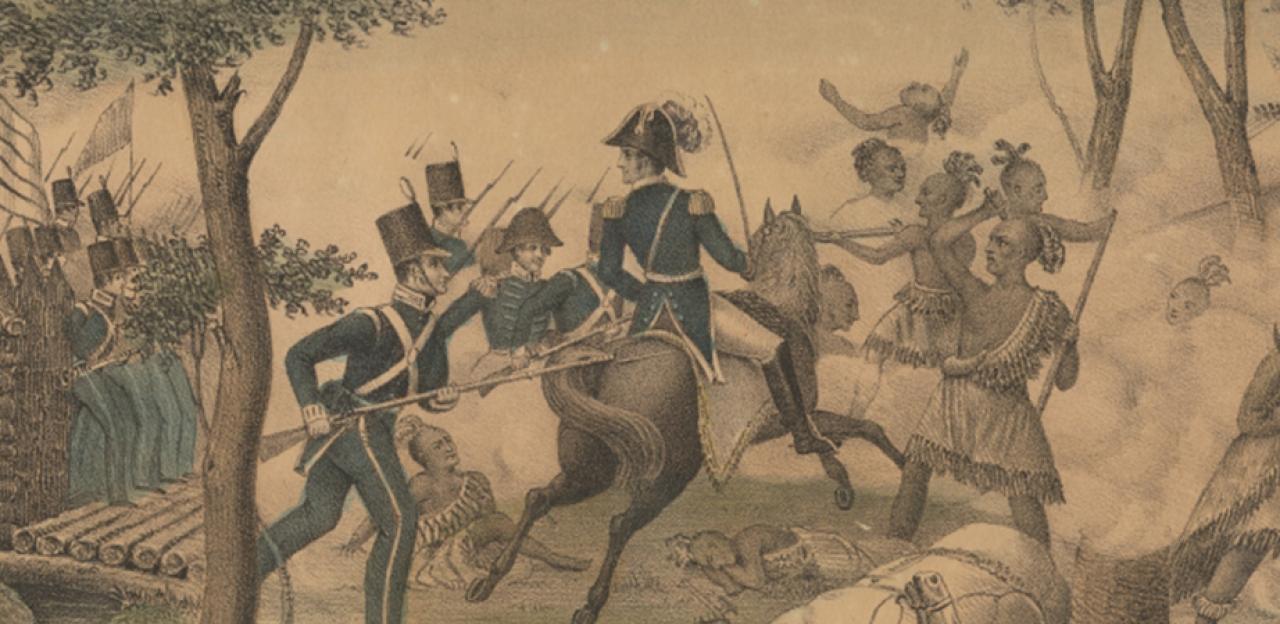
Joseph’s company of 125 men marched north as part of Gen. Green Clay’s army of 1,200 volunteers. They were on their way to the relief of Gen. William Henry Harrison, whose 1,000 men at Fort Meigs on the Maumee River were besieged by 2,400 British and Indians. Nearing the fort by boats on May 5, Clay ordered Col. William Dudley to take a detachment of 796 men and land on the opposite bank where British cannon were bombarding the fort. Dudley was to spike the cannon and immediately recross the river. Instead, after overrunning the guns, he was lured into an ambush, and 634 Americans were killed or captured. Joseph Clark was among those killed in action.