
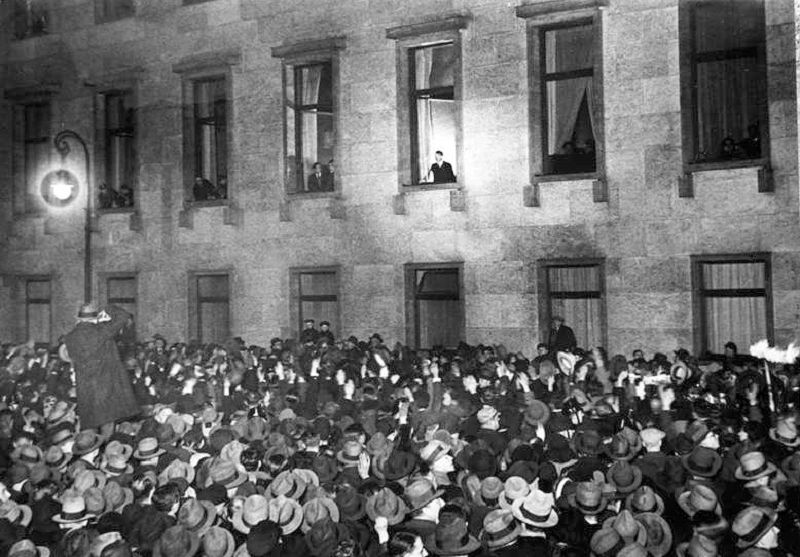

It didn’t take long after he assumed office. Within days and weeks substantial changes were taking place within government under the aegis of a single individual.
Many departments of civil service were purged of individuals who were considered not sufficiently supportive of the new government.
Under the belief that foreign governments were treating the country unfairly, tariffs on a multitude of imported goods were raised to historically high levels by executive fiat.
Amnesties were granted to hundreds of convicted felons who had been imprisoned for acts against the previous government, many of them criminals with previous records and who were released into society only to commit further crimes.
News outlets deemed too critical of the new government were harassed and reporters were banned from governmental offices.
Second Trump administration?
Nope. Opening of the Third Reich under Hitler, 1933.
But there appears to be a huge similarity, doesn’t there?
Timothy W. Ryback’s book 53 Days chronicles how Hitler assumed office and immediately began to build a new government under Nazi ideology.
But, reading the book, the similarities between 1933 and 2025 became strikingly apparent.
Of course, the constitution which governed Germany during the Weimar Republic did not contain the safeguards found in the U. S. Constitution so the U.S. is unlikely to be faced with a dictatorship anything like that which overtook Germany in the middle of the twentieth century.

The German courts in 1933 had virtually no power of enforcement even though numerous cases brought against the new régime were ruled in favor of the plaintiffs. Our current Supreme Court has very limited enforcement powers as well and many of the lawsuits brought against the excesses of the Trump administration have been ruled against the administration, which then seeks alternative routes.
The German government in 1933 was composed of a multitude of factions and parties and relied largely on the various factions eventually coming together in coalitions to reach compromise agreements. This condition was neutralized when all parties except the National Socialists were outlawed.
Here, the countervailing force of the legislative branch, Congress, has simply refused to exercise its duly authorized authority to curtail some of the excesses of the President because the ruling party of the Congress has been the same party as the President.
Theodor Heuss, a liberal journalist and editor in Germany who managed to survive the Nazi era, wrote of Hitler, “Hitler thrived on grievance and retribution.”
Another striking resemblance.
Get the book! "Our Stories, Our Voices: A 5-Year Anniversary Collection."
President Trump, in an interview for 60 Minutes, admitted that he could not forgive those who have opposed him even if meant doing so would assure his entry into heaven, and his attempts at retribution include removing reporters’ credentials, briefly banning CNN, MS NOW and Politico from the White House (until a judge ordered access restored,) and pushing the Department of Justice to investigate political opponents.
James Comey was indicted in September 2025, and that case was dismissed. He was indicted again in April 2026, and that case is pending. Letitia James and John Bolton were also charged.
It is certainly going to be interesting to see if the next two years of this administration are a succession of the past two, or whether a newly seated Congress will once again assume the mantle of authority granted it under the Constitution to balance the power of the Presidency.
1933 will not repeat itself in 2025–2029, but history has a way of showing how events can replicate when one fails to study the lessons therein.

