I don’t like admitting it, but I was wrong, and Mitch McConnell was right.
As a young newspaper editor, I had arrogantly asked the senator in private if the only thing he wanted to be remembered for was opposing campaign finance reform.
The issue was the Bipartisan Campaign Reform Act of 2002, sponsored by Sens. John McCain and Russ Feingold. One of its provisions was a ban on unlimited soft money contributions to national party committees.

Did I really think that weakening political parties was good for elections, he asked.
Maybe he had foreseen one of the unintended consequences of the law, which was a massive shift of campaign money away from parties and candidates and toward independent advocacy groups that were far less transparent and accountable.
Since that time, spending by independent groups has exploded. Many of the ads we now see on television and online are not the kind where the candidate says “I approve this message,” but rather where outsiders say what they want without the candidate’s consent.
Instead of watering down special interests, McCain-Feingold inflamed them.
I suspect it may be one of those independent groups that is behind an ad maligning Democratic congressional candidate Zach Dembo and inaccurately citing one of my articles for WinCity Voices as one of its sources.
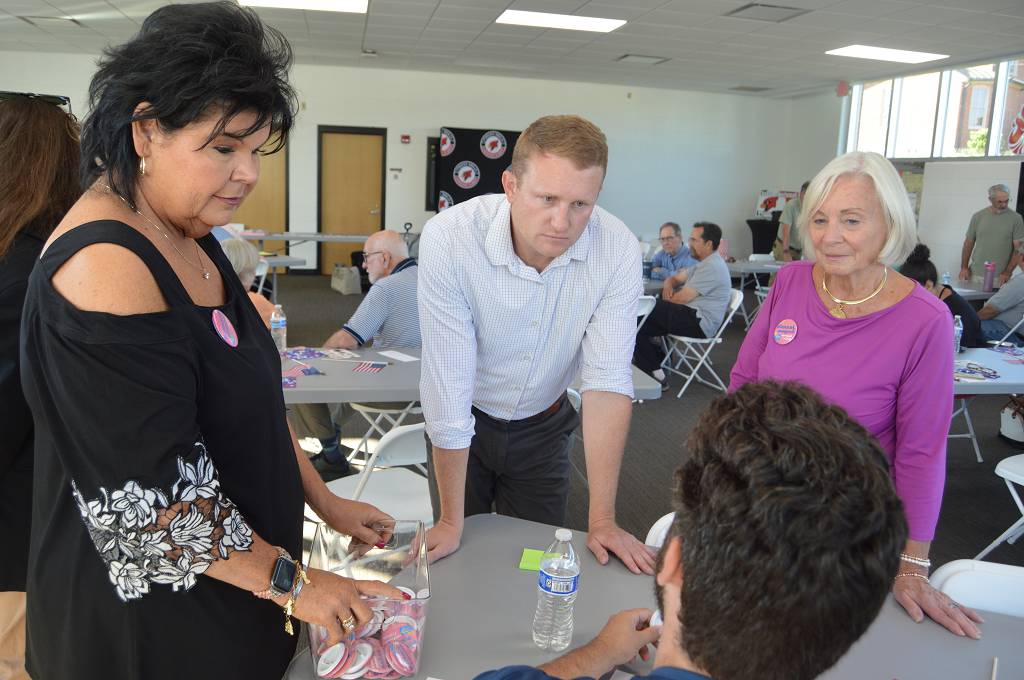
The article is one we published in July about a Democratic candidates’ event at the Cardinal Community Center where Dembo was the main speaker.
The ad appears on the Democratic Party of Clark County’s Facebook page with a banner across it and the words “Alvarado’s false claims.”
The ad accuses Dembo of being against tax cuts for working families, a plan to fund rural hospitals, and efforts to hold health insurance companies accountable.
The Facebook page also shared a link to my story with the suggestion: “Some people might need to read this article again.”
I interviewed Alvarado about the ad prior to a Republican campaign event on Oct. 8. He didn’t know what ad I was referring to, and he suggested that it may be one by an independent political action committee.
So the next day I texted the image to him, and he replied: “No. Not my ad.”

He did, however, double down on his position that Dembo had opposed working class tax cuts because the Democrat had been against President Donald Trump’s One Big Beautiful Bill, which, Alvarado said, cuts taxes for most Americans.
If the OBBB hadn’t been enacted, Alvarado said, it “would have caused everyone’s taxes to go up. Especially during the current climate, that would have been devastating for people.”
“He’s been very open about that,” he added.
Alvarado couldn’t say whether Dembo was against a plan to spend $50 billion to help rural hospitals because he didn’t know.
And we didn’t talk about the accusation that he was against holding health insurers accountable because the source cited for that accusation was not WinCity Voices, but something called the Paragon Health Institute from last November. I couldn’t find the specific reference online.
When I asked in the comments section of the Democrats’ Facebook post with the ad if anyone knew who was behind it, the admin posted a photo of another ad with a superimposed message saying it was “paid for by No Going Back PAC Inc and not authorized by any candidate or candidate’s committee.” The message also gave the website www.nogoingbackpac.org.
On its web page, the PAC says it “makes independent expenditures in U.S. federal elections in support of candidates who share the values of the founders and funders of No Going Back PAC Inc.”
According to multiple news sources, No Going Back PAC is a spinoff of President Trump’s MAGA Inc. political operation and is spending tens of millions of dollars on 2026 midterm races. There are several articles accusing the PAC of airing false or misleading ads about candidates across the country. One said the new PAC was created in order to postpone the disclosure of donors until later.
During the Democratic Party’s Wendell Ford Dinner Oct. 1 in Mount Sterling, I asked Dembo about the claims in the ad.
He told me he was not against the hospital relief fund or middle class tax cuts.
“Randy, you were in the room with me, and you wrote that article that they’re citing, so you know better than I do that they’re lying.”
Whoever they are.
“The thing that I was against and that I continue to be against is the effect these Medicaid cuts will have on our rural hospitals. And so to turn that around and pretend that somehow I’m against relief for rural hospitals is just typical D.C. politics. It’s exactly why folks don’t like career politicians,” he said.
As for middle class tax cuts, he said: “Of course I’m not for raising middle class taxes. I think the only thing I talked about in our meeting was the carried interest loophole and the fact that rich hedge fund managers on Wall Street pay the same tax rate as small business owners on Main Street.”
He added that whoever made the ad was “grasping at straws.”
“What you wrote was fair and accurate,” he concluded.
What I wrote actually doesn’t even mention Medicaid cuts, or the hospital relief fund, or the carried interest loophole. It mentions taxes and social spending cuts only indirectly, in the context of one paragraph about excessive federal spending:
Dembo said the government must get deficit spending under control. He said the president’s Big Beautiful Bill (its actual name) not only cut services for people in need but was a huge tax cut for the rich that added $1 trillion to the debt.
According to a fact check article by the Lexington Herald-Leader’s investigative reporter John Cheves, one of the things the One Big Beautiful Bill Act of 2025 does is cut Medicaid and Children’s Health Insurance Program funding by about $1 trillion over the next decade.
Dembo has called those cuts “catastrophic,” and said they could deny Medicaid coverage for 200,000 Kentuckians and risk closing 35 rural hospitals across Kentucky. One of the hospitals listed in initial reports was Clark Regional Medical Center, now named Centerpoint Health, in Winchester.
The $50 billion rural hospital relief fund mentioned in the ad is a sop intended to offset some of the damage done by the Medicaid cuts to hospitals.
Dembo isn’t against offering hospitals relief but wants to reverse the cuts that made the relief needed in the first place.
Never miss a thing with our FREE weekly newsletter.
Polls show the race between Alvarado and Dembo is close. If Dembo is elected, the former federal prosecutor has said he wants to use his experience to fight public corruption, including in the Trump administration and in both parties in Congress.
Dembo wants to ban insider stock trading by members of Congress, bar them forever from becoming lobbyists, and impose term limits on serving in the House and Senate.
One other issue that should be addressed is reforming political advertising rules and campaign finance law, which has gotten far worse in the last 24 years, especially since Citizens United v. FEC in 2010, which further tilted political influence toward wealthy donors, big corporations, and special interest groups.
Even if it means amending the Constitution to get around the idea that political advertising is protected speech under the First Amendment — I would argue that it actually overwhelms the voice of ordinary citizens — we must address this most pernicious form of public corruption. This time, let’s get it right.
