
I suppose that’s the funny thing about searching for where we come from. Sometimes you travel a long way only to discover you’ve been standing there all along.
I went looking across an ocean.
I found holy wells tucked into the green countryside of Ireland. I found stories of Brigid and women who prayed beside springs. I found ancient traditions that spoke of places where the distance between heaven and earth seemed to grow thin.
I found words for things I had felt but never quite known how to name.
And then I thought about my Great Gran.
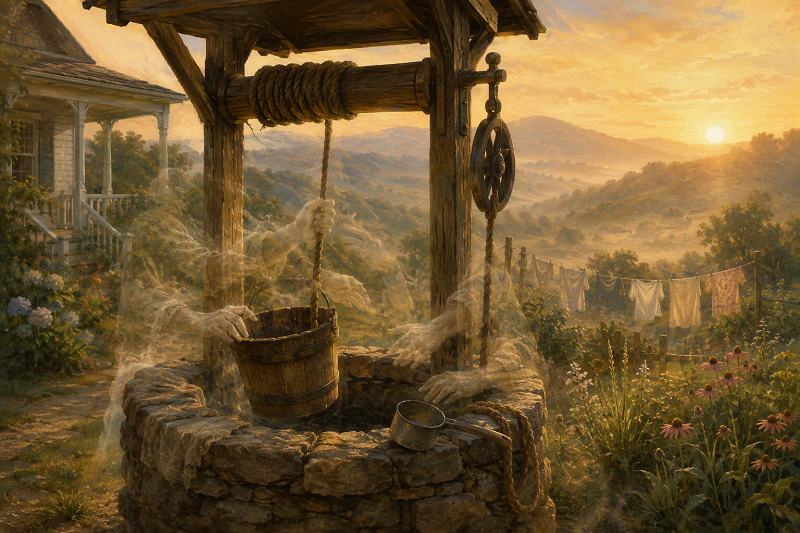
Standing beside that old well in her front yard.
Lowering a bucket.
Pulling up water.
Doing what needed to be done.
She didn’t know she was part of some ancient story.
She wasn’t trying to preserve Celtic traditions.
She wasn’t thinking about thin places or sacred springs or the women of Scripture.
She was getting water.
And maybe that’s exactly the point.
We have a tendency to think that traditions are preserved because someone deliberately decides to preserve them.
Sometimes they are.
But more often, I think, traditions survive because somebody simply keeps doing what their mother taught them to do.
A woman teaches her daughter how to save seeds.
A grandmother teaches a child which herbs belong in the garden.
A mother shows her daughter how to knead biscuits until the dough feels right beneath her hands.
Someone learns when the beans are ready to pick.
Someone learns how to can tomatoes.
Someone learns which road to take when the creek rises.
Someone learns how to pray when there aren’t any words left.
Nobody writes any of it down.
They just do it.
And then they teach somebody else.
That’s how a people remembers.
That’s how a culture survives.
That’s how a grandmother can leave pieces of herself behind without ever knowing she has done it.
I think about that now when I look at the well.
For most of my childhood, it was simply part of the landscape.
Like the garden.
Like the porch.
Like the clothesline stretched across the yard.
I never thought about the fact that someone had built it.
Someone had lowered the first bucket.
Someone had discovered that water lived beneath that particular patch of Kentucky earth.
Someone had probably stood there before my Great Gran, and someone else before them.
Generations of hands had touched that rope.
Generations of people had leaned over that stone wall.
Generations had drunk from that water.
And now I am one of the people who remembers.
Maybe that’s what wells really do.
They hold what we cannot see.
Water beneath the earth.
Memory beneath the years.
Stories beneath the silence.
You can cover a well.
You can build a house over it.
You can run plumbing into every room and make the old bucket unnecessary.
But the water doesn’t cease to exist simply because you stopped drawing it.
I think memory is like that.
There are things buried deep inside us that remain there, waiting.
A smell can bring them back.
A song.
A photograph.
The sound of an old screen door.
The first tomato from the garden.
A certain kind of rain.
Or the creak of a pulley.
One little sound and suddenly you’re five years old again, standing beside your Great Gran while the bucket disappears into the darkness.
You can almost hear her say, “Don’t get too close.”
And you find yourself smiling.
There is another memory I return to often.
Pap’s frozen jug.
I can still see those tiny pieces of ice floating in the water as we drank beneath the shade of a tree in the hay field.
At the time, I didn’t know what a gift that was.
I didn’t understand the work that went into it.
Pap had to draw the water.
My step-grandmother had to pack the dinner bucket.
Someone had to get up before sunrise.
Someone had to remember the jug.
Someone had to freeze it overnight.
Someone had to carry it into the field.
That’s what love often looks like in families like mine.
It doesn’t announce itself.
It doesn’t always say, “I love you.”
Sometimes it freezes a jug of water the night before.
Sometimes it packs your lunch.
Sometimes it puts a blanket over you when you fall asleep in the living room.
Sometimes it stands at the stove long after everyone else has gone to bed.
Sometimes it draws water.
Maybe that’s why the women of the wells have stayed with me.
Because I know those women.
I know the ones who got up before dawn.
The ones whose hands were always busy.
The ones who could feed twelve people from what looked like an empty pantry.
The ones who knew how to make something stretch.
The ones who prayed while they worked.
The ones who carried everybody else’s burdens and rarely spoke of their own.
The ones who didn’t consider themselves wise because nobody had ever given them a title that said they were.
But they were.
Lord, they were.
They knew things.
They knew the land.
They knew weather.
They knew childbirth and sickness and grief.
They knew when somebody needed food without being asked.
They knew when to speak and when to sit quietly beside someone.
They knew how to keep going.
And they knew that water mattered.
Maybe that is what I mean when I call them the women of the wells.
I’m not talking only about the women who appear in the Bible or the women who walked to holy wells in Ireland.
I’m talking about all of them.
Rebekah.
Rachel.
Zipporah.
The Samaritan woman.
Brigid.
The nameless women who carried water across Celtic hills.
The women who gathered at Appalachian springs.
My Great Gran.
My mother.
My step-grandmother.
And all the women whose names have disappeared from history but whose hands are still visible in the lives they shaped.
They are connected by something deeper than geography.
They knew that life is something we receive.
Water falls from the sky.
Springs rise from the earth.
Seeds push through dirt.
Babies arrive screaming into their mothers’ arms.
Bread rises.
Gardens produce more than we planted.
And every morning, whether we deserve it or not, the sun comes up over the hills.
Perhaps that is why water has always carried such spiritual meaning.
We cannot make it.
We can only receive it.
We can carry it.
We can share it.
We can waste it.
We can give thanks for it.
And when we’re thirsty, we know immediately that all the other things we’ve been worrying about can wait.
There is something humbling about thirst.
It reminds us that we are dependent creatures.
No matter how modern we become, no matter how many things we invent, we still need the same things our ancestors needed.
Water.
Food.
Shelter.
Love.
Community.
Hope.
And maybe a place where we can sit quietly long enough to remember who we are.
That’s what I think about when I hear the phrase thin place now.
I don’t imagine some mystical doorway opening in the sky.
I think about the places where my attention changes.
The old well.
The garden after rain.
The hay field before the heat rises.
The porch when evening settles over the hills.
The kitchen before everyone wakes up.
The cemetery where people I love are buried.
The creek running high after a summer storm.
The places where memory and gratitude meet.
Maybe a thin place is simply a place that makes us pay attention.
And perhaps that is what the women of the wells have been teaching us for thousands of years.
Pay attention.
The water is here.
The earth is here.
The child is here.
The old woman beside you is here.
This morning is here.
Don’t rush past it.
I wish I could go back and stand beside my Great Gran one more time.
I would watch her lower that bucket.
I would listen to the rope creak.
I would wait for that familiar splash.
And this time, I would ask questions.
I’d ask how long the well had been there.
I’d ask who drew water from it before her.
I’d ask whether her mother taught her to use it.
I’d ask what she thought about while she worked.
I’d ask if she ever stood there before sunrise and felt that particular Kentucky morning when the world is still quiet enough to hear yourself think.
Most of all, I’d ask her if she knew how much I would miss her.
But children don’t know to ask those questions.
They think there will always be another summer.
Another afternoon.
Another bucket of water.
Another chance.
That’s one of the cruelest things about growing older.
You begin to understand the value of ordinary moments only after you can no longer step back into them.
But perhaps memory gives us another kind of well.
We can return.
Not physically.
But through story.
We can lower the bucket.
We can listen for the splash.
We can taste the water again.
And for a moment, the distance between then and now becomes thin.
Maybe that’s the closest thing to a miracle I know.
I have spent a lifetime believing that wells were places where water came from.
Now I think they are also places where we return to.
We return for water.
We return for memory.
We return for stories.
We return for the people who taught us how to carry what we were given.
And perhaps, if we are lucky, we return to ourselves.
The well in my Great Gran’s yard is still there.
It has outlived some of the people who drew water from it.
It has watched children grow old.
It has watched families change.
It has watched seasons come and go.
Spring green.
Summer heat.
Autumn leaves.
Winter snow.
It has stood quietly through births and deaths, weddings and funerals, harvests and hard years.
It never asked anyone to remember it.
It simply remained.
Maybe that’s another lesson the women of the wells left us.
Stay.
Keep showing up.
Give what you have.
Draw the water.
Carry it home.
Share it with whoever is thirsty.
And when the next generation comes along, hand them the dipper.
Let them taste what you have tasted.
Let them know where it came from.
Because someday, if we’re fortunate, they will stand beside that same well and remember us.
They’ll hear the old rope creak.
They’ll hear the bucket splash.
And they’ll understand, perhaps for the first time, that they come from people who knew how to draw life from the earth and carry it home.
I don’t know if the Celts were right about thin places.
I don’t know if every holy well was truly a doorway between heaven and earth.
I don’t know whether Brigid was goddess, saint, or some complicated weaving of both.
But I know what happens when I stand beside my Great Gran’s well.
The years fall away.
The world grows quiet.
And for just a moment, I am a little girl again, standing beside an old woman who loved me, waiting for a bucket to rise from the darkness.
The water is cold.
It is sweet.
And somehow, after all these years, it is still enough.
Maybe heaven doesn’t always come to us with thunder.
Maybe sometimes it sounds like an old pulley turning.
Maybe it feels like a child’s hand wrapped around a metal dipper.
Maybe it tastes like cold water on a hot Kentucky afternoon.
Never miss a thing with our FREE weekly newsletter.
And maybe, sometimes, the veil grows thin enough that we can hear the women who came before us whispering from the other side:
Draw the water.
Carry it home.
And don’t forget who taught you how.
