
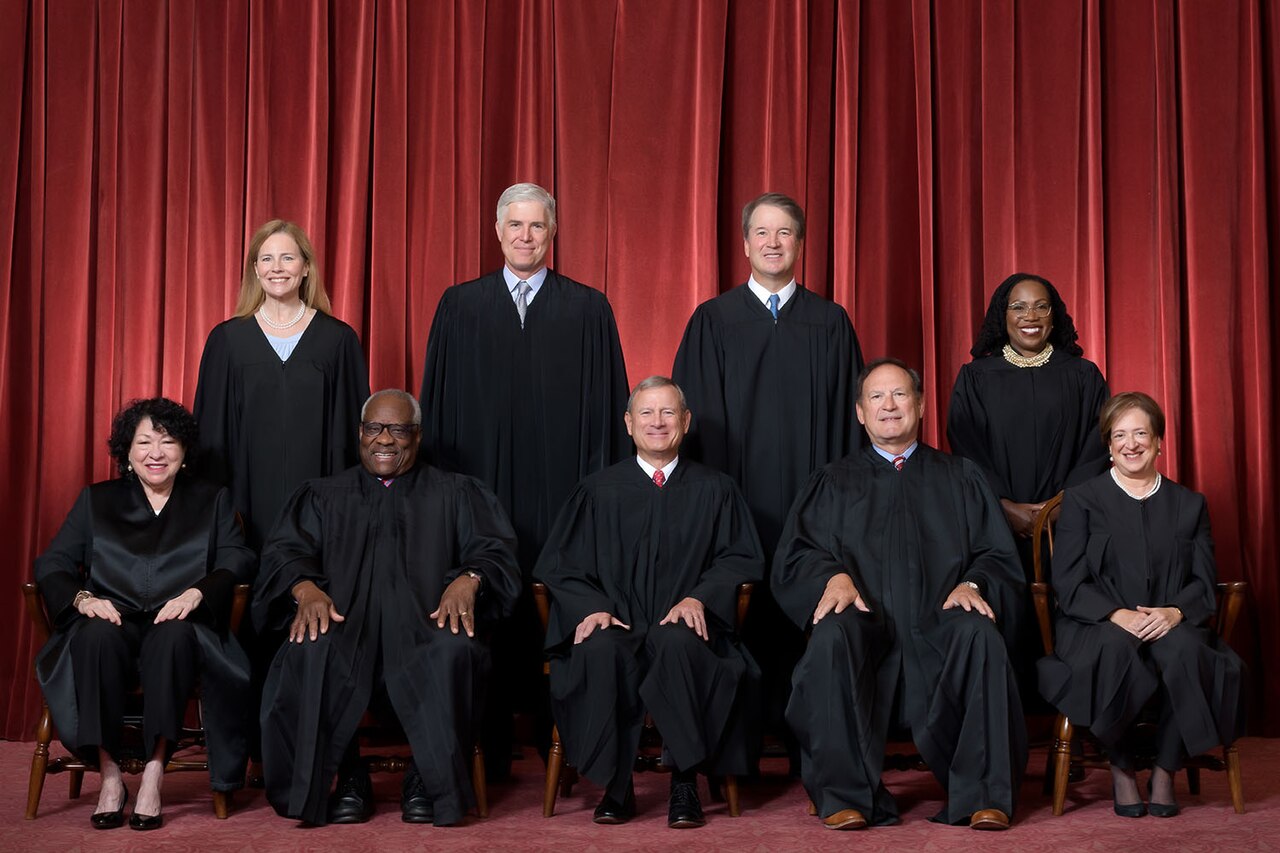

The United States Supreme Court has probably never been held in less esteem than now, based on recent and current polling.
But since the first scientific polling methods were not introduced until 1936 by George Gallup, it may never be known how the populace may have felt about the Court before that time.
Throughout its history the Court has made terrible decisions, some of which may now be viewed that way, but may not have been widely unpopular at the time.
Dred Scott, 1857, denied citizenship to Black people. Plessy v. Ferguson, 1896, upheld racial segregation. Korematsu v. Unites States, 1944, upheld incarceration of Japanese American citizens during the war. Citizens United v. FEC, 2010, allowed unlimited corporate spending in elections. Shelby v. Holder, 2013, invalidated key provisions of the Voting Rights Act of 1965 (and led immediately to voting suppression in many states).
Depending on one’s political orientation, the Roe v. Wade decision permitting abortion might be viewed as an awful ruling.
Regardless of its history — and how it may be viewed in hindsight — the current status of the Court is at its lowest point that has ever been recorded, with only a 41% favorable rating in early 2026, according to uspollingdata.com.
While recent discussions about alterations to the Court have centered mostly around a Constitutional Amendment which would place term limits on the justices’ tenures, a study by the Brennan Center for Justice suggests that Congress already has authority to modify terms of the justices through what is termed The Necessary and Proper Clause.
The study suggests that Congress can modify and reduce judicial duties (this would allow a Supreme Court justice to assume duties in lower courts).
The conclusion of the forty-page report states: “The Constitution designates to Congress substantial power to pass ‘necessary and proper’ legislation regulating the Supreme Court, including with respect to the duties exercised by Supreme Court Justices. Constitutional history, text, structure, and precedent establish that Congress has the power to modify and reduce Justices’ duties, to require them to sit on lower courts, and to regulate the Court’s appellate jurisdiction.”
It should be remembered that Congress has manipulated the size of the Court numerous times. In 1789, the size of the Court was set at one chief justice and five associate justices. The number was reduced to 5 in 1801 and that law was repealed a year later with the number raised back to six. The size of the Court was enlarged in 1807 to seven, to nine in 1837, to ten in 1863, back to seven in 1867 and finally to nine in 1869, where it has remained.
So, the ability of Congress to alter the Court seems to be well established.
Two questions remain.
One, if Congress has the ability to utilize statutes to alter the terms of the Court’s justices, why has it not done so? Two, if the method of creating a Constitutional Amendment to stipulate conditions relating to the Court is proper, why has it not been done?
There appears to be a great deal of support for changing the Court.
Recent polling has shown that mandatory retirement ages for the justices should be established, with 80% of Democrats and 67% of Republicans in support. Eighty-four percent of Democrats and 61% of Republicans support term limits (usually suggested as 18 years) and 77% of Democrats along with 63% of Republicans support requiring a 2⁄3 majority of the Senate to confirm an appointment.
Never miss a thing with our FREE weekly newsletter.
With these high percentages of the population supporting changes to the Court, there seems little doubt that the necessary 3⁄4 of the states would readily adopt an Amendment with these requirements.
So, going back to questions one and two, why won’t Congress do what is necessary to allow the American public to have a say on how its Supreme Court should be configured?
Perhaps the underlying reason is that Congress, seeing the American public’s desire to place term limits on public offices, will demand that the same be applied to the House of Representatives and the Senate.
And that would not be a bad thing.
