

As new, high-end subdivisions spring up like dandelions in rural parts of Clark County, a question I always ask is why.
Why, when there is still much undeveloped land within or adjacent to the city limits of Winchester?
Why, when finding affordable housing is such a problem?
Why, when local governments already struggle with raising enough revenue to provide the services their citizens need and deserve?
Why not try more “smart growth?”
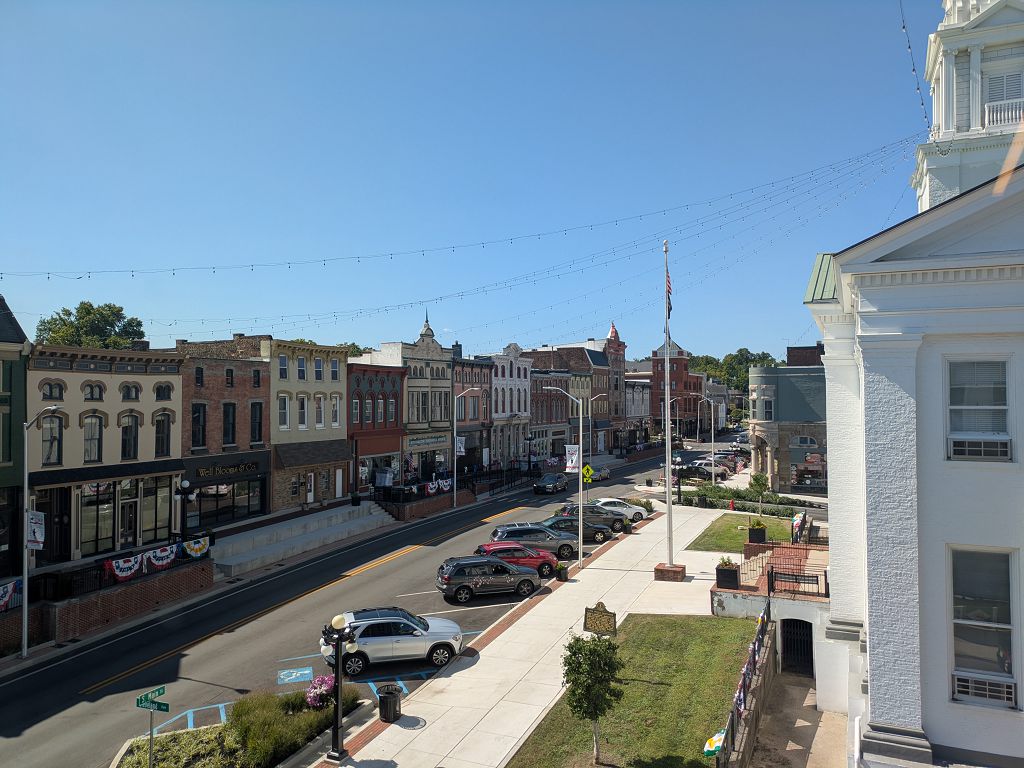
Smart growth is an urban planning approach that promotes compact, walkable, and transit-oriented communities to manage growth sustainably while enhancing livability and environmental quality. Emphasizing mixed-use development, strong amenities for bicycles and pedestrians, and a variety of housing options for all levels of income, smart growth is being employed in more large urban areas and even in small cities like Winchester.
Another way of looking at smart growth is by comparing it to the way cities and towns grew organically before the advent of interstate highways, big-box retailers, and two or more cars in every driveway. And before the decline of mass-transit, walking, and shopping downtown.
No one called it smart growth back then — it was just the way cities and towns naturally organized. There was a time here in Winchester, as in thousands of other towns across America, when it was not uncommon for a person to be able to walk to work, to school, to dining and shopping, and pretty much anything else. Back then owning an automobile was an luxury for folks who lived in town, not a necessity.
Aesthetics, life quality, health, and economics
But smart growth is not only about not having to drive everywhere.
Research consistently shows that living in a walkable, mixed-use neighborhood is associated with better physical health, mental well-being, and happiness. The CDC notes that walkability increases physical activity, improves safety, fosters interaction, and makes communities more livable. (Designing Activity-Friendly Communities | Physical Activity | CDC)
And the benefits don’t stop at your front door — the whole community benefits from lowered cost of government when smart growth is employed by local governments. Compact, walkable neighborhoods strengthen the fiscal foundation that keeps services funded and farmland intact.
Low‑density, auto‑oriented residential plats out in the country tends to require more miles of road, longer utility runs, and more dispersed emergency services coverage and generates relatively low tax revenue per acre.
Compact, mixed‑use, and commercial developments close to existing infrastructure tend to produce much higher tax revenue per acre and use infrastructure more efficiently.
In North Carolina, researchers found that infill development saves about $12,000 per home and generates $2,000 more tax revenue per acre than fringe development. (Pew Charitable Trust)
Grow where we already are strong
Take a look at your favorite online map provider. Center it on Winchester. Switch to terrain view to see where the green space is. You will note many small, medium, and large tracts close to existing development, as well as brownfield space. (Previously developed land — often industrial or commercial — that is abandoned, idled, or underused.)
There is no question that there is plenty of land available near downtown Winchester that could be developed.
We don’t need to turn our rural landscape into a patchwork of scattered neighborhoods, as has happened in other communities.
Many communities — from large cities to towns like Winchester — have discovered the power of smart growth. The kind of growth that allows people in a diversity of economic circumstances to enjoy walkable neighborhoods near the amenities they depend on.
We’re talking about such things as infill neighborhoods, small‑lot single‑family, townhomes, and gentle density near existing schools, parks, and utilities.
The east side of Winchester in particular has much land that could utilize this kind of development.

Protect the countryside
Scattering subdivisions across rural Clark County erodes the tax base per acre and forces everyone to pay more for roads and utilities that serve relatively few households.
But it does something much worse, in my opinion. It destroys the rural landscape forever, and it divides people into small enclaves where there is nothing but single-family homes on large lots. No stores. No schools. No sidewalks beyond the boundary of the subdivision. (And sometimes not even then.)
I remember pleasant drives along US 27 between Lexington and Nicholasville many times as a child. My mother used to take us kids with her to Danville to visit her sister. Back then, there was not much of anything between the Fayette Mall and downtown Nicholasville but scattered farms and rural houses.
Today, one can drive that stretch of highway (which, by the way, is now much wider but so congested that traffic often comes to a near complete stop) without ever noting that they have left one town and entered another. Nicholasville has essentially become a part of Lexington.
What kind of town do we want?
Today, some people want to create massive development along US 60 in Clark County between Winchester and the Fayette County line — adding hundreds or thousands of new homes along a country corridor. Besides weakening our town’s unique identity and cluttering up the countryside, this development would make no sense to anyone except home builders and realtors anxious to sell homes to people fleeing Lexington.
What would that do for us?
Never miss a thing with our FREE weekly newsletter.
I think it would add more congestion, spread us out more, and provide a place for Lexington workers to sleep — while most of them would continue to work and shop in the city. Economically, it would be a disaster for Clark County as resources are spread thinner and tax rolls struggle just to break even on the new housing for perhaps decades.
Do we want to be another Nicholasville?
I have a different vision for us. I see a future where smart growth enables us to add to the city core and the outskirts in a way that creates walkable, diverse, mixed-use neighborhoods. With lower development costs should come affordability that will open up home ownership for more people.
I challenge our government leadership, both city and county, to study smart growth and consider revising our planning and zoning code to incorporate more of it.

