
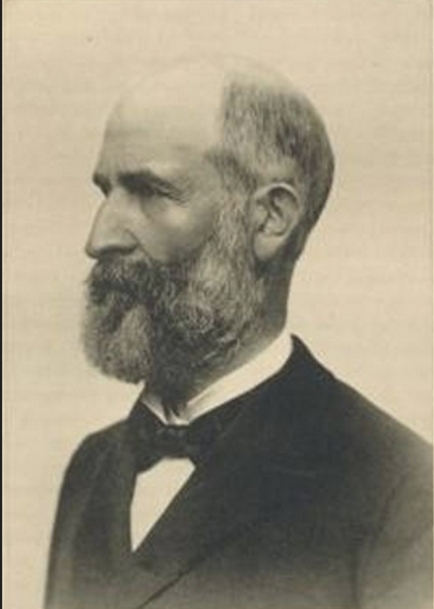
Last week, Bobbi Newell gave an excellent talk on Judge William M. Beckner at Holly Rood. Judge Beckner played such an influential role in Winchester that I thought his story deserved to be in print for readers, especially his role in advancing public education in Kentucky.
William Morgan Beckner (1841−1910) began acquiring his education credentials as soon as he came to Winchester at the close of the Civil War. He established a school for boys in the old Seminary (which later became Hickman Street School), then served a term as principal of the Winchester public schools.
A glowing obituary in the newspaper he founded stated, “He advocated for better schools, better roads, better streets, turnpikes and railroads, and public improvements of all kinds. He was not afraid of increased taxation if the community secured corresponding benefits. He was largely responsible for the removal of Kentucky Wesleyan College to this city [and for acquiring a grant to erect a Carnegie Library on its campus]. Much of the most progressive school legislation of the State was due to his influence.”
Beckner followed his beliefs with action. “Judge Beckner was by nature a leader of men. What he believed was right he advocated with all his might whether or not it was popular at the time.” This was especially true regarding public education. Here Beckner left his most enduring mark, and the principles he fought for are still relevant in Kentucky today.
Kentucky’s poor counties had woeful public schools for years. This injustice to Kentucky school children resulted in a 1985 lawsuit, Council for Better Education et al. v. Martha Layne Collins, Governor, et al. Former governor Bert Combs and his legal team argued that the poorer counties of Kentucky could not provide an adequate education for their children because of an insufficient local tax base compared with wealthier counties. Statements such as “48 percent in this county [Owsley] can’t even read” were undisputed by the defense. Judge Ray Corns heard the case, and his opinion declared Kentucky’s entire system of school finance unconstitutional. The state’s widely publicized Education Reform Act of 1990 (known as KERA) resulted from the court’s sweeping mandate.
So what does the Kentucky Constitution say about education? Section 183 requires that “The General Assembly shall, by appropriate legislation, provide for an efficient system of common schools throughout the State.” Both courts cited this clause as the basis for throwing out the existing education framework. And this clause was the work of William M. Beckner, Clark County’s representative to the Constitutional Convention of 1890.
Beckner was born in Moorefield, a small town in Nicholas County, and attended neighborhood schools, an academy in Maysville, and Centre College. Leaving college after five months due to lack of funds, he taught school while reading law in Maysville. Beckner settled in Winchester in 1865 and was soon elected Police Judge. In 1866 he was County Attorney, four years later County Judge, in 1880 State Prison Commissioner, and in 1882 State Railroad Commissioner. In 1893, he served in the General Assembly and a year later was elected to the U.S. House of Representatives.
Beckner’s passionate belief in the value of education led him to reform the state’s system of common schools. Kentucky, like most of the rural South, had a deplorable record of educating its citizens. Our first state law dealing with common schools was not passed until 1838, and compliance was voluntary. Slight progress was made in the 1840s and 50s with the enactment of a small state school tax. The Civil War disrupted progress, as did hostility to local taxation, political infighting, racial tensions, and citizen apathy.
In the 1870s, Beckner began advocating for better education in his newspaper columns and eventually secured passage of a graded public school system in Winchester. Following this, he began speaking out across the Commonwealth about the need for more state funding for schools. Condemning the level of illiteracy, he argued that “the free school has been the foundation of New England’s power and greatness.”
He urged citizens to raise local taxes and to provide adequate education for Black children. At that time, the state had grossly unequal school systems for White and Black children.
Never miss a thing with our FREE weekly newsletter.
One of his speeches, entitled “A Problem To Be Solved,” was reprinted in newspapers across the state in 1882. He organized a state Education Convention in Frankfort in April 1883 and the Inter-State Educational Convention in Louisville that September. These efforts resulted in Kentucky’s Common School Act of 1884, which created a “uniform system of schools,” but did nothing to address their inadequate funding. In 1889, he was invited to speak at a symposium in New York City on the question, “Shall the Negro Be Educated or Suppressed?” There, Beckner expressed “a Christian hope that prejudices of the past would die, racial antagonism cease, and equal rights before the law endure of ‘all races of men.’”
At the 1890 Constitutional Convention, Beckner was easily the most widely recognized advocate for public education. He worked tirelessly during the 226-day convention to advance his ideas in the Committee on Education.
When the convention took up debate on the committee’s report, Beckner asked if he might “say a word or two.” He then launched into a two-hour oration that touted education’s “power to break down class barriers, prevent crime and poverty, enrich democracy, and improve the general economic condition of the state.” The convention ultimately voted to approve his committee’s six recommendations on education. For his efforts, he was recognized by the other delegates as the leader of the “friends of education” and dubbed “the Horace Mann of Kentucky.”
Beckner had no way of foretelling that 100 years later, his Section 183 would be the justification to remake Kentucky’s education system.
In 1998, James C. Carper of the University of South Carolina published a 32-page article in the Register of the Kentucky Historical Society on William Beckner’s educational accomplishments. He credits Beckner with making universal public education a fixed, constitutional commitment.