When I was a teenager, I couldn’t wait to get out of this small town. It felt provincial and unsophisticated. So I jumped at the opportunity to spend sophomore year of college in London, England. My plan was to drink a lot of wine, write a novel, take a French lover, get a degree in art history and blow off Winchester forever. (Spoiler alert: I drank a lot of wine, I wrote only in my journal, my lover turned out to be from Tennessee and the art degree was abandoned when I remembered that I was colorblind).
There was much to love about London. Buildings, many older than America’s constitution, dominate the skyline — concrete, stone and brick as far as the eye can see, the River Thames the only colorful crack in the landscape of gray. The streets are clogged with red buses and black cabs; the squares are clogged with tourists and pigeons at all hours of the day.
David and I spent weeks walking back and forth across the London Bridge, me reading from a travel book, David pioneering our course, both our minds reeling with information about Buckingham Palace, the Tower of London, Big Ben, and the Houses of Parliament. In addition to three squares a day, we heartily adopted taking a toastie (their name for a grilled cheese sandwich) each day at elevenses and tea and scones each day around 4.
After a few weeks, we grew weary of the hustle and bustle. I was overwhelmed by the constant sea of humanity, the cacophonous noise, the putrid smells. London smells like garbage, exhaust, the vinegary tang of fish and chips and stale ale (imagine Bourbon Street on an early Sunday morning, and you’re close.) Since I was at Regent’s Park College, I fell in love with the park, home of Queen Mary’s formal rose garden and some lovely ponds with gliding swans.
We took to spending Sunday afternoons in Regents Park, lying in the grass under our favorite tree. The marker on our tree (and it will always be our tree, though it’s almost 200 years old), halfway between the football pitch and Baker Street tube, named it as an Indian Bean tree, though I recognized it from home as a Catalpa. I would read poetry while David napped, rousing occasionally to gaze upward through the branches and ponder life’s mysteries. This weekly habit became our buoy against the city, a balm for two rural souls trapped in an urban landscape.
It became clear to us that the homes we had run from ran deep in our veins, that provincial beat metropolitan in our hearts, that we prefer the smell of cow poop to that of diesel and exhaust.
London taught us that we were, indeed, country mice.
The Catalpa Bignonioides tree takes its name from the Native American Seminoles, who named it Catawba. It’s thought that the Latin name was a spelling mistake by a sloppy botanist. And there are no actual beans on the tree, despite its name. Instead, the tree produces long, skinny seed pods that look like beans. Mama always called it an Indian cigar tree.
The pods hang off the limbs all fall and winter. In June and July, the tree explodes in enormous white and yellow blooms that smell like honeysuckle.
Never miss a thing with our FREE weekly newsletter.
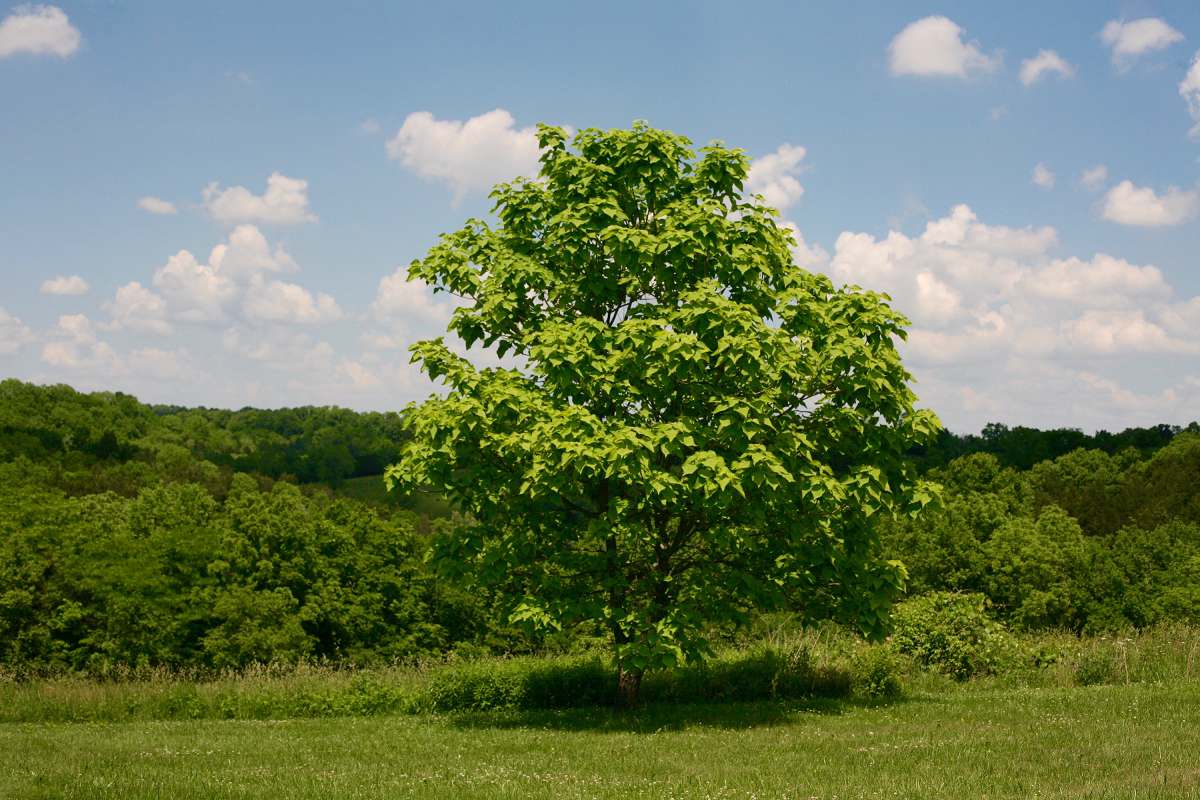
Ten years ago we planted a Catalpa in our backyard, a nod to the city where David and I met and fell in love. We named her Catalina. Catalina is a decade old this summer, grown from a ten-foot stick in a plastic bucket to a lush, gorgeous shade tree with heart-shaped leaves as large as elephant ears. Though Catalpas can grow to be over 75 feet tall, Catalina is still a mere 25 or so, with a Y‑shaped trunk that is perfect for climbing into when you need to flee from life (Catalina is especially fond of being read to.)
A friend told me a few years ago that her dad calls them worm trees. Last year, we discovered why, horrified when every lush leaf was eaten by sphinx moths in a three-day span. These bright green caterpillars with black markings are beautiful and I might have become enamored with them had they not devoured every last leaf on my beloved tree. Catalina was completely stripped bare, and we feared for her life. But a Google search reassured us that this is a natural occurrence for a Catalpa every few years and she has come back stronger than ever.
Trees are essential for life, playing a crucial part in the exchange of oxygen and carbon dioxide. We feel happy when we are around them. Research shows that within minutes of being surrounded by trees, your blood pressure drops, your heart rate slows, and your stress levels come down.
But as the longest living species on earth, trees also give us a link between the past, present and future. For my family, Catalina serves as a link between the meeting of two, becoming three, and the numbers of people in our unknowable future family. She is a friend, someone we hold in high esteem.
Who is your favorite tree? Drop me a note and tell me about her (or him).