
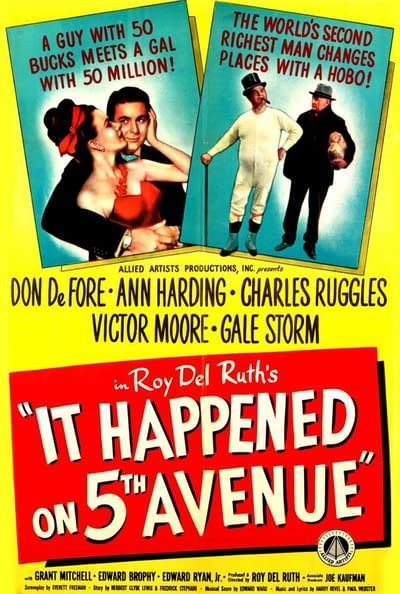
Just in time for the Christmas holiday, today’s Reel Classic takes a look at what I would call an “under the radar” Christmas film, It Happened On 5th Avenue. Michael J. O’Connor (Charlie Ruggles) is the second richest man in the world. He has all the material possessions one can imagine, but with the assistance of the other characters in this story, comes to realize he is missing the most important possession of all—love and compassion for others.
The story begins with a homeless hobo walking down the street with his dog. We learn that Michael J. O’Connor possesses a mansion on 5th Avenue but leaves in the winter to stay in another of his mansions in a warmer climate. The hobo, Aloysius T. McKeever (Victor Moore), is aware that the home is vacant in the winter and has been “squatting” in it at this time of year for some time. He makes his way into the house, feasts on the food left behind by the owner, and “borrows” O’Connor’s clothes while there.
While out walking his dog in the park one day he comes across another homeless man on a park bench. We learn that this fellow, Jim Bullock (Don Defore), is a WWII veteran who had been living in an apartment building owned by Michael J. O’Connor and was evicted as O’Connor plans to tear the building down as part of a business venture. Bullock shares with McKeever the difficulty for returning vets to find affordable housing. He has friends with families living in their cars. McKeever offers to have Bullock stay with him, and eventually, Bullock’s friends and their families join them in the huge 5th Avenue house. Bullock is very grateful for the kindness shown by who he believes to be the generous and rich owner of this home.

In the meantime, Bullock and his friends come up with an idea and plan to convert a nearby abandoned military base into affordable housing units, not knowing that O’Connor has plans to purchase that property in another of his business ventures.
We get to meet and learn more about Michael J. O’Connor when his daughter Trudy (Gale Storm) runs away and goes to the mansion on 5th Avenue to get clothes. We learn that O’Connor is divorced and his ex-wife, Mary O’Connor (Ann Harding), now lives in Florida. We find O’Connor alienated from the family that once loved him dearly. He learns his daughter is at the 5th Avenue location and goes to her. She has, in the meantime, fallen in love with Jim Bullock but has not disclosed to him her true identity. She convinces her father to take on the identity of a homeless man and he too comes to the house that now has a host of homeless people living there. They are soon joined by Mary O’Connor who has come to support her daughter.
Christmas approaches and Mr. O’Connor is about to receive one of the greatest gifts in his life. The folks gathered in the mansion celebrate Christmas together showing love and caring for each other. I will stop there as I do not want to provide spoilers. But most will figure we are in for a happy ending—this is a Christmas movie.
This film, released in 1947, was the first production by Monogram Pictures released as an “A‑film.” The studio was well known for their “B‑films” that cost about $90,000 to produce. This release cost $1.2 million but earned nearly $2 million in box office returns. This venture was under a new division established by Monogram entitled Allied Artists Productions.
The story had originally been obtained by Liberty Films in 1945 and it was intended for Frank Capra to direct it. However, he opted to direct another film instead, It’s A Wonderful Life. The story was picked up by Monogram and directed by Roy Del Ruth. Another familiar face in the cast is Alan Hale Jr. (Gilligan’s Island) who plays one of Jim Bullock’s army buddies.

Many may remember Gale Storm from her days on TV. In the 1950s she starred in two TV shows, My Little Margie and The Gale Storm Show. But before TV she was a prolific actress, making nearly forty films at Monogram alone. She was also a successful stage actress and recording star.
Though he did not get top billing, many critics identified Victor Moore as the star of the movie. The critic for the Los Angeles Times wrote that Gale Storm was “all radiance and springtime” but that the film “is keyed by Moore, whose tempo is never animated, but who attains a fascinatingly droll warmth in his interpretation.”
Variety called Moore’s performance “a gem that thoroughly clicks in every facet.” The critic for Film Daily wrote that It Happened On 5th Avenue was a “delightfully amusing picture finely played and directed . . . Victor Moore’s work is brilliant.”
The Hollywood Reporter also had praise for Charlie Ruggles. The critic wrote “Victor Moore has one of his most priceless roles as the jolly tramp, Mac. He misses none of its joy, and is matched in every respect by what Charlie Ruggles makes Michael O’Connor mean.” They also praised Ann Harding: “And speaking of personality, Ann Harding brings superb craftmanship to her portrait of the divorced wife. Miss Harding comes into the picture quite late, then proceeds to dominate her every scene with the exquisite perfection of her playing.”
The New York Magazine critic wrote “It Happened On 5th Avenue earns its warmth honestly, tethering a tale of fresh starts and changed hearts to the real difficulties faced by those reaching for the American dream in a postwar era that was supposed to bring prosperity to all.”

As one review I read stated, “this film doesn’t shy away from social commentary. There are many references to the lack of jobs for veterans and obviously the lack of housing. The rich have gotten richer . . . and the wonderful world of high-paying jobs and homes the soldiers were promised fails to materialize. That element gives this movie a Capra-esque, socially conscious feel . . .” (Cameron at The Blonde At The Film)
The film received an Oscar nomination for Best Writing, Original Story in 1948.
Lux Radio Theater broadcast a radio adaptation of the film in May 1947. Victor Moore, Don Defore, Charlie Ruggles, and Gale Storm all reprised their roles for the production.
Around 1990 the film essentially disappeared from both TV broadcasts and retail sales. A group of fans began an effort to petition Turner Classic Movies (TCM) and the American Movie Classics (AMC) to show the movie. Almost twenty years passed before the film appeared on TV again when Turner Classic Movies aired it in 2009. It now often appears in their Christmas holiday offerings.
Never miss a thing with our FREE weekly newsletter.
The Internet Movie Database rates It Happened On 5th Avenue at 7.6 of 10. Rotten Tomatoes gives it a audience score of 81%.
The Clark County Public Library has two copies on the shelf in two separate Christmas film collections. Interestingly, one is a collection of Christmas holiday films by Turner Classic Movies. I was only able to find one free streaming site (Artiflix) on my Roku search.
A description I read regarding the film sums it up nicely: “A sparkling comedy laced with Christmas overtones, romance, and a dash of social commentary, It Happened On 5th Avenue . . . spreads plenty of seasonal cheer.”
Information for this Reel Classic review was gathered from Internet Movie Data Base (IMDb), Rotten Tomatoes, Turner Classic Movies (TCM) and Wikipedia.
I’ll be back soon with the next Reel Classic, but before I leave you with the trailer below let me remind you that if you enjoy these classic movies, please join me on the second Tuesday of each month at 6 p.m. at the Clark County Public Library for “Ron Kibbey’s Comedy Classics.” I present a classic comedy film usually accompanied by a vintage cartoon. Popcorn and drinks are provided. More information about the next film is available on the library’s website and Facebook page.
