
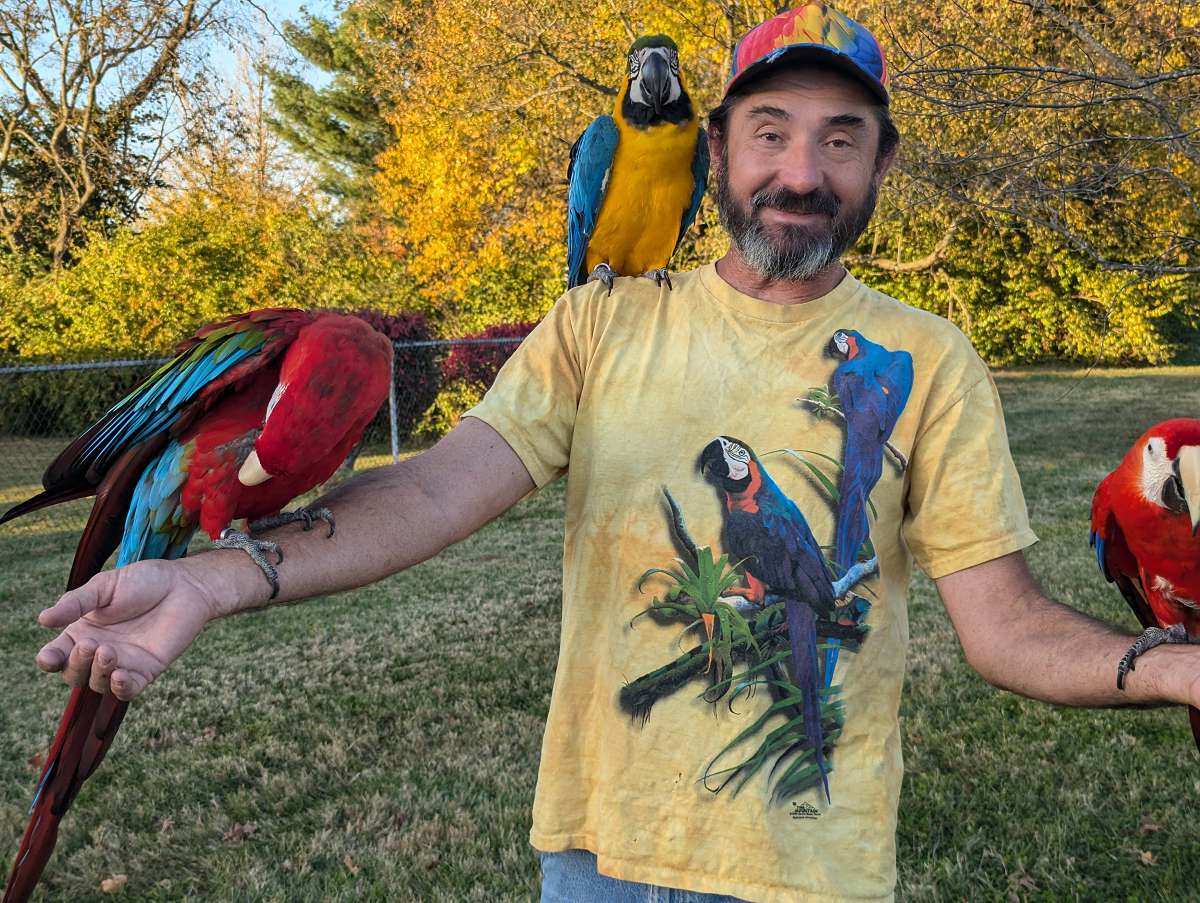

If you live in Central Kentucky and get out much, you may have seen a guy walking around town or at area festivals with colorful birds perched on his shoulders. Brit Reese — a Winchester resident who moved here from Washington State two years ago — loves his birds, and he loves getting to know his new community.
“I like getting out,” Brit says, “I love to meet other people and let them see these beautiful birds that I have. I have eleven of them. The birds and the festivals . . . are definitely a big hobby of mine.
“These are great birds to come out and visit with people, go to festivals with them, take pictures, go to nursing homes and schools, and all of our functions.”
I met up with Brit recently at Legacy Grove Park, one of the spots around town where he can often be found along with his beautiful, feathered friends. He brought along three of his macaws: Lacey, his youngest bird at four years, is primarily blue and blue-green with gold patches. Skittles, age 27, and Scarlet, his oldest, at 52, are both scarlet colored, with shades of blue, green, and yellow on their wings.
Surprised at Scarlet’s age, I asked if 52 was old for a macaw.
“No, she’s on the upper end of middle age. They can live to be about 60, 70, even 80 years. The bigger birds tend to have very long lifespans.”
And macaws are definitely big birds!
I was also surprised at how well-behaved Brit’s macaws are. Other than a bit of beak-fighting when they got too close, the birds spent the entire hour we were together perched calmly in a tree — or on Brit’s shoulders and arms. I even took a turn playing macaw perch. I was amazed they didn’t just fly away.
Obviously, that kind of behavior comes after a lot of training, patience, and a mishap or two. Brit showed me a bruise on his arm where he had gotten “pinched” by one of his birds. He blamed that on his own inattention.

One of his birds, Coco — a blue and gold macaw like Lacey — got away from him in August.
“We were outside my home taking some nice pictures . . . I put him in a tree and went inside to grab Lacey to bring her out. At the very moment that I went inside, he took off and he flew up and over my front door outside and ended up being outside for a couple days.”
Brit posted about the missing macaw on his Facebook page. It became a community effort to locate Coco and return him home safely.
“I knew he was safe. I’d made my initial post because I had lost sight of him for a couple of hours. And from there, I got sight of him again. It was just a matter of waiting him out until he was finally tired and hungry enough to come down. We had good weather, so I wasn’t worried about him up there.”
There were a few sightings, mostly near Brit’s home, but several attempts to get Coco down from trees failed, as he would get spooked and fly to a different location. Eventually, Coco got tired of flying from tree to tree and became stationary long enough for Brit to climb up and get him out.

I asked Brit how he made it to Winchester all the way from the upper West Coast.
“My son had bought property over in Owingsville and I was ready for a new start in life. So, I moved out this way. I didn’t come out here with a job or anything like that. I chose Winchester mainly because it had a little bit of everything that I was looking for in a town without being Lexington and without being some little itty bitty tiny town that had nothing . . . This is a really nice community that, you know, I really like.”
How did he get interested in owning birds?
“I got into these birds because of my ex-wife; she had always wanted a large bird, and we had a friend who worked at a rescue sanctuary in Washington State. We went down to visit, and she decided that she wanted to bring one home. And, of course, when she got one, well, hey, I’ll get one too. And my one turned into two, and then it turned into four. And then, when I moved out here from Washington, I came here with the four big macaws and the two African Greys, and since I’ve been here, I’ve got five more birds.”
The birds’ natural habitat is the tropical rainforests of Central and South America: Guatemala, Venezuela, Nicaragua, Honduras, and Costa Rica. As such, they can’t survive outdoors in Kentucky year-round. So Brit, like other tropical bird owners, keeps his macaws indoors.
“Yeah, my birds are on the inside. They have about 1,000 square feet of my house. They are cage-free, and there are challenges of having cage-free macaws. You’ve got to make sure that you have things for them to do. They [need] things to chew on and places to go potty from.
“You have to have a good habitat for them so they don’t destroy your house. I mean, I have a grand piano inside that room with them, and they have never touched it.”

Another challenge is keeping the animals adequately fed. For that, Brit can’t run down to the store and buy a big bag of bird chow. Instead, he makes all the birds’ food himself from fresh ingredients. And their main ingredient surprised me: spicy peppers!
“One of the best foods that they can have is these types of hot peppers. It’s all ‘fresh chop,’ as we call it. I normally mix about 30 or 40 different vegetables. I chop it up and prepare it for them. I’ll make a 100-pound batch at a time, and it will last about four to six weeks. Preparing fresh food for them is cheaper than buying something that’s processed — and it is definitely better for them. I know that my birds’ colors are much more pronounced when they have that type of food versus when they have any of the processed pellet-type stuff.”
If all of this care, feeding, and training sounds like a time-consuming and quite difficult challenge, it certainly is. Brit emphasized that owning even one of these big birds is a major commitment — and one that lasts a lifetime.
“The main thing with these birds is that they are difficult [to care for]. To have them is not something that anybody should take lightly. Don’t just go out and get one because they see me with them running around with them. They are a lot of work, and there are a lot of problems that can happen.
Never miss a thing with our FREE weekly newsletter.
“With these birds, when people don’t give them all the attention they need, you will have problems. And they live a long time. With these birds, you need to have well-thought-out beneficiary plans if you die because the bird is going to outlive you.
“And they’re expensive! That’s the other thing. You know, they may look great, but they’re very expensive. For example, Skittles is an $8,000 bird.”
I can see how much care, nurturing, and money must be expended to acquire and care for these beautiful animals. But I can also see Brit’s love and pride in these magnificent birds.
Near the end of our conversation, Brit had me stand still with my arms outstretched while he carefully placed all three birds on my shoulders and arms. I must admit, I felt a bit uncomfortable initially, never having been a large bird owner — or a pirate. But I quickly got accustomed to the feeling.
They really are amazing creatures. Be sure to check out Brit’s Facebook page and watch for him and his prized companions at a local festival or just roaming around a local park.

