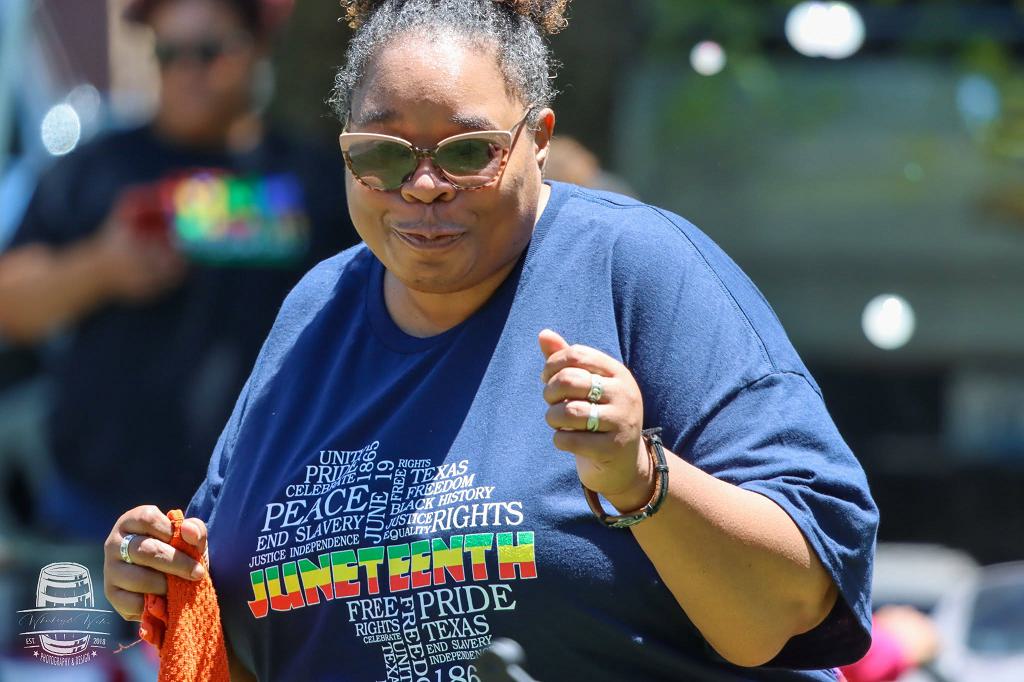

Winchester held its first (of many, as we’ve been told) Juneteenth Celebration right here on Washington Street on Saturday, June 20.
Organized by the Winchester Labor Day & Juneteenth Committee, events included a historical presentation by Dr. Elaine Farris, Natalya & Evea Williams of the Williams Sisters Praise Dancers, speeches, dance, and songs performed by Juneteenth Pageant participants, music by DJ Brown, a traditional Congolese drum and dance by Kumba, Dis n Dat Dance Company, and live music by One Sound Band.
There were also special appearances by Jerone Morton, former George Rogers Clark High School basketball star and current University of Kentucky basketball player. Jeremiah Mundy-Lloyd, a former GRC football and basketball player and former Union College football player, volunteered his day to help ensure the event was a success.
As an extremely pale person (i.e, much like a sickly Victorian child), some may have questioned my arrival there, but it wasn’t long before people of all walks of life began to show up, browsing the booths, grabbing some delicious food, and enjoying the entertainment.
Because, despite what some may think, Juneteenth is for everyone.
The practice of recognizing Juneteenth began almost immediately following an event in Texas.
The Emancipation Proclamation, issued by President Lincoln on January 1, 1863, freed all enslaved people in the South, but the Civil War continued until April 1865. Texas became the perfect spot for Confederate enslavers to run, as the isolation of the area allowed continued enslavement without consequence.
That all changed when Union troops arrived on June 19, 1865, enforcing the Emancipation Proclamation and freeing the remaining 250,000 enslaved African Americans. And thus began the celebratory gatherings among those freed people every June 19th.
Initially, it was called Emancipation Day, Jubilee Day, or Freedom Day. As the freed people moved around the country, they took the tradition of celebrating June 19th with them, gaining more and more momentum during the Civil Rights Movement in the 1960s, since emancipation was only the beginning for the Black community to truly be free and thrive.
Its first declaration as a national holiday was in Texas in 1979, with continued recognition through 2021 during the Biden administration, when it was declared a national holiday.
Despite all of this information being easily accessible, there are still people who claim they’ve never heard of Juneteenth, don’t understand why it’s a holiday, or express offense that there is a holiday specifically for “one race, ethnicity, culture, heritage, etc.”
But that’s the biggest point to the celebrations being held across the United States and our very first Juneteenth Celebration this year in our town.
“We are proud of everyone who attended, performed, volunteered, sponsored, and supported Winchester’s First Annual Juneteenth Celebration. We witnessed people from different backgrounds coming together in peace, sharing culture, music, food, education, and fellowship.”
McKeon Mundy-Asamoah
Juneteenth is for EVERYONE. Every single person in the US has the ability and justification to recognize this holiday.
“We want families to come together, local businesses to grow, young people to see themselves represented, and neighbors from every background to learn from one another,” explains McKeon Mundy-Asamoah, secretary for the Winchester Labor Day & Juneteenth Committee.
Juneteenth is a show of freedom, resilience, hope, and continued action for equality. It’s also a reminder that law changes don’t always mean day-to-day changes without continued education and enforcement. It’s an integral part of US history that we all benefit from being educated about.
The themes of resilience, rights, and freedom are applicable across any demographic, and acknowledging this monumental day in the history of Black Americans isn’t a slight against other histories but is about including ALL histories that have built the beautiful melting pot of cultures we now get to enjoy.
As we’re all painfully aware, this country’s history has been (and still is) often molded and whitewashed into something comfortable or ignored, allowing the same mistakes to continue to be made, even in 2026.
I read something online recently — some “recommended” social figure that Facebook plopped into my feed while I was doomscrolling — that said, “Juneteenth is for Black Americans to celebrate and white Americans to observe,” and this expressed perfectly how I felt about being present at the Juneteenth Celebration this year. It wasn’t exclusive.
It didn’t restrict any people. It was joyful. It was hellos and hugs and dancing in the street.
Mundy-Asamoah shared, “We are proud of everyone who attended, performed, volunteered, sponsored, and supported Winchester’s First Annual Juneteenth Celebration. We witnessed people from different backgrounds coming together in peace, sharing culture, music, food, education, and fellowship. You do not have to attend every event, agree with every event, or celebrate every occasion the same way. What we can do is respect one another and recognize that every community has room for different cultures, traditions, and celebrations.”
Whether it be from lack of information, lack of exposure, fear of the unfamiliar, or any other reason that you may not yet understand Juneteenth, I encourage you to attend events during which the true history of our country, especially Winchester’s own future Juneteenth events, for an amazing display of community and the hope for a continued upward motion of diversity and inclusion.
And in the meantime, we can keep the spirit of uplifting marginalized communities by listening, learning, economic support, and continued respectful participation.
The Winchester Labor Day & Juneteenth Committee would like to extend a special thank you to the strong community support and sponsors, including but not limited to Greater Clark Foundation, Ale-8-One, Winchester Chamber of Commerce, and Blue Grass Community Foundation.