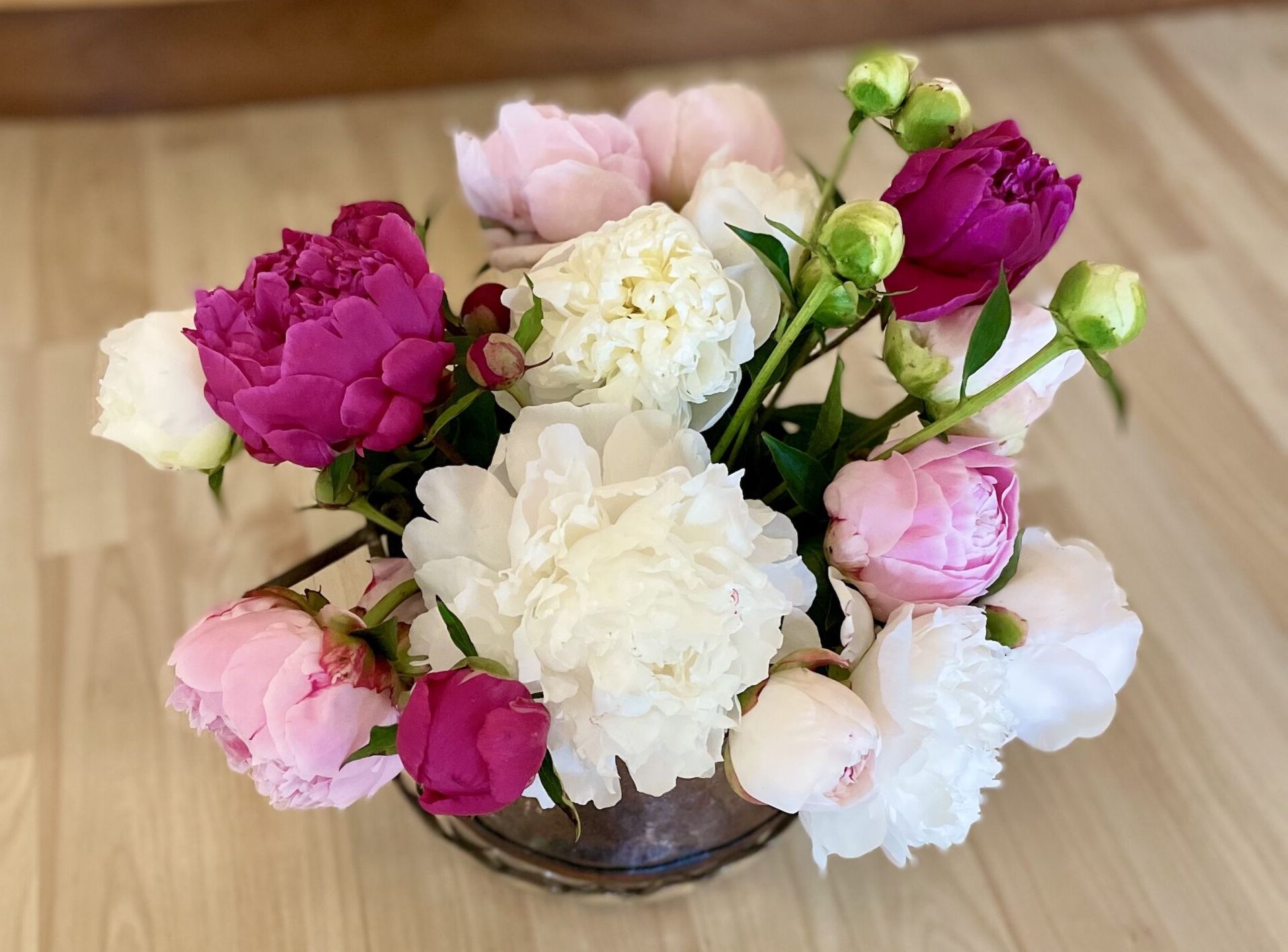
My mother brought me a bouquet of peonies yesterday, my favorite flower. Hers range from white with fuchsia-tinged edges to pale pink to a vibrant, deep raspberry. This was the first bouquet of the season and the first time I have truly seen her peonies in all the years she has grown them. You probably know by now that I am colorblind, a rarity in women (less than half a percent of women are colorblind, compared to more than 8% of men). This means my eyes don’t absorb photons, or light particles, as well as the average bear, so everything looks muted and sepia-toned, like Kansas before Dorothy gets to Oz. But thanks to technology, I now have what I call “magic glasses,” which allow me to take in more light particles and see the world like everyone else.
So, while this was the first time I saw them, I didn’t actually see them. All the yoga students that commented on these gorgeous pink beauties? They didn’t see them either.
Confused? Let me explain.
The Science
Among the vast and vibrant palette of colors we perceive in the world, pink holds a curious place because it is not a color that truly exists in the physical world. It is, instead, an invention of the human brain.
Never miss a thing with our FREE weekly newsletter.
Perception begins with light (specifically, electromagnetic radiation of various wavelengths). The visible spectrum ranges from violet (short wavelengths) to red (long wavelengths). Every color we see is the result of how our eyes and brains interpret this spectrum. When photons hit an object, every color of the spectrum is present, but most are absorbed. The color reflected the most is the color your eye “sees.” For example, with an apple, every color except red is absorbed.
My colors are blush and bashful.
Shelby, Steel Magnolias
Red and violet lie on opposite ends of the spectrum. There is no wavelength of light that corresponds to pink, no P in ROY G BIV. The idea of pink arises when our brains are presented with a mix of high-energy (blue/violet) and low-energy (red) light without the presence of green. In other words, pink is the brain’s creative solution to a problem: how to reconcile input from both ends of the visible spectrum while skipping the middle. The result is a color that doesn’t exist in the light spectrum but exists quite vividly in our minds.
The Lesson
The story of those pink peonies then is not just about color, but about the human experience. Our brains are not simply passive receivers of information, but active creators of reality. In the absence of a straightforward answer, our brain invents one. It fills in blanks, bridges gaps, and creates meaning where none objectively exists. The pink we “see” is a metaphor for how we navigate the world: not by perceiving it exactly as it is, but by interpreting it in ways that make sense to us.
We are wired to make connections, to find beauty, and to create coherence in a world that often resists simple explanation. Pink teaches us that perception is not just observation, but also invention. Those flamingo-colored peonies are a reminder that some of the most beautiful things in life are not grounded in cold, hard reality, but as products of the mind. Like music, poetry, and love, pink is a creation that defies objective measurement but resonates deeply, nonetheless. It shows that our world is not merely what is but also what we dream, what we hope, and what we imagine.