
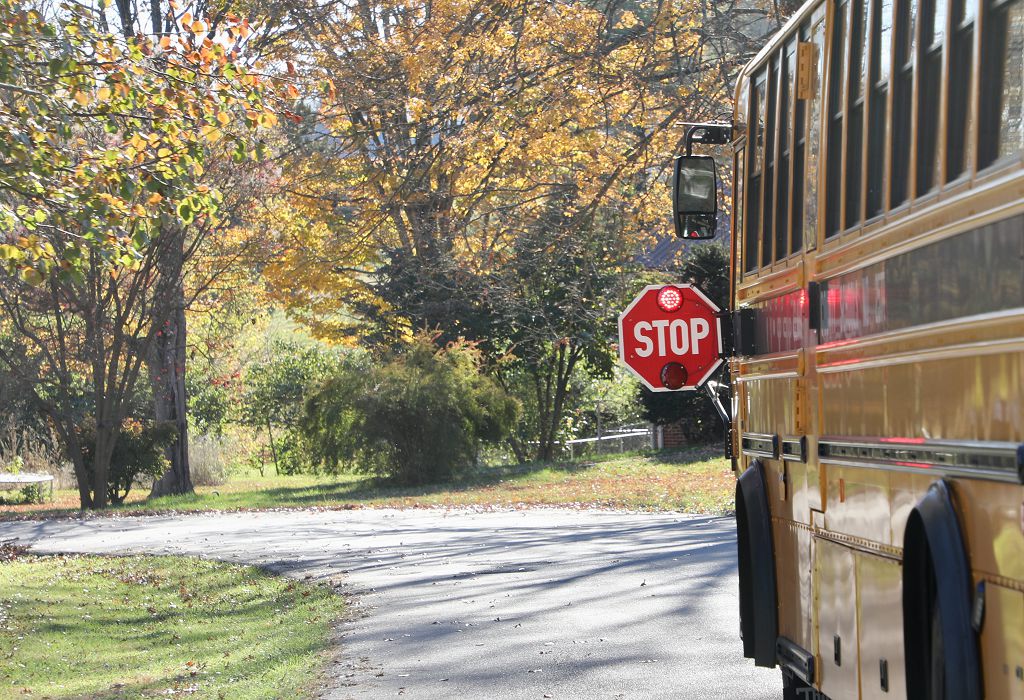

A new law should make it easier to hold drivers accountable if they pass school buses that are stopped to pick up or drop off children.
House Bill 7, which was signed into law by the governor and took effect July 15, allows school districts to equip buses with cameras to record the license plate numbers of vehicles whose drivers ignore bus stop-arm signs and flashing red lights.
It also allows civil penalties for the owner of the vehicles if the drivers aren’t identified.
Drivers or owners who violate the statute, KRS 158.486 to 158.490, are subject to a $300 penalty for a first offense or $500 for a second or subsequent offense. If the penalty is not paid within 60 days, the vehicle’s registration may be suspended.
Clark County Attorney William Elkins said he would expect to see very few of the cases contested. Drivers will likely pay the $300 penalties to avoid having their registration suspended, he explained.
Until this year, stop arm violations were treated as a criminal matter. That law, KRS 189.370, remains in effect. It includes tougher penalties, including the possibility of jail time. But the new civil law gives police and school resource officers another tool to use that increases the likelihood of enforcement.
Elkins explained that under the criminal statute, prosecutors must prove “beyond a reasonable doubt” that the person cited was the driver and committed the offense. The civil law, however, requires only a “preponderance of evidence” to issue a notice of violation. And if the person doesn’t contest it, it becomes a judgment against him or her.
“That lower penalty and reduced obligation to identify the owner . . . is going to give rise, I think, to a greater incidence of treatment and better results,” Elkins said.
“If you don’t send the notice to the accused within 30 days, on the 31st day, the school district has to destroy the images,” he mentioned.
Elkins noted that the new law does not require county attorney offices to be involved in the prosecution of civil cases, although contested cases will be heard in district court, not by the school board.
The school district must hire an attorney to handle the cases.
“I wouldn’t rule out the possibility that after we’ve had an opportunity to discuss how we implement this on a local basis, that instead of the school board providing an attorney at its own expense, we would be able to provide one for them,” Elkins said.
However, at this point, the Clark County Attorney’s Office is not involved.
State Sen. Greg Elkins, R‑Winchester, said that last year he sponsored a bill that would have treated stop arm violations as a criminal matter, but it did not pass the legislature. This year, he supported the civil bill.
The legislator said the new law is needed.
“There are hundreds of violations on a school day in Kentucky,” he said. “This will help to identify the offenders.”
The state senator said that not all school districts have been able to afford to equip their buses with cameras, but under the new law, school districts can contract with camera companies, and those companies would get the money generated by the penalties until the cameras are paid for; then after that, the money would go to the school district. The court system would get only a nominal fee for each violation.
Law enforcement agencies involved in the enforcement would get $25.
House Bill 7 also clarifies the rules about when drivers must stop for buses. Even on four-lane, divided highways, motorists must stop in both directions when a bus has its stop arm out and its flashers on, unless there is an unpaved median or an elevated barrier dividing the lanes. A center turn lane does not qualify as a barrier or median.
There are only a few multilane highways in Winchester and Clark County that are not divided by either a grassy median or a concrete barrier. One is Maple Street (Ky. 627). Another is the section of Veterans Memorial Parkway between KY 627 and Mount Sterling Road.
David Smith, a school bus driver for the past three years, said that Clark County’s buses have cameras but the quality of their images often isn’t good enough to use as evidence. However, he said, the district is considering upgrading its camera system.
Darren Snell, director of logistics and student support services for Clark County Public Schools, verified that the district is getting new cameras. He said CCPS has 12 new buses on order, and they will all be equipped with the newer video cameras, which constantly record images and make it easy for drivers to locate the segment.
“Our plan is to see how good those are,” and if they’re good enough, he said, they could also be used on all buses.
Snell said the school district hasn’t sent many photographs to the Winchester Police Department or the Clark County Sheriff’s Office.
“I’d say in the last four years, we’ve sent less than five,” he said.
William Elkins said that Deputy County Attorney Daniel Varney told him he could think of only one case the office has handled in the past year under the old criminal law, and that case arose from a 2020 criminal summons that didn’t get served for years.
By the time the case made it to court, the video was no longer available from the bus garage, and there was no resolution of the case.
Elkins said he believes one other case under the old law did not reach court until 2025.
Get the book! "Our Stories, Our Voices: A 5-Year Anniversary Collection."
Snell said he isn’t interested in working with a third party, but would prefer that the school district own its own cameras because the companies don’t care about the community the way local officials do.
“I don’t think we would ever recover the total cost of the cameras” from the fees levied against violators, but “we can make it safer for our students, and that is the goal,” Snell said.
The director said Clark County probably has two or three instances per week of drivers failing to stop for school buses.
He believes the new law will result in increased enforcement.
“I think it’ll be good for the community and for Kentucky as a whole,” he said.
