

Democrats have defied the odds, gaining control of Congress in a historic landslide election.
With contests for the last two Senate seats decided this week, the party will begin 2027 with a 56–44 majority in that chamber, as well as a likely 260–175 margin in the House of Representatives.
Not only did Democrats take Capitol Hill, but they also now control most of the state legislatures and governorships in the country.
The 2026 midterm reminds me of 1974, when voters repudiated Richard Nixon’s corrupt, autocratic administration by electing a new generation of reform-minded Democrats to Congress, and then two years later, putting a Democrat in the White House after eight years of Republican rule.
But I’m also reminded of how quickly Republicans reversed that rout and how easily it could happen again.
Already, Democratic progressives are trying to snatch defeat from the jaws of victory. They want to replace moderate Chuck Schumer as Senate majority leader and are encouraging leftists Ro Khanna and Alexandria Ocasio-Cortez to run for president.
Those two have about the same chance of winning the White House as the Los Angeles Chargers or the New York Jets have of winning the Super Bowl.

True, there was a string of wins by democratic socialists and social liberals from L.A. to D.C. last week, but what that means is that blue parts of the country got a little bluer — not that the left won converts in red states and districts.
What has been largely overlooked by party activists and the media is that in almost every competitive race in the country, it was centrists who accomplished what seemed unlikely or even impossible only a few months ago.
In Kansas, which had not elected a Democrat to the Senate in almost a century, megachurch pastor Adam Hamilton won with 51 percent of the vote in a three-way race with a Republican and a Libertarian.
In Texas, Democrat James Talarico won John Cornyn’s U.S. Senate seat, and his party gained House seats. But also, Gina Hinojosa, who distanced herself from the progressive label she once embraced, unseated the Republican governor, Greg Abbott, becoming the first Democrat to lead the Lone Star State in more than three decades, and in a stunning reversal, Democrats claimed the majority in the Texas House of Representatives for the first time in two decades.
In Ohio, too, Democrats won a U.S. Senate race with former Sen. Sherrod Brown and elected Amy Acton governor over former Republican presidential candidate Vivek Ramaswamy.
In battleground Michigan, all the attention was on the progressive Senate candidate, Dr. Abdul El-Sayed, but centrist Democrat Jocelyn Benson won the governorship by promoting innovation and entrepreneurship as engines for economic growth. And, it’s worth noting, she won by a landslide, while El-Sayed barely won, by only 1 percent.
Not only did a moderate Democrat, former Gov. Roy Cooper, win the Senate race in North Carolina, as expected, but in South Carolina, where no one expected a blue wave, Democrats elected Annie Andrews to the Senate, captured a U.S. House seat, and overturned 10 seats in the state legislature, breaking the GOP’s supermajority.
Also, in North Carolina, voters approved conservative ballot measures to require photo IDs for voting and to rein in tax increases.
It should be clear: Americans don’t want a revolution. They want commonsense policies.
The message from the heartland is that people are hurting because they can’t afford health care, housing, and food. They’re sick of public corruption. They don’t want another war that goes on and on, demanding sacrifices of our young men and women and a big drain on our resources. And they are willing to give Democrats a chance, just as they were willing to give Republicans a chance two years ago.
Behind that message, however, is a warning: If you mess it up, you can forget about 2028.
Here in Kentucky, Democrats missed a rare opportunity to be part of a national blue wave.
I believe that if Gov. Andy Beshear had done what Cooper did in North Carolina and run for the U.S. Senate instead of holding out for a crowded presidential race that he’s unlikely to win, he would have been Kentucky’s senator-elect.
It would also have been more interesting to watch the two Andys — Beshear and Congressman Andy Barr — compete in a nail biter than to watch Barr savage the likable, but hopelessly liberal Charles Booker, for whom the third time was not the charm.
I know, Beshear has said he has no interest in being a legislator, that his strength is in executive action. But he’s only 48 — the same age Barack Obama was when he became president — so he has time on his side. He could have served a short time in the Senate, as Obama did, and then run for president in 2032.
With national leadership experience, and a larger national profile, Beshear would have been a formidable candidate six years from now, the kind of Democrat who could win over enough moderate Republicans and independents to be elected president in what is arguably a center-right country.
Rocky Adkins, who was a masterful legislator as leader of the Kentucky House of Representatives, and who ran a strong second to Beshear in the 2019 Democratic gubernatorial primary, might also have had a good chance of winning against Barr, and probably would have been a good senator.
And, as a member of the new Democratic majority, he would have had more clout than Barr.
Instead, Adkins and Lt. Gov. Jacqueline Coleman will likely bloody each other in the 2027 primary, allowing Republican James Comer to stockpile his money for the general election and probably defeat a badly wounded adversary.

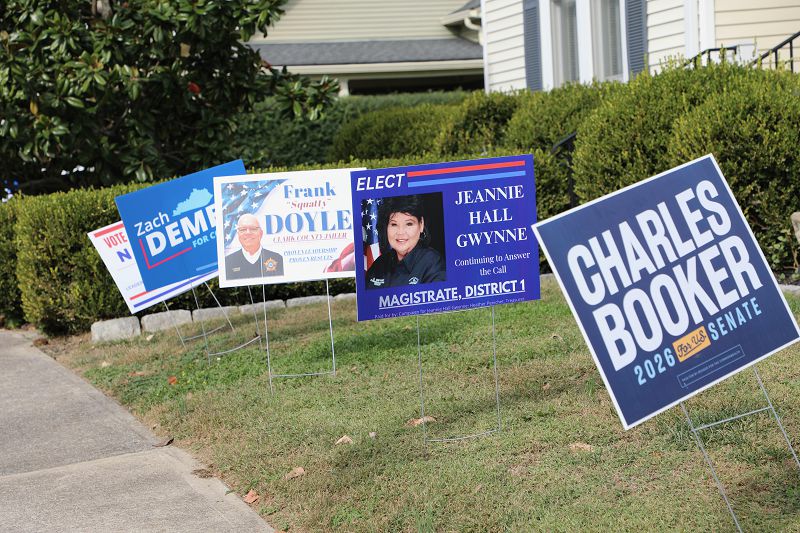
The one big win for Democrats in Kentucky was in the contest for the 6th District of the U.S. House. Zach Dembo, a former federal prosecutor who focused like a laser on the issues of corruption and the cost of living, won the open seat against Republican Dr. Ralph Alvarado of Winchester, whose early embrace of President Trump didn’t help him in the end.
Dembo is the first Democrat to win the 6th since Ben Chandler, who lost to Barr in 2012. It was a narrow win; Alvarado won his home county of Clark and every other county in the district except Fayette and Woodford.
I wouldn’t be surprised to see a rematch in 2028.
I’ve had several people ask me if I was surprised by the outcome of the local election in Clark County, and I would have to say that for the most part, I wasn’t.
Earlier in the year, I thought the Winchester Board of Commissioners was going to be largely made up of young people with fresh ideas about governing and growing our city. But candidate Logan Hall dropped out of the race to become the county’s emergency management director, and at the end of the campaign, Commissioner Hannah Toole left to become the new tourism director for Winchester and Clark County.
James Bowman, who ran what I thought was a brilliant campaign, didn’t make the cut, but has already said he will be back in 2028.
The board will have one new commissioner, Jim Caldwell, who is well-known as a former WKYT weatherman. Since he skipped the debates, it’ll be interesting to learn what ideas he has for the city and see how he votes as a commissioner.
I wasn’t surprised that Circuit Judge Lucy VanMeter won over the appointed incumbent, Judge Will Moynahan, grandson of the late federal judge Bernard Moynahan, in the contest for the Kentucky Court of Appeals seat in the 5th District, especially in Clark County, where her husband, former Supreme Court Chief Justice Larry VanMeter has deep family roots.
What I was surprised by, though, was that the judicial race was so partisan. Democrat Beshear openly supported Moynahan, and Kentucky’s Republican legislative leaders openly supported VanMeter.
Get the book! "Our Stories, Our Voices: A 5-Year Annioversary Collection."
Judicial races are supposed to be nonpartisan, and it used to be that candidates were careful not to be so obvious about their political affiliation.
Probably the biggest surprise of the night for me was in the contest for the 4th District seat on the Clark County Board of Education. That’s because the winner, incumbent Ben Dorsey, who received more than three quarters of all the votes, had just been indicted for felony theft along with another school board member who was not on the ballot this year.
He had been unopposed when he filed in January, but near the end of the election, he faced two write-in challengers, Katie Brashear Jones and Valerie Frost.
Granted, Dorsey hasn’t been convicted of anything, and he told me he intends to vigorously defend himself against the allegations. Still, given the fact that he was charged, it surprises me that he won by so big a margin.
I think it just shows how hard it is for write-in candidates to get many votes when their names aren’t on the ballot and election workers can’t give voters the names in written form to take into the polling place with them when they go to vote.
