
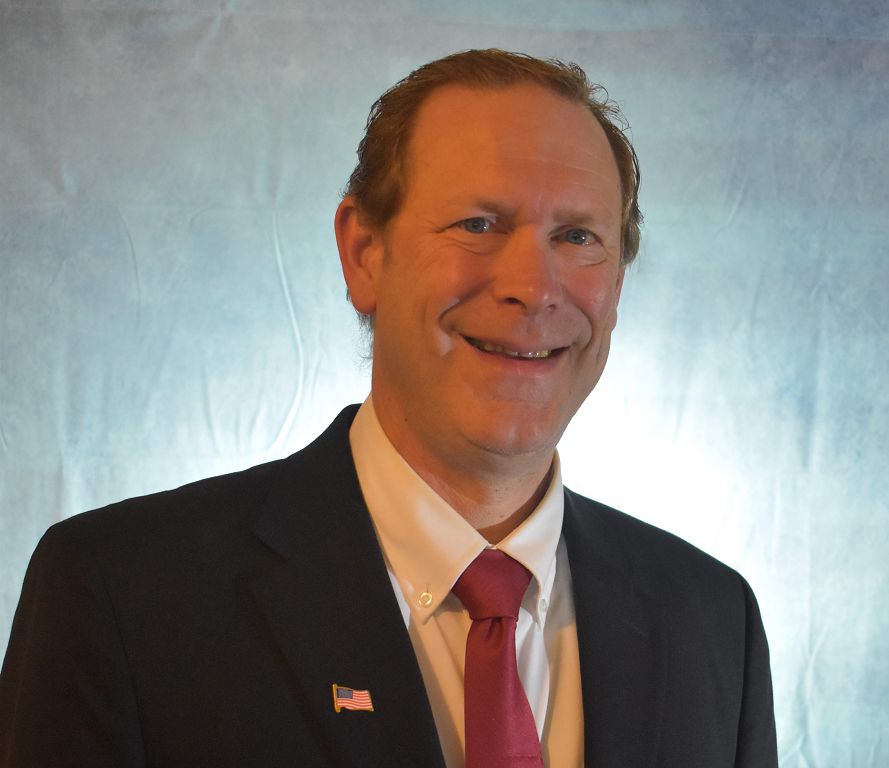
Eric Vetter has never held elected office, but he has run large organizations.
The retired Navy captain and hospital pharmacist is one of four candidates vying for the Republican nomination of Clark County judge-executive, and he thinks his military leadership makes him a good fit for the office.
Vetter said in a recent interview that he has two important qualifications. One is his background. He has commanded hundreds of men and women. The other is his ability to relate to people, including influential political leaders he has known for a long time.
“I think one of the strengths I would bring to the office is those relationships that I’ve developed over 20 years in GOP politics,” he said.
Vetter said he has known U.S. Senate candidate Andy Barr since 2003, before Barr first ran for Congress. And he got his start in politics campaigning door-to-door for Dr. Ralph Alvarado of Winchester, a former Kentucky state senator and Tennessee commissioner of health who is now running for Congress. He also has close ties to the other leading candidate for Congress in the Bluegrass, the Rev. Ryan Dotson, also of Winchester. And he has known both Republican candidates for state representative from Clark County, Daniel Konstantopoulos and Les Yates, as well as state Sen. Greg Elkins of Winchester, all of Winchester, for close to a decade.
Vetter was state chairman of the Kentucky Young Republican Federation for two years and started the local chapter here.
He describes himself as a traditional Ronald Reagan Republican.
Also, being in senior-level executive leadership in the military has helped him learn how to work with people from different backgrounds and experiences, he said.
“Relationships, whether it’s specific political relationships like I have, or just the way I work with people, I think that’s a strength,” he said.
Vetter, 57, grew up in a small town in Michigan and earned his bachelor’s degree from Ferris State University in Big Rapids in 1993 and his doctoral degree in pharmacy from the Kalamazoo Center for Medical Studies, associated with Michigan State University, in 2001. He joined the Navy Reserve right after his sophomore year as a hospital corpsman and made the military his career, being commissioned an ensign in 1993 and retiring as a captain in 2022.
He and his wife, Sharon, who is from Lexington, met in the Navy when both were on active duty, and they decided to move close to her parents.
“I’ve lived in Chicago, I’ve lived in San Diego, but I much prefer the pace of a smaller town,” he said, explaining why they chose Winchester, where they’ve lived for 25 years.
He’s a pharmacist for Centerpoint Health, formerly Clark Regional Medical Center, and she’s retired as a dentist from the Veterans Administration clinic. She also retired from the Navy as a captain, in 2019.
They have three adult children, an older daughter, Theresa, who works for Palmer Engineering; a son, Daniel, who recently graduated from Eastern Kentucky University and is considering following his parents into the military; and a younger daughter, Katie, who just graduated from high school and is a student at Blue Grass Community and Technical College.
The 9⁄11 terrorist attacks happened a month after they arrived in Kentucky, and they wanted to volunteer, but the Navy at the time needed dentists but not pharmacists, and the Letters told the recruiter they were “kind of a package deal.”
Later Vetter was director of administration in Portsmouth, New Hampshire, for 20 detachments, or 900 personnel, and when the coronavirus pandemic occurred, he became acting executive officer, or second in command.
“There’s a lot of management that goes into a command that large,” he said.
Also during the public health crisis, when the U.S.S. Theodore Roosevelt, which was headed for Guam, had 1,000 covid-positive sailors on board, Vetter was part of a group called up from Camp Pendleton, California, to establish the first expeditionary medical facility hospital since the Vietnam War.
Vetter was director of clinical support services, meaning he was over pharmacy, lab, radiology, behavioral health, and preventative medicine — everything except nursing and physician services.
He believes that kind of experience is good training for being a county government chief executive.
Asked why he wants to serve Clark County after decades of military and medical service, Vetter answered that “we’ve made this place our home, and I just think there’s so much potential in this county,” in large part because of its location.
“I feel confident in saying I’m the most pro-growth candidate,” he said, and he thinks the county needs “responsible growth,” adding that what he’d “really like to see are some Keystone Industries” in Clark County.
“At the forefront of my mind is what do we need to do to be ready so that we can take advantage of those opportunities when they strike,” he said.
He also believes that growth is the answer to the county government’s current financial problems. He would rather increase revenue by growing the tax base than by raising taxes, and also prefers that to reducing services.
Vetter, a former member of the Clark County Board of Health, said he is “a quick learner.”
As for the issues facing fire protection and emergency medical services, he said, “that’s going to be a challenge.”
Never miss a thing with our FREE weekly newsletter.
“Nobody wants to cut those services,” he said.
Vetter thinks the state legislature needs to pay more for county jail services.
Asked what he would like to achieve as county judge, Vetter answered: “One of the things I would envision if I come into office would be a change of tone. I think I’d like to bring a new tone, a new focus and a new energy to the job of judge-executive.”
“I think I have a very good working relationship with a lot of our magistrates we currently have. Obviously, the court’s going to change, but that’s all right. You can leverage the experiences that those members already have,” he said.
“I have really enjoyed this community, and I just think that now is a really good time to step up and take the helm,” he concluded.
