
What’s holding Kentucky back?
The minimum wage will increase in nearly half the states this year even as the federal wage floor remains stuck at $7.25 per hour.
In many states, the minimum wage is automatically adjusted upward as inflation rises. But voters in several states, including deeply red ones such as Alaska and Missouri, chose in November to significantly increase their minimum wages this year.
Michigan will see its minimum wage jump from $10.33 to $12.48 on Feb. 21 after the state Supreme Court concluded the legislature subverted residents when it adopted but then significantly amended voter-initiated ballot measures in 2018 to raise the minimum wage and mandate paid sick time.
Michigan’s wage floor is set to rise to $14.97 by 2028 — more than double the federal minimum wage, which has not increased since 2009. That’s the longest period without a federal increase since Congress first set a minimum wage in 1938.
A total of 30 states and the District of Columbia have set their own minimum wage higher than the federal rate. And 67 localities — including Birmingham, Alabama; Denver; Flagstaff, Arizona; and Los Angeles — have raised their minimum wage above the state minimum, according to the Economic Policy Institute, a left-leaning think tank.
$7.25 is KY minimum
Kentucky in 2023 had 14,000 workers earning the minimum wage of $7.25 an hour or less, according to the U.S. Bureau of Labor Statistics.
The Kentucky Supreme Court has ruled that local governments in Kentucky lack the power to increase the minimum wage. The court overturned local wage increases enacted by Louisville in 2014 and Lexington in 2015.
Currently, 10 states have a minimum wage of $15 or higher: California, Connecticut, Delaware, Illinois, Maryland, Massachusetts, New Jersey, New York, Rhode Island and Washington.
Alaska, Florida, Hawaii, Missouri and Nebraska are on track to reach the $15 benchmark in the coming years. Such movement in red states should prompt Republicans who control Congress and the White House to move the national wage floor, argued Richard von Glahn, the political director at the labor advocacy group Missouri Jobs with Justice.
“We should have Republican legislators looking and seeing what their own voters are telling them and say, ‘You know, maybe they’re on to something here and maybe I should follow their lead,” he said.
Von Glahn led a successful campaign to raise Missouri’s minimum wage from 2024’s rate of $12.30 to $15 per hour next January through a November ballot initiative that also guaranteed sick leave for many workers.
While a tight labor market forces many employers to pay above minimum wage to compete, von Glahn noted many workers still earn at or near the lowest legal rate. The Economic Policy Institute estimates that more than half a million Missouri workers will see raises as the state’s minimum wage increases.
“That sort of proves the point as to why this is so necessary, why these guardrails are so important,” he said.
For Kaamilya Hobbs, the Missouri law means she can expect at least an extra 31 cents per hour once she returns to work at Arby’s following maternity leave.
This year’s new minimum wage of $13.75 isn’t enough to live comfortably in Kansas City, she said. But every bit helps her afford the basics, such as diapers and baby formula.
“It won’t be a huge difference. But it’ll still be a little bit of something for us,” said Hobbs, 33, who is also an organizer for a group advocating for low-wage workers.
Inflation has significantly eroded the buying power of the stagnant federal minimum wage. Advocates say raising the wage floor helps low-wage workers cover the rising cost of essentials and boosts the economy by putting more money into the pockets of people who are likely to spend it. But many employers, especially retailers and restaurants, counter that raising the minimum wage forces them to cut workers or raise prices.
In December, President-elect Donald Trump said he would consider a national increase in the minimum wage. Trump won 19 of the 20 states — all but New Hampshire — still subject to a $7.25 minimum wage. In an NBC News interview, he acknowledged the $7.25 rate was “a very low number,” but said raising the minimum wage too much would decrease employment.
“There is a level at which you can do it,” he said, without specifying a number.
Earlier this month, Alaska’s minimum wage went up 18 cents thanks to an automatic inflation-based bump.
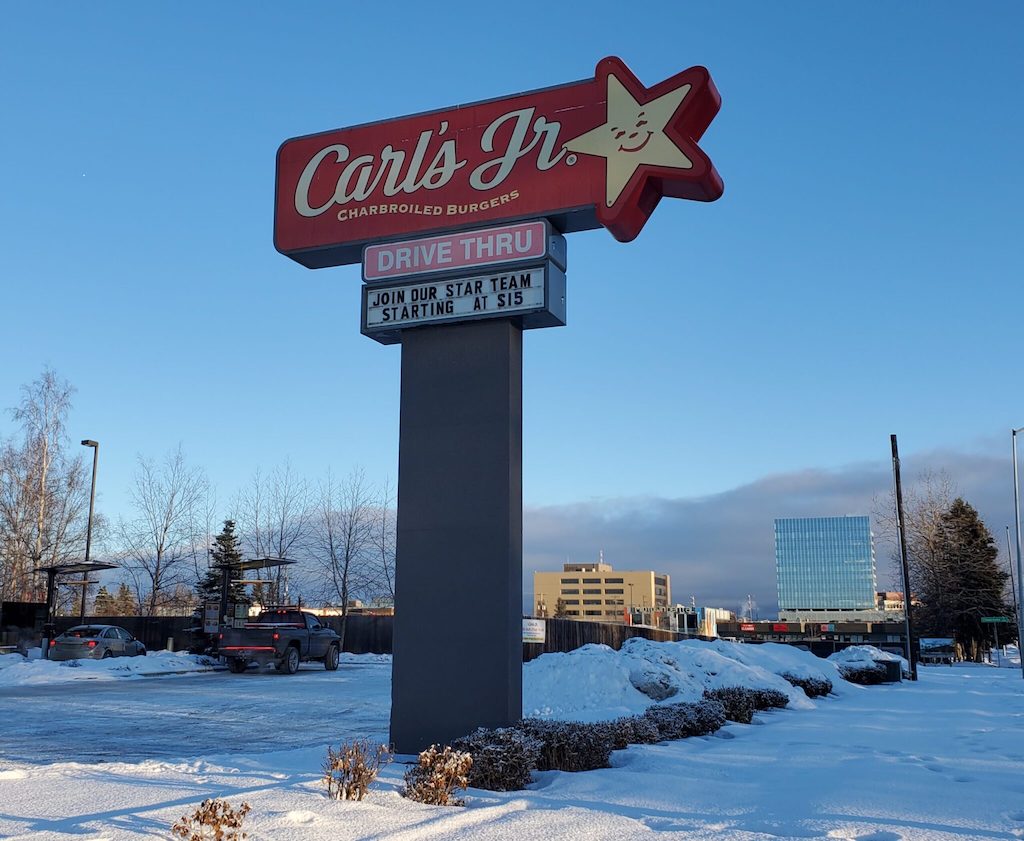
But the state’s current $11.91 rate will increase to $13 this July, thanks to the passage of a November ballot measure. Under the measure, the wage will increase to $14 in July 2026 and $15 in July 2027, followed by inflation-adjusted increases starting in 2028.
The ballot measure drew fierce opposition from business groups but won approval by 58%-42%. The new law also mandates employers provide up to seven paid sick days per year — a major concern particularly in seasonal industries, including tourism.
Before November’s election, members of the Alaska Cabaret, Hotel, Restaurant and Retailers Association said passage of the ballot measure would result in higher prices and lead to layoffs and reduced hours for workers, said Sarah Oates Harlow, president and chief executive officer of the organization.Mark Robokoff, owner of the pet supply store AK Bark in Anchorage, Alaska, supports the effort to raise the state’s minimum wage. (Courtesy of Mark Robokoff)
The minimum wage hike will particularly hurt smaller businesses, she said, and those with tipped workers such as servers and bartenders. Alaska is among seven states that don’t allow employers to pay tipped employees less than the minimum wage, meaning many of those workers are already making well above the state’s wage floor, she said.
“I guarantee you we will be seeing prices going up across the board,” she said. “Groceries are going to be more expensive. Eating out is going to be more expensive.”
But Mark Robokoff, who owns the pet supply store AK Bark in Anchorage, sees a higher wage floor as good for business. He said the minimum wage increase will put more money into the pockets of his customers.
“It’s not like there’s no benefit to this cost,” Robokoff said.
Never miss a thing with our weekly newsletter.
To attract the best staff, he said, employee wages start at $17 per hour. But he expects to ratchet that figure up as the state’s minimum wage increases.
“That’s why it needed to be a law,” he said. “It only works if we all do it. Then we all get more revenue and pay our employees a little bit more.”
This story is republished from Stateline, a sister publication to the Kentucky Lantern and part of the nonprofit States Newsroom network.
