
We gotta get outside more.
Our prehistoric brains aren’t coping too well in our modern technological world. Homo Sapiens have been around now for about 200,000 years. And until about 5,000 years ago, we were hunter-gatherers, wandering the land in clans. The first civilizations – where we stayed in one place, more or less – only arose around 5,000 years ago. And a lot has happened in that 5,000 years.
It started out slowly, with hundreds of years passing between major shifts in our newly formed societies. We figured out how to domesticate corn, the pig, the potato. We figured out how to extract iron and make weapons. We figured out Euclidean geometry. We built the Great Wall and then windmills. The industrial revolution gave rise to the clock, the steam engine, the spinning jenny, the hot air balloon.
Then, new inventions were introduced in very short order. The telephone. The light bulb. The telegraph. Insulin. Cars. Televisions. Nuclear power plants. Sputnik. Personal computers. In vitro fertilization. The internet. Cloned mammals. Smartphone apps were introduced in 2008, only thirteen years ago. Consider how our phones are, for all intents and purposes, like an extra appendage to most of us now. We’ve completely changed the human experience in a mere thirteen years.
Now consider evolution. Thirteen years isn’t enough time for our brains to fully adapt to the overly fast pace of modern society. Even 5,000 years isn’t enough time, only a blip in the history of humanity.
What I’m saying is this. We’re navigating a technologically-advanced existence with a brain that hasn’t changed that much in 200,000 years.
We were designed to hunt, gather, and wander. Our world no longer requires these skills to survive.
We were designed to live in the now, following our of-the-moment instincts to eat, find shelter, avoid danger, and procreate. Our world has us living in the future, worrying constantly about what might happen, dress-rehearsing tragedy at every turn.
We were designed to know a small number of people intimately. Our world tells us we must know what is happening to everybody at every moment.
Get the book! "Our Stories, Our Voices: A 5-Year Anniversary Collection."
No wonder we’re so overwhelmed. We gotta get outside more.
Nature gives us back our groove. Our brains were evolutionarily designed to interpret information about plants and streams, not photoshopped photos and pixelated phones.
Each season is sacred. So why do we allow them to slide by unnoticed? As Mary Oliver reminds us, “Attention is the beginning of devotion.” What a crime to direct our gaze into a tiny screen over the brutal magnificence, sadness, and beauty of the natural world. Mother Nature is an instruction manual for humanity. So why do we constantly divert our attention to a post, a podcast, a scientific article? We’re searching but moving too quickly to see that the answers lie on the other side of the pane. And on the other side of the pain.
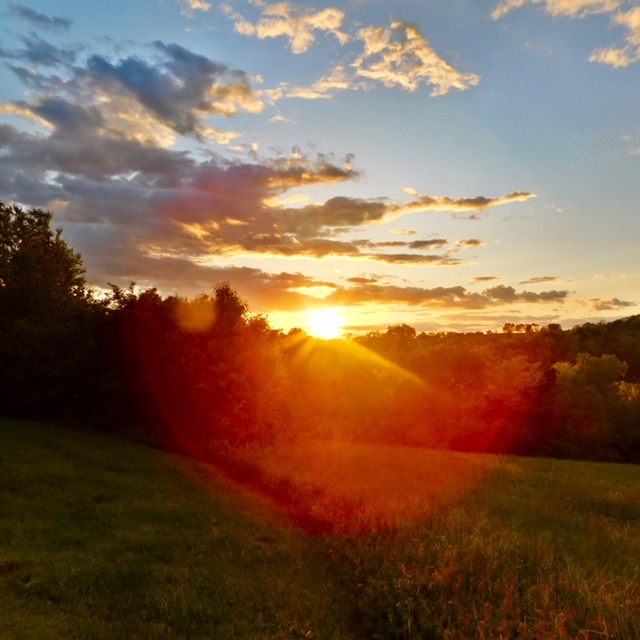
Kentucky’s skies are pure magic right now, with the bluest of blue dotted by the puffiest of white. Just as lovely are rainy days, warm enough to leave the doors or windows open to smell that amazing ozone. There lies daily closure in every sunset and a promise to begin anew each dawn. There’s growth in grass, connection in the smell of trees, a vast temple just waiting in the fields. I’ve intentionally been spending lots of time outside of late.
I am intentional, and then life intersects. Soon enough I shall forget, placing the shallow over the hallowed. But for now, I lace up my boots. Take the dog, and leave the phone. Remember, if only for an afternoon, that this is what I was designed for.