
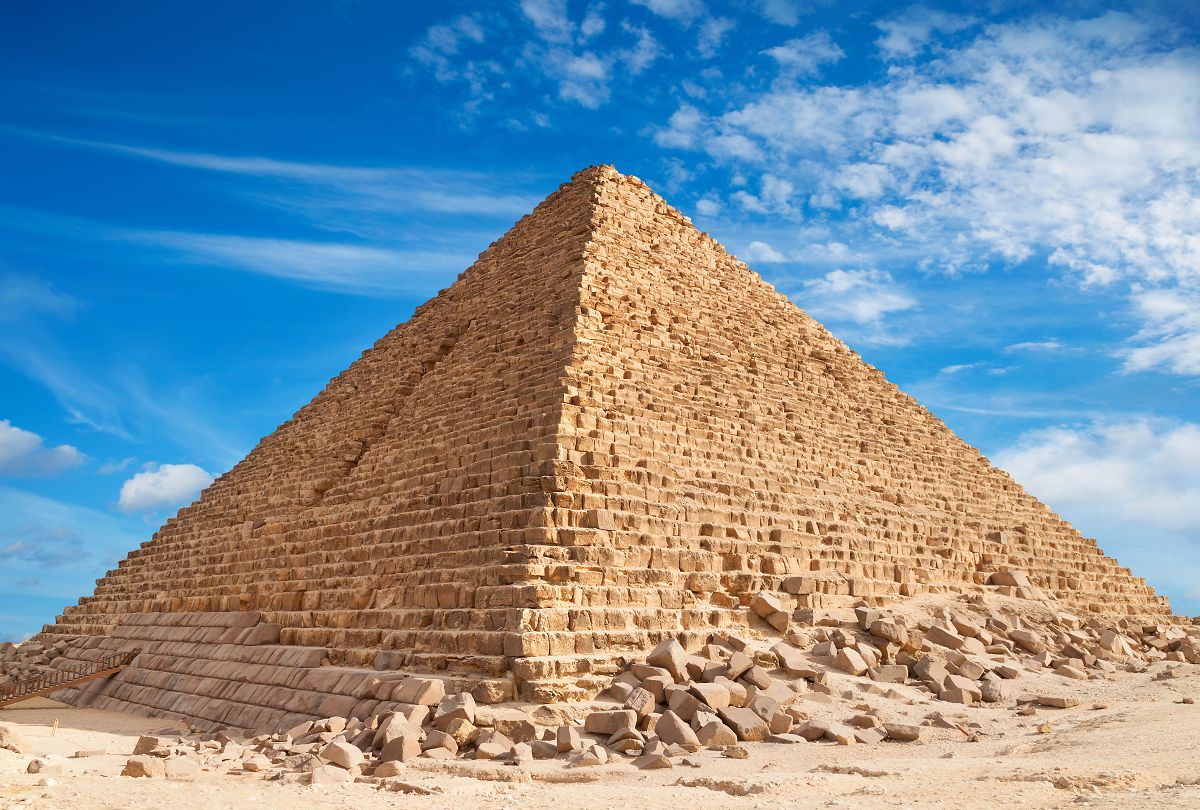
All conversations in this story have been translated from hieroglyphic to English for the convenience of the reader.
Imhotep approached the royal pavilion, having been summoned by his most illustrious pharaoh, Khufu. A worried wrinkle adorned his brow since one could never be sure why a summons had been issued, and the end result of many of them had led to beheadings or premature burial.
“Imhotep, how good to see you. Please come in out of the hot sun,” the pharaoh liberally gushed as his designated architect stepped into the cooling shade and positioned himself before the throne of the exalted one.
Imhotep’s sigh of relief was barely visible as he knelt, his white skirt spreading and contrasting sharply with his tanned features. Behind him was a slight wake of sand from his sandals, a wake that was, even then, being swept away by the king’s handmaidens.
“Thank you, your most imperial radiant majesty, son of the Sun. It is indeed a great honor to be summoned to your exalted presence.”
“Knock it off, Im. You should know by now that we can speak to one another on the same level, and those unnecessary compliments won’t earn you one additional farthing in architectural fees. You may refer to me simply as ‘Your Highness’.”
“Yes, Your Highness. Uh, what’s a farthing?”
“Never mind. Listen, I’ve got a new commission for you, something I think you’ll really glom onto since all you’ve been doing lately are those terribly boring mastabas. Are you busy at the moment?”
“No, Your Highness. As you noted, just a few mastabas on the drawing papyrus, although the possibility of some new obelisks looks promising.”
“How boring these royal commissions are,” thought Imhotep to himself, never daring to voice such thoughts. “The papyrus-work on those jobs is just phenomenal. Pay records, accident reports, daily progress records, CPM schedule updates. What foolishness it is to keep such detailed records on every laborer who gets crushed by a falling stone or drowns when a barge sinks or gets eaten by a crocodile. And all the safety regulations. Leather skull caps. Bronze-toed sandals. No wonder pyramid building is on the decline. These royal regulations are running costs right through the roof. And the royal pay scales and environmental impact statements don’t help any either.”
Imhotep’s reverie was abruptly interrupted by the voice of Khufu, “Say, Im, get with it boy. I want to get started on this right away. I need your full attention.”
“Yes, Your Highness. Sorry. What did you have in mind? A new temple? Canal works? Perhaps a processional avenue or a new sphinx? I have some really nifty sketches for some new designs featuring your likeness on bodies of different animals, like elephants and giraffes, even monkeys.”
“Caution varlet,” warned the pharaoh. “Placing the visage of the high one on certain types of animals might be considered a bit too controversial.”
“Of course, Your Highness. Sorry. Perhaps I’ve carried ‘artistic license’ a bit too far. Uh, what’s a varlet?”
“Never mind. And as for ‘artistic license’, just keep in mind that I’m the one who issues those licenses.
“And all those projects you listed are simply too passé. I want a pyramid that will dwarf all those that have come before.”
“Oh, Ra,” thought Imhotep. “Not another pyramid. Haven’t those things been overdone already? And the construction period inevitably stretches out over decades, which means that, if the pharaoh dies before it’s completed, the whole configuration might have to change. After all, look at what happened over at Dashur with Snefru’s pyramid when the sides were designed too steep and they had to change the angle after two-thirds was already complete. Now they call it the ‘bent pyramid.’ No wonder the architect’s name was never inscribed on that one. He was probably shut in with the pharaoh’s corpse for not meeting the occupancy deadline. The attrition rate among royal architects is absolutely incredible, including those who simply get buried with the pharaoh so that the secrets of the entrances won’t get revealed.”
Imhotep returned to reality.
“Very well, Your Highness. Did you have anything special in mind?” Pharaohs always did. “Or shall I prepare some sketches for you to look at?”
“I think that would be an excellent idea, Im. I have some ideas of my own (an inward groan by Imhotep) but we can discuss them over your sketches. I do know that I don’t want anything like that monstrosity over at Dashur. That’s what happens when you don’t have a proper CPM program. I want something truly grand, truly monumental. A real gutsy government program. By the way, who was the architect for Snefru? I never heard his name mentioned after the project was finished.
“I’m . . . not sure, Your Highness,” said Imhotep, looking sheepishly from under his brows as he backed from the audience chamber, instinctively aware that the audience was over, and not wanting to be drawn into a discussion about Dashur. Such discussions inevitably led to talk about the horror at Meidum where they tried to erect a pyramid over a mastaba and the outside collapsed.
Several days later, Imhotep was ushered – if that’s what one can call being escorted by two burly guards wielding spears – into the presence of the great one.
“Well, architect, have you something to show me?” inquired Khufu as Imhotep struggled to keep the many rolls of papyrus contained and walk at the same time. Imhotep got a shiver of pride whenever he heard himself referred to as “architect,” and his white skirt was barely able to contain the goosebumps that flowed over him.
“Yes, O great deity of the sun, radiant majesty. I have contrived some designs which may please you. Shall I unroll them for you?”
“By all means. But let me warn you once again, Im. If you insist on making your entrances with these unnecessary remarks about my exaltedness, you’ll likely find yourself on the Nubian frontier designing revetments. Now, let’s see what you have.”
As Imhotep unrolled the many papyri, Khufu descended from his throne and helped lay the drawings flat, scurrying about on his hands and knees with eager anticipation as each roll was opened, and he and Imhotep tried rather vainly to keep the rolls open as they tended to close themselves unaided.
“Let’s get some ewers on the ends of this roll, Your Highness, to hold it down,” suggested Imhotep as he reached for various objects around the royal chamber to serve as end weights. “How about we get a couple of your viziers or handmaidens to stand on this one and let’s put this end under the throne leg.”
“Okay,” replied Khufu, “but let me lift the throne. You know that, as a mere mortal, you aren’t allowed to touch it. If you did, I would have no choice but to place you in the iron maiden.”
“Of course, Your Highness. Uh, what’s an iron maiden?”
“Never mind. Damn these papyrus rolls,” complained the king. “Once you roll one up, you can never get it to lay flat again. Hasn’t anyone ever thought about using flat pages?”
“The papyri are at least better than clay tablets,” waxed Imhotep philosophically. “And much lighter, too. I would have needed a wheelbarrow to haul in clay tablets with all these sketches.”
“Indeed,” agreed Khufu. Uh, what’s a wheelbarrow?”
“Never mind,” responded Imhotep, treading perilously close to unacceptable informality.
“I didn’t know what size or shape you had in mind, Your Highness, so I have drawn up several sizes and styles for you to inspect. You will notice that I have included some scale human figures to help you gauge the proposed sizes.”
“I can see that quite well, Im, but why do all your figures have their arms bent that funny way?
They all look like walking ‘Zs’. And they all have their faces to the side. Can’t you ever draw a three-quarter view?”
“What’s a three-quarter view?”
“Never mind. Most of these are too small, and that stepped job went out with Zoser. Really, Im, you must keep up with the times.”
“I try, Your Highness, but the trade magazines take up so many papyrus rolls that I can’t afford the postage, and I wind up not knowing what other architects throughout the kingdom are doing. Anyway, let’s get some of these excess rolls out of the way.”
CRASH!
“I wish you had let the vizier know you were going to release that end. I don’t like them sprawled all over the royal floor like that. It isn’t very regal.”
Khufu continued to pore over the remaining scrolls, oblivious to his vizier being unceremoniously dragged from the room by two guards.
“This one with the apex on the bottom is rather nice and certainly a departure from convention, but don’t you think balance would be a problem? Once the ramps are removed, wouldn’t it just topple over?”
“Well, don’t forget this is only a preliminary concept. If you like it, we can work out the technical problems later,” responded Imhotep.
“No, no. it lacks a feeling of permanence. What else have we here? Hmmm.”
“Find something you like, Your Highness?”
“Yeah, I kinda like this one, even though it’s like so many others that have been done. You’ve made some change, haven’t you? Something small, I can tell, but I can’t quite put my finger on it.”
“You’re absolutely right, Your Highness. I knew your falcon eye would discover it. Remember what happened over at Meidum?” Imhotep hurried on, wallowing in his momentary importance.
“They had the side angles too steep, and the casing fell off? I’ve lowered the side angles to fifty-one degrees fifty-two minutes so that won’t happen again. This pyramid will last four thousand years. At least.”
“Don’t be foolish, Im. Nothing lasts that long. All I care about is whether it will last long enough to pay off the mortgage and for me to reunite with the gods.”
“Most assuredly, Your Highness.” Imhotep was now picking up the tempo, and his relish for the situation was easily discernible.
After Khufu had mused over the proposed design, he said, “Okay, I think this one will do fine, architect.” At the word ‘architect,’ Imhotep’s goosebumps returned.
“Now I want this to be really big,” continued Khufu. “In fact, I’d like for you to use so much stone that that upstart, Khafre, won’t be able to quarry enough to build anything bigger. I know him well and he’s such a snit that he’s bound to copy whatever I do. What size do you figure would be appropriate to display the true greatness of my reign?”
“Oh, Your Highness, if we were to attempt a structure of the appropriate size, we would be building for hundreds of years,” said Imhotep, gushing with flattery. However, I was thinking in terms of 503 cubits on each side and 321 cubits high. How does that strike you?”
“What’s a cubit?” inquired the pharaoh.
“Never mind,” dared the increasingly confident architect. “How about 755 feet on each side by 481 feet high?”
Khufu stroked his chin, and some of the fake whiskers floated gently to the floor as he pondered the scale of the proposal. “How close to these dimensions can you build?”
“Close enough to make future generations marvel at the majesty of your rule, most exalted one.”
“Watch it, Im. You’re slipping again. Tell me more about it.”
“Well, I’ve got figures here on a three-sided and a four-sided pyramid. Which one do you think you might prefer? The four-sided one is so passé now. May I recommend the three-sided one?”
“Passé perhaps, architect (Imhotep’s chilblains could have cooled the room), but I have a great aversion to odd numbers. Let’s stick with the four-sided one for now. That way, we can orient the faces to the cardinal points.”
“I don’t know anything about cardinal points, Your Highness. Could we just orient it so that each of the sides faces north, south, east, and west?”
“We must not tempt the gods, Im. Remember the old saying:
A pyramid in tune
With the sun and the moon
Its resident will keep
In eons of sleep.
“Perhaps you’re right, Your Highness.”
“PERHAPS? Perhaps, you say? Tread softly there, knave, lest you question the wisdom of your pharaoh.”
“Of course, Your Highness. No insult intended. Uh, what’s a knave?”
“Never mind. What else can you tell me about this pyramid?”
“For the four-sided one, it will cover about five, point three hectares . . .”
“Huh?”
“Thirteen point one acres, Your Highness.”
“Oh.”
“And it will take about 2.3 million blocks of stone averaging two-and-a-half tons.”
“Long, short, or metric?” inquired the pharaoh.
“Oh, definitely ‘long’, Your Highness. As you know, only those barbaric Nubians and Lydians have adopted the metric system so far and what do they know? And your high council of viziers has suggested a period of ten years to study the metric system to see if it has any potential.”
“Two point three million, eh? Boy, that ought to put a dent in the quarry. Now, how about the entrance?
“As tradition dictates, Your Highness, it will be located on the north face . . .”
“That’s fine, fine. But can we place it fairly high up, say fifty-five feet or so?”
“Of course, Your Highness. Anywhere you wish. But why so high? No one will ever come to visit you.”
“I’ll be dead, remember? Hardly in a position to know if there are any visitors. And you know how family are. They never come to see you when you’re gone. No more gifts of myrrh or acanthus. No animal sacrifices.”
The pharaoh’s eyes seemed to water some as he spoke.
Regaining his composure, he continued, “Besides, you know how the thieves are in this neighborhood. As soon as you’re put away, they come take all the pretty things one absolutely must have to enter the afterlife.”
“As you wish, Your Highness.” Imhotep jotted down entrance, north face, 55 feet up in the margin of the papyrus.
“How long do you schedule for the building?” asked the pharaoh.
“Four to six years, Your Highness. No more.”
Never miss a thing with our FREE weekly newsletter.
“Okay, but I want liquidated damages in the contract.”
“It shall be done, Your Highness.”
Of course, everyone knows it took twenty-three years to build Khufu’s pyramid, and as a consequence of the liquidated damages clause, both the contractor and Imhotep were liquidated.
But Imhotep was nevertheless considered to be a great architect. He was subsequently deified and his name lives on, inscribed on obelisks and columns all over Egypt — along with serpents, birds, eyes and other funny little squiggly lines.
And as for Khufu? Well, his grandchildren took his body from the pyramid and gave him a proper Christian burial somewhere out in the desert where the thieves couldn’t find him, and the Greeks came along and gave him the new name of Cheops because they had a funny alphabet and couldn’t pronounce Khufu, persisting in saying Ka-hoo-few. But the Romans – who came along later – kept pronouncing it as Chee-ops instead of Ke-ops, so they weren’t all that smart either.
