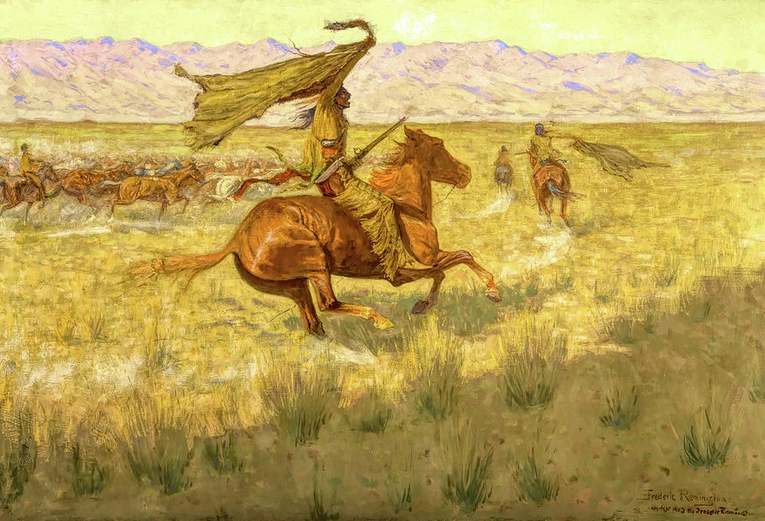
(Photo credit: “Horse Thieves” by Frederic Remington)
During Kentucky’s settlement period, the pioneers lost an incredible number of horses on the frontier. Some of them just ran off, but great numbers were taken during hostilities with Native Americans. According to Kentucky’s first federal judge, Harry Innes, 20,000 horses were carried off between 1783 and 1790. One of the pioneers said the Shawnee stole so many horses that it sometimes seemed the whites were raising them for the Indians. Another remarked, “The first moonlight night in March, you would hear the men hollering out, ‘Boys, put up your horses. If you don’t, the Indians will get them.’”
Though Indians were always blamed by the early settlers, whites were guilty of stealing horses too. As one of the pioneers later recalled, “They hung men for stealing horses after the treaty by Wayne—in numbers. It was all attributed to the Indians before.”
Stealing horses had long been a capital offense under Virginia law, which Kentucky adopted outright under our first constitution in 1792. Kentucky’s early court system was quite different from today’s. Until replaced by the circuit courts in 1803, the County Court of Quarter Sessions had jurisdiction over civil and criminal matters but could not try capital offenses. The latter were referred to a higher court, called the Court of Oyer and Terminer, which means “to hear and decide.” This court met three times a year in Lexington.
In May 1794, John Wood was brought before the Clark County Court of Quarter Sessions, with Robert Clark, Hubbard Taylor, and John McGuire being the presiding judges. This was the first court session held in the new log cabin courthouse. Wood was charged with stealing John Martin’s bay mare and colt valued at 21 pounds. After hearing the testimony of Martin, Lewis Jones, and Allen Niel, the court ruled that Wood “ought to be tried at the next Court of Oyer & Terminer” in July.
Official records of Wood’s trial in Lexington have not survived; however, court matters were routinely reported in the local newspaper. According to the Kentucky Gazette, “The Grand Jury, having received their charge, retired, and on their return into Court presented the following indictment, viz., against John Wood for horse stealing: A true Bill.”
Returning a true bill meant that the grand jury agreed there was enough evidence to try Wood on the charge of horse stealing. At his trial, Wood was “found guilty of Felony by the Petit Jury & received sentence to be hanged on the first Tuesday in September.”
Never miss a thing with our FREE weekly newsletter.
You may wonder if the sentence was, in fact, carried out. Contemporary evidence suggests that it was. Each year, Clark County prepared a list of delinquent taxpayers, listing the names of those who had skipped out of the county without paying or who were judged insolvent and unable to pay. The delinquent list for 1794 included the following entry: “John Wood, Hanged & Insolvent.”
There was one twist in the case to report. In an interview many years later, Clark County pioneer Benjamin Allen stated, “I stood guard over one Woods at Strode’s Station that was hung at Lexington for horse stealing, and he was only an accomplice and had sold the horse.”
This may be accurate. In 1748, Virginia passed a law regarding “Accessaries in horse stealing.” The law stated that “if any person shall receive or buy any horse that shall be feloniously taken or stolen from any other person, knowing the same to be stolen, and... being legally convicted by the testimony of one or more credible witness, shall incur and suffer the pain of death as a felon convict.”
The same Clark County court session that heard the case against Wood also heard evidence against John Petty for stealing a horse from Daniel O’Harrow. Petty had escaped from the county jail in April, was recaptured, and appeared before the court in May. They ordered that he be tried before the Court of Oyer and Terminer. Before he could be tried in Lexington, he escaped again.
Amazingly, after he was captured for the second time, Petty was released on bail. According to the newspaper account, “John Petty, indicted for horse stealing, bailed and run away.” And, we might add, was never heard from again.